
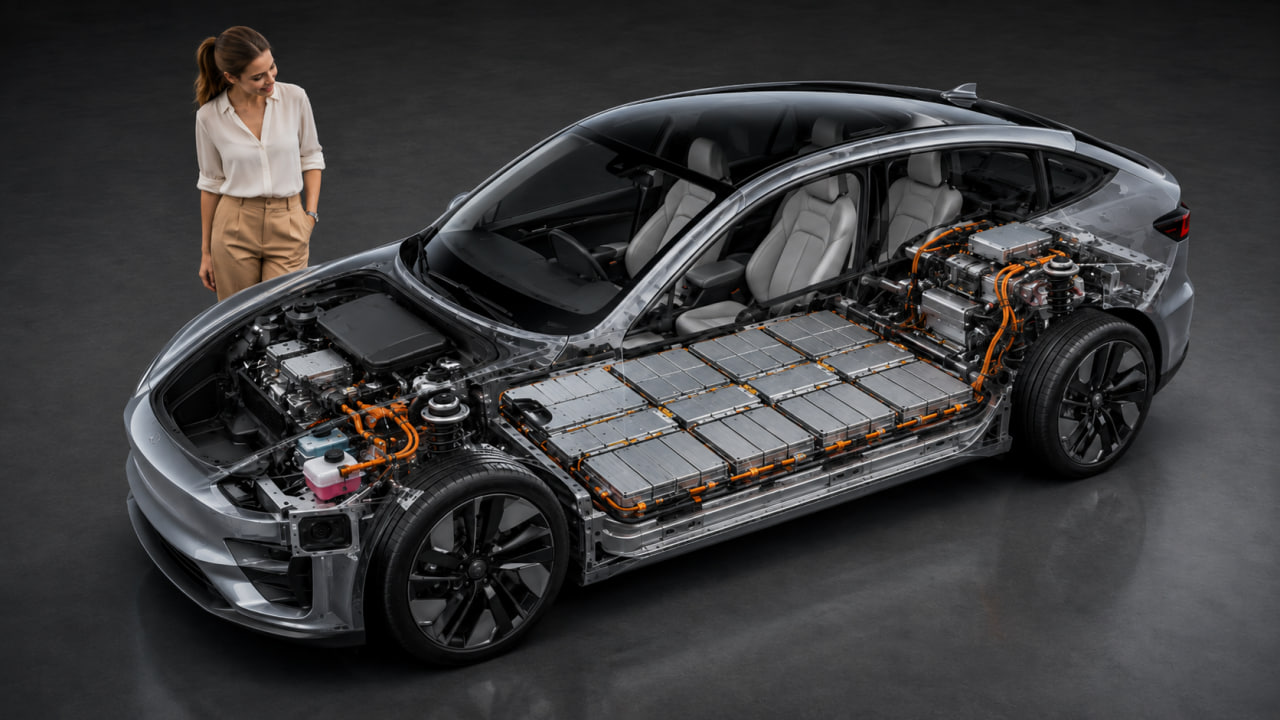
Modern electric cars can look deceptively simple. Open the door of a premium EV and you may see a minimalist dashboard, a flat floor, silent climate control, large displays, soft materials, and almost no visible evidence of the machinery responsible for moving the vehicle.
Underneath that polished cabin, however, sits one of the most tightly integrated pieces of engineering in the automotive industry.
A modern battery-electric vehicle combines a large high-voltage battery, one or more electric motors, inverters, reduction gears, sophisticated cooling circuits, onboard charging hardware, DC-to-DC converters, structural crash protection, electronic control units, high-voltage cabling, and increasingly powerful computers.
The U.S. Department of Energy's Alternative Fuels Data Center describes the essential components of a battery-electric vehicle as including the traction battery, electric traction motor, power electronics controller, onboard charger, DC/DC converter, thermal system, charging port, and transmission.
An electric car is not mechanically simple in the sense of being uncomplicated. It is simple because many mechanical systems have been replaced by highly integrated electrical, electronic, thermal, and software systems.
The Battery Pack Forms the Foundation
The largest and usually most expensive component is the high-voltage traction battery.
In many purpose-built electric cars, the battery is positioned beneath the passenger compartment, spanning much of the area between the front and rear axles.
This "skateboard" layout has several advantages.
It keeps the heaviest component low in the chassis, which lowers the center of gravity. It frees designers from having to package a large combustion engine, fuel tank, exhaust system, and conventional transmission. It can also create a flatter cabin floor and better use of interior space.
The battery pack itself is much more complicated than a box filled with cells.
It generally contains:
- Battery cells
- Modules or cell groups
- Electrical busbars
- Temperature sensors
- Voltage monitoring
- Coolant channels or plates
- Contactors
- Fuses
- Battery-management electronics
- Structural protection
- High-voltage connectors
- Fire and impact protection systems
Depending on the manufacturer, individual cells may be cylindrical, prismatic, or pouch-shaped.
Thousands of cells can be electrically connected to create a pack operating at hundreds of volts.
The battery must simultaneously behave like an energy reservoir, a structural component, a thermal system, and a safety-critical electrical device.
What the Battery Management System Actually Does
The battery cannot simply be connected directly to the motors and charger.
A battery-management system, usually called the BMS, continuously supervises the pack.
It monitors parameters such as cell voltage, temperature, current, state of charge, and overall battery condition.
The BMS attempts to keep individual cells operating within safe limits.
This matters because lithium-ion cells can be damaged by excessive voltage, extremely low charge levels, excessive current, or inappropriate temperatures.
The BMS also estimates how much energy remains available.
That sounds straightforward, but a battery does not contain a mechanical fuel gauge. Its state of charge must be inferred from electrical measurements and mathematical models.
The system can also limit charging or power output when conditions require it.
For example, a very cold battery may temporarily accept less regenerative or charging power. A very hot battery may require aggressive cooling before sustained high-performance driving or rapid charging can continue safely.
The Electric Motor Is Surprisingly Compact
Compared with a combustion engine, an electric motor can produce extraordinary performance from a relatively compact package.
Most modern EVs use one or more AC traction motors.
Common designs include permanent-magnet synchronous motors and induction motors, although manufacturers use different variations depending on efficiency, cost, material requirements, and performance targets.
Inside an electric motor are two basic elements:
The stator remains stationary and contains electromagnetic windings.
The rotor turns inside or around the stator.
By controlling magnetic fields in the stator, the vehicle causes the rotor to rotate.
That rotation ultimately drives the wheels.
Electric motors can produce strong torque from very low rotational speeds, which is one reason EVs often feel immediately responsive when the accelerator is pressed.
They can also operate across a broad speed range, eliminating the need for the many gear ratios required by most combustion vehicles.
Why Most EVs Do Not Need a Conventional Gearbox
A gasoline or diesel engine operates efficiently only within a relatively narrow engine-speed range.
That is why internal-combustion vehicles traditionally require multi-speed transmissions.
Electric motors are different.
They can generate useful torque across a much broader rotational range.
As a result, most modern EVs use a single-speed reduction gear rather than a conventional multi-speed automatic transmission.
The motor may rotate at many thousands of revolutions per minute while the wheels rotate far more slowly.
The reduction gear converts that high-speed motor rotation into suitable wheel speed and torque.
The Department of Energy notes that the transmission in an all-electric vehicle transfers mechanical power from the electric traction motor to drive the wheels.
There are exceptions. Some high-performance EVs use multi-speed arrangements, but the single-speed layout remains dominant because it is compact, efficient, and mechanically straightforward.
The Inverter Is the Hidden Powerhouse
The battery stores electricity as direct current.
Most traction motors require precisely controlled alternating current.
The inverter sits between the battery and motor and performs that conversion.
But calling it merely a converter understates its importance.
The inverter controls the frequency, voltage, and current supplied to the motor.
By changing those parameters thousands of times per second, the electronics control motor torque and speed.
The DOE describes the power electronics controller as the system that manages electrical-energy flow from the traction battery and controls the speed and torque of the traction motor.
When the driver pushes the accelerator, the command therefore does not mechanically open a throttle.
Instead, sensors interpret pedal position, control software determines the requested torque, and power electronics deliver the precise electrical current necessary to produce it.
In an EV, the accelerator pedal is fundamentally a request sent to software and power electronics.
Regenerative Braking Reverses the Energy Flow
One of the most important differences between electric and combustion cars appears when the driver slows down.
A conventional vehicle converts most braking energy into heat through friction at the brake discs.
An electric vehicle can recover part of that energy.
During regenerative braking, the traction motor operates as a generator.
Instead of electrical energy producing rotation, the moving wheels rotate the motor and generate electricity.
That electrical energy is sent back toward the battery.
Hyundai, for example, explains that regenerative braking on the IONIQ 5 uses the electric motor to slow the vehicle while returning energy to the battery.
The physical friction brakes remain essential.
They are needed for emergency stops, very low-speed operation, situations where regenerative power is limited, and other conditions determined by the brake-control system.
Modern EVs therefore blend regenerative and friction braking electronically.
The driver may feel one smooth braking action while several systems are coordinating underneath.
The Car May Have Two or More Motors
A basic electric car can operate with one motor driving one axle.
More powerful models often use separate motors for the front and rear axles.
This creates electric all-wheel drive without requiring a long mechanical driveshaft connecting the two ends of the vehicle.
The front and rear motors can be controlled independently.
Software can continuously decide how much torque each axle should receive depending on acceleration, traction, efficiency, cornering, and stability requirements.
Performance vehicles may go further with multiple motors controlling individual wheels or axle sides.
This allows exceptionally precise torque distribution.
Electric all-wheel drive is as much a software system as it is a mechanical system.
The High-Voltage Architecture Runs Through the Entire Car
EVs operate with voltages far above the traditional 12-volt electrical systems used in ordinary automobiles.
Many modern EVs use architectures around 400 volts, while increasingly sophisticated platforms operate closer to 800 volts.
Hyundai's E-GMP architecture, for example, was developed with 800-volt charging capability while also supporting 400-volt charging.
Higher voltage can allow the same amount of electrical power to be transferred with lower current.
Lower current can reduce resistive losses and potentially allow lighter cabling for a given power level.
That becomes particularly valuable during ultra-fast charging and high-performance driving.
High-voltage cables are commonly identified by bright orange insulation so technicians can recognize them immediately.
They connect the battery to components such as the inverter, motor, onboard charger, air-conditioning compressor, and high-voltage heating equipment.
Why the Car Still Needs Low-Voltage Power
Even though the traction battery operates at hundreds of volts, the car still contains a low-voltage electrical system.
Lights, computers, control modules, locks, sensors, infotainment equipment, safety electronics, and many other systems are not powered directly by full traction-battery voltage.
A DC/DC converter steps high-voltage battery power down to the lower voltage required by those components.
The DOE specifically identifies the DC/DC converter as the device that supplies lower-voltage systems and supports the auxiliary battery.
That is why many EVs still contain a conventional low-voltage battery.
The low-voltage system can activate computers and control circuits before the large traction battery is electrically connected to the main powertrain.
AC Charging and DC Fast Charging Follow Different Paths
When an EV is plugged into a typical home or public AC charger, alternating current enters through the charge port.
The battery, however, stores direct current.
The onboard charger therefore converts AC into DC.
According to the DOE, the onboard charger also communicates with charging equipment and monitors important battery characteristics while charging.
DC fast charging works differently.
The large external charger performs the AC-to-DC conversion outside the vehicle.
High-voltage DC can then be supplied more directly to the battery, subject to control by the vehicle's charging and battery-management systems.
This is one reason DC fast chargers can deliver substantially more power than typical onboard AC chargers.
Thermal Management Is the EV's Hidden Circulatory System
Temperature control is one of the least visible but most important aspects of electric-car engineering.
The battery, motor, inverter, charging electronics, cabin, and power electronics all generate or require heat under different conditions.
Modern EVs therefore use pumps, valves, radiators, heat exchangers, coolant circuits, refrigerant loops, sensors, and control software to move heat around the vehicle.
Tesla service documentation, for example, shows dedicated coolant pumps, battery coolant circuits, inverter cooling connections, heat exchangers, and heat-pump components integrated into its thermal-management architecture.
The objective is not simply to cool the car.
Sometimes the battery needs heating.
Sometimes the cabin needs heating while the battery needs cooling.
During fast charging, the vehicle may precondition the battery toward a temperature that allows high charging power.
A sophisticated EV therefore actively manages thermal energy rather than simply disposing of heat.
The Heat Pump Can Preserve Winter Range
Heating a cabin requires significant energy.
If that heat comes entirely from resistive electrical heaters, electricity is converted directly into heat.
A heat pump can be more efficient because it transfers heat rather than generating all of it resistively.
Modern EV heat-pump systems may extract thermal energy from outside air or recover waste heat from powertrain components.
Tesla's service documentation confirms extensive integration of heat-pump equipment into the thermal systems of its current vehicles.
This becomes especially valuable in winter, when heating demands compete directly with driving range for battery energy.
Beneath the Cabin Is a Crash Structure
Putting a large battery beneath passengers creates major structural challenges.
The pack must be protected from:
- Side impacts
- Frontal collisions
- Rear impacts
- Road debris
- Water
- Vehicle deformation
- Mechanical intrusion
Engineers use strong enclosures, underbody protection, crossmembers, reinforced side structures, controlled crumple zones, and carefully designed battery mounting systems.
Some manufacturers have gone further by integrating the battery more directly into the structure of the vehicle.
Tesla's current service documentation, for example, explicitly references structural high-voltage battery packs in some Model 3 and Model Y configurations.
A structural pack can allow the battery enclosure to contribute directly to vehicle stiffness rather than behaving only as cargo bolted beneath the floor.
Why EV Interiors Can Be So Spacious
The absence of a large engine and conventional gearbox changes the proportions of the entire vehicle.
A dedicated EV platform can push the wheels toward the corners, shorten the hood, flatten the floor, and increase cabin space relative to overall exterior dimensions.
Hyundai says its E-GMP dedicated electric architecture was created specifically to support EV packaging and provides benefits including increased interior space.
This explains why some EVs feel unusually spacious despite having relatively ordinary exterior dimensions.
The machinery has not disappeared.
It has simply moved beneath the floor, closer to the axles, and into compact electronic modules.
Computers Are Becoming Central to the Vehicle
An electric car depends heavily on software.
Control units manage:
- Battery charging
- Motor torque
- Regenerative braking
- Traction control
- Thermal management
- Stability systems
- Energy consumption
- Driver assistance
- Cabin electronics
- Infotainment
- Diagnostics
Many modern vehicles are moving from dozens of isolated control modules toward more centralized computing architectures.
This can reduce wiring complexity and allow manufacturers to coordinate vehicle functions through software.
The physical automobile and its digital control system are therefore becoming increasingly inseparable.
In a modern EV, software does not merely operate the entertainment system. It controls how energy moves through the vehicle.
Expert View: The EV Is a System, Not Just a Battery and Motor
The U.S. Department of Energy's Alternative Fuels Data Center provides one of the clearest authoritative descriptions of electric-vehicle architecture.
Its component model emphasizes that an EV requires much more than a traction battery and electric motor: charging electronics, power conversion, thermal management, low-voltage systems, transmission hardware, and electronic power control are all essential to making the vehicle function.
That systems perspective is crucial.
A manufacturer could install an excellent battery but produce a poor EV if cooling is ineffective.
A powerful motor does little good if the inverter cannot supply it efficiently.
An 800-volt architecture provides limited benefit without compatible charging hardware, battery chemistry, thermal management, and control software.
The best electric cars are not defined by one spectacular component. Their advantage comes from how efficiently every component works together.
What Really Sits Beneath the Luxury Interior
Strip away the leather seats, panoramic roof, displays, sound insulation, body panels, and polished trim, and the underlying architecture becomes much clearer.
A modern EV is essentially built around several tightly connected systems:
The battery stores energy.
The BMS protects and monitors it.
The inverter controls electrical power.
The motor converts electricity into motion.
The reduction gear transfers that motion to the wheels.
Regenerative braking converts some motion back into electricity.
The thermal system moves heat.
The onboard charger converts AC charging power.
The DC/DC converter feeds low-voltage electronics.
Computers coordinate almost everything.
The chassis protects the occupants and battery.
Together, these systems create the apparently effortless experience drivers see from the cabin.
Conclusion
The luxurious interior and smooth body of a modern electric car hide an extraordinarily sophisticated technical platform.
Beneath the seats lies a large high-voltage battery containing cells, sensors, cooling equipment, power connections, protective structures, and management electronics. Near the axles sit compact electric motors connected through reduction gears. Inverters control torque almost instantaneously, while regenerative braking sends part of the vehicle's kinetic energy back toward the battery.
An onboard charger manages AC charging, DC/DC converters support the vehicle's low-voltage systems, and hundreds of meters of wiring and high-voltage connections link the architecture together. Sophisticated coolant and refrigerant circuits keep batteries, motors, power electronics, and passengers within appropriate temperature ranges.
Dedicated EV platforms such as Hyundai's E-GMP also demonstrate how electrical architecture affects the entire vehicle, from 400- and 800-volt charging compatibility to cabin packaging and drivetrain design.
The greatest difference between an electric car and a conventional car is not simply that an electric motor replaces an engine. The entire vehicle is reorganized around electricity, electronics, thermal management, and software.
That is what the elegant bodywork conceals: not a simpler version of the old automobile, but a fundamentally different machine in which energy, computation, cooling, structure, and propulsion have become parts of one integrated system.