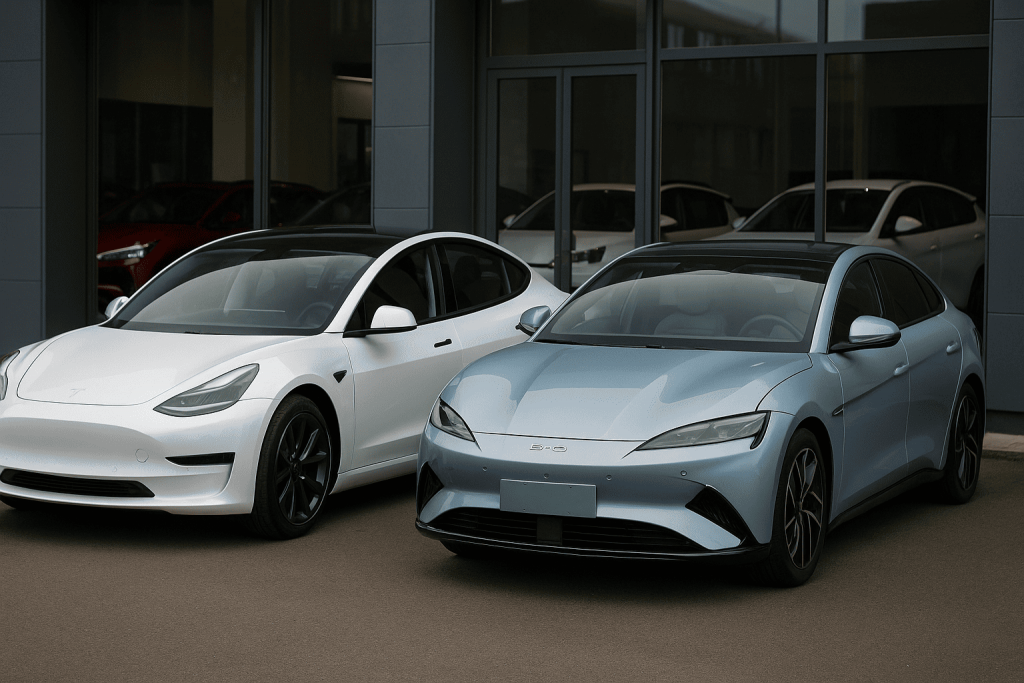
The global EV market has entered its most ruthless phase yet: a price war where scale, supply chains, and software decide who eats and who gets eaten. Tesla’s broad price cuts collided with China’s hyper-competitive champions—BYD, Geely Group brands, SAIC, XPeng, Li Auto, Xiaomi—compressing margins, shaking residual values, and forcing a new strategy playbook. Here’s the business logic of the discount era: how it affects unit economics, cash flow, and long-term positioning. 🔥
Why a price war now? Demand growth is still positive but slower and more uneven by region; capacity, however, has been built for “S-curve” takeoff. When factories must be filled to keep unit costs low, producers cut price to protect utilization. EVs are capital-intensive: depreciation, leases, and interest don’t shrink if a line idles. Selling more units at lower price can improve cash generation if contribution margin stays positive.
Average cost vs. marginal cost (the real battlefield): In a downturn, fixed costs dominate. If the marginal cost (materials + logistics + warranty accrual + sales cost) sits far below the headline MSRP, you can discount aggressively and still earn positive contribution margin. Tesla’s vertical integration (electronics, motors, software, thermal) and China’s unrivaled supply clusters (cells, packs, castings, interiors) both push marginal cost down—just by different routes.
The BOM reality check: Battery chemistry (LFP vs. NMC), pack format (CTP/CTC), motor type (permanent magnet vs. induction), die-cast structures, and in-house electronics control 60–75% of cost variance. Chinese LFP dominance and intense supplier competition lower cell $/kWh; Tesla leans on scale, simplified designs, and software to keep non-battery costs lean. When lithium spot prices fell, both sides gained headroom to cut retail price without instantly nuking margins.
Channel strategy and discount optics: Direct sales (Tesla, some Chinese startups) translate price moves to the street instantly. Legacy automakers discount through dealers—rebates, finance subventions, option bundling—masking the true cut. Chinese brands frequently deploy “limited-time subsidies,” trade-in bonuses, and “old-for-new” scrappage credits to preserve price perception while still moving metal.
Utilization is king (and why cuts can be rational): A plant running at 85–95% capacity spreads fixed costs across more cars. If a €1,500 cut adds 10–15% volume, unit economics can improve even if gross margin per car narrows. For high-fixed-cost players, volume stability is often worth more than headline percentage margins—especially when market share today compounds software and service revenue tomorrow.
Software, services, and the annuity effect: Tesla can sacrifice hardware margin knowing some revenue returns over time: premium connectivity, insurance, Supercharging, and software options. Chinese peers are fast-following with ADAS subscriptions, connected services, and energy ecosystems. The price war makes sense if lifetime value (LTV) from services and referrals offsets thinner Day-1 gross profit.
Financing as a competitive weapon: Lower APRs, guaranteed buy-backs, and balloon products reduce monthly payments without slashing MSRP. Chinese OEMs increasingly partner with captive finance or fintechs to compress the “cost of money.” Tesla alternates sticker cuts with financing tweaks; both methods target the same outcome: lower monthly outlay to unlock demand elasticity.
Residual values and brand risk: Frequent price moves depress used values, raising lease costs. Tesla’s counter is lower running costs and software upgrades that sustain desirability. Chinese brands hedge with strong warranty terms, rapid product cadence, and trim walk value. Still, if cuts turn chronic, fleets and finance houses widen risk buffers—quietly raising the hurdle for future sales.
Export vs. local build (tariffs, FX, policy): Europe and the U.S. now lean protective; tariffs and incentive rules skew the math. Localized manufacturing (e.g., Tesla’s Berlin/Austin; Chinese OEM plants in ASEAN/Middle East/EU if allowed) reduces tariff exposure and logistics cost, enabling surgical discounting where needed. Currency swings add another layer: a strong home currency can erase export margins overnight.
BYD vs. Tesla: two different cost flywheels: BYD’s “battery-to-brand” control—mines to cells to packs to semiconductors—drives ruthless cost floors on LFP and sodium-ion. Tesla’s flywheel spins on simplified architecture (large castings, structural packs), global software stack, and a dense charging ecosystem. In a knife fight over entry and mid segments, BYD’s LFP economics shine; in higher segments, Tesla’s software and charging moat defend pricing power.
Product cadence and the discount trap: Cutting price without improving product invites commoditization. Both sides push frequent facelifts: better heat pumps, efficiency tweaks, interior refinement, camera/compute upgrades. The best defense against margin erosion is a rolling product advantage—so that every €1,000 of discount “buys” visibly more car.
Marketing without burn rate: OTA features, referral programs, owner communities, and content-driven launches substitute for classic ad spend. Chinese brands excel at social commerce and short-video virality; Tesla banks on earned media. Lower acquisition cost per buyer makes each discount euro work harder at the P&L line.
Fleet and ride-hail: hidden volume valves: Corporate fleets, rentals, and ride-hail operators care about TCO. Aggressive OEM-fleet pricing, bundled service, and guaranteed uptime can smooth factory utilization when retail demand wobbles. China’s domestic fleets are a powerful buffer for local makers; Tesla courts European corporate car schemes with efficiency and residual-value stories.
Quality and service as margin insurance: Price wins the first purchase; service wins the second. Lean service footprints can backfire if volumes surge. Chinese brands invest in dense service networks at home; abroad, partners and mobile service fill gaps. Tesla’s mobile service and part commonality reduce downtime. The fewer repeat faults per thousand vehicles, the smaller the warranty drag on thin margins.
Strategic use of “option deletes” and simplification: In price wars, complexity kills. Fewer trims, standardized interiors, and common harnesses shorten takt times and lift yield. Tesla’s short option list is a cost strategy masquerading as minimalism. Chinese OEMs are racing to similar modularity to keep discount-era builds profitable.
Scenarios for the next 12–24 months: If raw material prices stay moderate and demand grows mid-single digits, expect continued tactical cuts and finance offers—especially around quarter-ends. A surprise rebound in lithium or tariff shocks could force selective price increases, but competition will cap upside. Winners will be those who keep plants full, protect quality, and expand software/service take-rates.
Investor lens: margins vs. cash flow—Headline automotive gross margin may compress, but cash from operations can strengthen if inventory turns accelerate and capex moderates. Watch unit deliveries per plant, working capital swings, and deferred revenue from software. Those tell whether a company is using discounts as a bridge to durable scale—or as a life raft. 📊
Consumer lens: how to buy smart in a price war—Expect periodic promos, loyalty bonuses, and finance specials. Prioritize efficiency (€/100 km), warranty terms, service coverage, and charging access over raw 0–100 km/h. If resale matters, favor models with stable pricing and strong fleet demand; they hold value better when the music stops.
Policy lens: what governments will weigh—Industrial policy now intersects climate targets. Expect incentive redesigns that favor local content, durability, and energy efficiency. Scrappage schemes and grid-friendly smart charging rebates can pull demand forward without blunt price subsidies.
Bottom line for margins: In a knife-edge market, sustainable margins come from three flywheels working together—cost (scale + simplification), revenue (software + services), and utilization (full factories + smart channel mix). Tesla and China’s leaders are playing the same game with different strengths; both can win—often in different segments and regions—while mid-pack players with high costs and thin software stacks get squeezed.
Conclusion: The EV price war isn’t a race to zero; it’s a race to resilient unit economics. Discounts are a tool to defend utilization and seed installed base for future software revenue. Tesla leverages integration and a powerful charging/software moat; Chinese champions weaponize supply-chain depth and LFP cost leadership. The victors will be those who convert short-term price cuts into long-term scale, loyalty, and lifetime value—turning today’s thin margins into tomorrow’s durable cash engines. ✅
feels like we’re watching the smartphone wars all over again, just with cars. Makes total sense why mid-tier brands are sweating right now