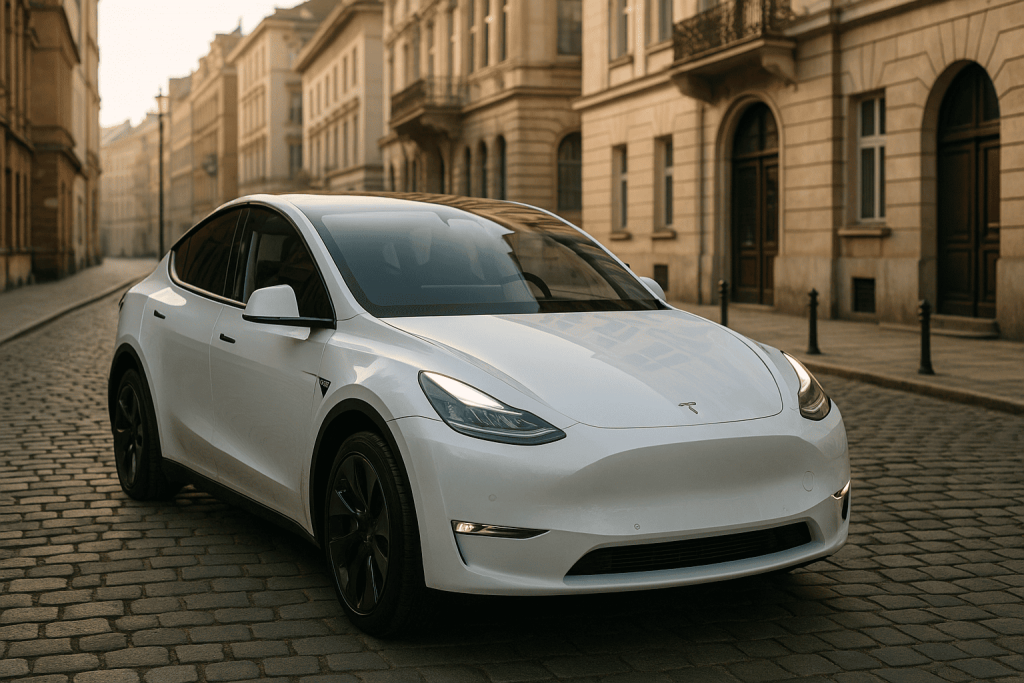
The Tesla Model Y didn’t just arrive in Europe—it colonized the leaderboard. What looks like a familiar midsize crossover hides a ruthless focus on efficiency, manufacturing, software, and charging that aligns perfectly with European buying habits. Here’s why the Y is Europe’s best-seller, and why rivals keep benchmarking it even when they won’t admit it. 🚀
Right-size packaging for Europe’s roads—The Model Y strikes a sweet spot: compact enough for dense cities and narrow parking (vs. full-size SUVs), yet roomy enough inside to replace a family wagon. A flat floor, deep rear well, and a massive frunk create estate-car practicality without estate length. High seating, big hatch, and 60/40 fold-flat rear seats convert it from commuter to IKEA hauler in seconds.
Gigafactory Berlin = price, lead time, and tune—Local production trims shipping costs and tariffs, shortens delivery times, and enables fast configuration cycles. More importantly, regional tuning (suspension, NVH, thermal maps) matches European roads and climates. Local supply also gives Tesla latitude to run promotions or spec updates without months of pipeline inertia.
Efficiency first, always—Europe taxes mass and rewards low consumption. Tesla’s motor control, heat pump, aero, and lightweighting yield class-leading efficiency, which means smaller usable battery for the same range, lower energy bills, and better performance at Autobahn-adjacent speeds. Efficiency scales into lower company-car taxes and better WLTP figures—both highly visible to buyers.
Software UX that feels “alive”—The Y’s minimal interface works because the software iterates weekly, not yearly. OTA updates add range optimizations, new driver aids, charging improvements, and app conveniences (preconditioning, remote schedules, route planning with live stall availability). That living-product feel is rare in legacy lineups and helps residual values. 📱
Integrated route planning and thermal preconditioning—The trip planner actually works for pan-EU driving. It stacks Supercharger stops with realistic state-of-charge targets and heats/cools the battery before arrival. Result: more sessions at the power “plateau” and fewer minutes wasted. Owners remember time saved much more than peak-kW headlines.
The charging moats: Superchargers + reliability—Thousands of stalls across Europe with growing third-party roaming give the Y a simple, predictable long-trip story. Payments auto-authenticate; maps show live power and occupancy; pricing is clear. Even when using CCS public networks, the car’s handshake and charging logic are amongst the most robust, which matters on road trips and in winter. ⚡️
TCO beats list price—Sticker shock fades when you tally total cost. High efficiency cuts €/100 km, minimal scheduled maintenance trims opex, and strong resale values compress lease rates. For fleets, Benefit-in-Kind and low emissions-based taxes make the Y a default pick for perk cars. The result: monthly cost parity (or better) vs. many ICE crossovers despite higher MSRPs.
Safety & crash confidence—Top-tier Euro NCAP scores, stiff passenger cell, and fast-acting active safety make the Y an easy family recommendation. Camera-heavy ADAS and frequent OTA refinements keep lane-keeping, collision avoidance, and parking aids improving over time without dealer visits.
Performance without drama—Instant torque plus competent chassis tuning gives effortless overtakes and secure wet-weather traction. Even non-Performance trims feel quick, but efficiency and thermal management keep it repeatably quick—a subtle differentiator on mountain passes and fully loaded holiday trips.
Manufacturing innovations show up in ownership—Structural pack architecture, large castings, and simplified wiring reduce parts count. Fewer parts can mean fewer rattles and faster service. When parts are needed, Tesla’s vertically integrated catalog and mobile service model handle a surprising share of fixes in your driveway.
Pan-European brand familiarity—Tesla’s showrooms, test-drive funnels, and direct online ordering simplify the path from curiosity to ownership. Transparent spec sheets and short lead times beat showroom haggling and long factory waits—powerful in a market that values predictability.
Trim strategy that hits the bullseye—A short, well-spaced lineup keeps decision friction low. Each step (RWD → Long Range → Performance) is a meaningful capability bump, not just cosmetic bundles. Buyers don’t need to navigate endless option trees to land on a smart spec.
OTA clarity: features get better after purchase—Adding range, faster DC curves in cold weather, new visualizations, or better park-assist via software keeps the product “new.” Owners share those changes socially, creating a positive feedback loop for demand—free marketing most brands don’t enjoy. 🔄
Ecosystem lock-in that feels helpful—Phone-as-key, HomeLink, intelligent preconditioning, energy usage charts, and app-based service booking make the Y feel like part of your daily OS. For households with rooftop solar or Powerwall alternatives, energy flows can be monitored in the same app—clean, sticky, and useful.
Why rivals struggle to dislodge it—Many competitors have one or two of these strengths; the Y stacks them. Some are efficient but lack pan-EU charging reliability; others have plush cabins but slow software cadence; still others price well but miss residual value. The Y’s “whole system” advantage is hard to copy quickly.
What could dethrone the Y?—A rival that matches efficiency, ships with robust pan-EU charging access (or bulletproof roaming), undercuts price with equal residuals, and updates software weekly. Add warmer interior design, tighter panel fit, and class-best NVH, and the conversation changes. Several models are close—competition is heating up, which is great for buyers. 🔥
Buyer’s cheat sheet—If you need family-car space in a compact footprint, drive long distances, want a dependable road-trip planner, and care about monthly costs more than sticker price, the Y is the safe bet. If your priorities are lavish interior materials or brand-traditional cabins over software and charging, you might prefer a premium competitor—just sanity-check energy use and charging access on your actual routes.
Conclusion—Model Y’s European dominance isn’t a mystery. It’s the compound effect of right-size packaging, ruthless efficiency, OTA-driven software, and a charging network that minimizes friction. Local manufacturing cements price and supply advantages, while safety and TCO seal the deal for families and fleets. Until rivals deliver the same integrated experience at scale, the Y remains the benchmark everyone has to beat. ✅
Honestly this nails it — the Y wins here because it just works in real life, not just on spec sheets. Rivals keep trying, but the whole package is hard to beat