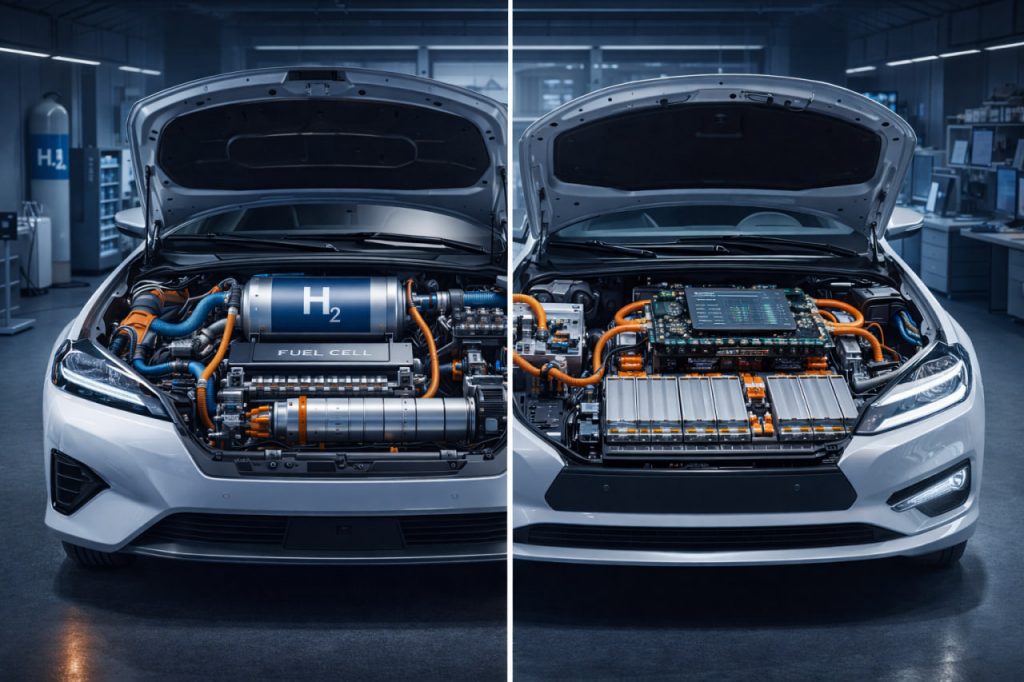
The global transition away from internal combustion engines has brought two main alternatives into focus: hydrogen fuel cell vehicles (FCEVs) and battery electric vehicles (BEVs). Both technologies promise lower emissions, reduced dependence on fossil fuels, and a cleaner transportation future. However, they rely on fundamentally different energy principles, infrastructure requirements, and economic models. Understanding how these technologies compare helps explain why battery electric vehicles currently dominate the market, while hydrogen vehicles remain a topic of long-term strategic debate.
How Battery Electric Vehicles Work
Battery electric vehicles (BEVs) store electrical energy in large lithium-ion battery packs, which power one or more electric motors. Energy is supplied through charging stations, ranging from household outlets to high-power DC fast chargers. BEVs convert stored electricity directly into motion, making them highly energy-efficient. With fewer moving parts and advanced battery management systems (BMS), BEVs offer predictable performance and relatively low maintenance requirements.
“Battery electric vehicles are currently the most energy-efficient way to convert electricity into motion,” — Dr. Michael Reynolds, electric powertrain researcher.
How Hydrogen Fuel Cell Vehicles Work
Hydrogen fuel cell vehicles (FCEVs) generate electricity onboard using hydrogen fuel cells, which combine hydrogen with oxygen to produce electricity, heat, and water vapor. Instead of charging a battery, drivers refuel hydrogen tanks in a process similar to conventional fueling. The electricity generated powers an electric motor, making FCEVs electric vehicles at their core. While hydrogen refueling is fast, the system relies on complex components such as high-pressure tanks, fuel cell stacks, and power control units.
“Fuel cell vehicles are electrically driven, but their energy carrier is fundamentally different from batteries,” — Dr. Laura Kim, hydrogen mobility specialist.
Energy Efficiency and Environmental Impact
Energy efficiency is one of the biggest differences between the two technologies. BEVs typically convert over 70–80% of stored electrical energy into motion. Hydrogen vehicles, by contrast, suffer efficiency losses during hydrogen production, compression, transport, and fuel cell conversion, resulting in significantly lower overall efficiency. Environmental impact also depends on how energy is produced. Electricity can be generated from renewable sources directly, while hydrogen is often produced from natural gas, leading to indirect emissions unless green hydrogen is used.
“From a well-to-wheel perspective, battery electric vehicles are currently far more efficient than hydrogen alternatives,” — James Porter, energy systems analyst.
Infrastructure and Scalability Challenges
Infrastructure plays a critical role in adoption. Charging infrastructure for BEVs is expanding rapidly worldwide, supported by existing electrical grids and private home charging. Hydrogen infrastructure, on the other hand, requires entirely new systems for production, transport, storage, and refueling stations. Building and maintaining this network is capital-intensive and geographically limited. As a result, hydrogen vehicles remain viable only in select regions with strong government support.
“Infrastructure, not technology, is the main barrier to hydrogen vehicle adoption,” — Anna Müller, transportation infrastructure consultant.
Cost, Maintenance, and Practicality
BEVs benefit from falling battery costs, simplified mechanical design, and lower operating expenses. Maintenance typically involves software updates, tires, and brakes rather than complex mechanical servicing. Hydrogen vehicles use fewer batteries but rely on expensive fuel cell components and high-pressure systems, which increase production and service costs. Additionally, hydrogen fuel itself remains significantly more expensive than electricity on a per-mile basis in most markets.
Driving Experience and Real-World Use
From a driving perspective, both BEVs and FCEVs offer smooth acceleration, quiet operation, and electric motor responsiveness. Hydrogen vehicles provide faster refueling times and consistent range regardless of temperature, while BEVs offer superior efficiency and widespread charging convenience. For daily commuting and urban use, BEVs are currently more practical, while hydrogen vehicles are often positioned as potential solutions for heavy-duty or long-range transport in the future.
Long-Term Outlook: Competition or Coexistence?
Rather than a single winner, many experts predict technological coexistence. BEVs are expected to dominate passenger vehicles due to efficiency and infrastructure momentum. Hydrogen technology may find its niche in commercial transport, long-haul logistics, and industrial applications where fast refueling and high energy density are critical.
“Battery electric vehicles will lead passenger mobility, while hydrogen may serve specialized transport sectors,” — Dr. Stefan Weber, sustainable mobility strategist.
Conclusion
The battle between hydrogen cars and battery electric vehicles is not simply a contest of innovation, but a comparison of efficiency, infrastructure, and real-world practicality. Battery electric vehicles currently offer superior energy efficiency, lower costs, and faster market scalability. Hydrogen vehicles, while technologically impressive, face significant challenges related to efficiency and infrastructure. In the near future, batteries are likely to remain the dominant solution for passenger cars, while hydrogen may evolve as a complementary technology in specific use cases.


Lowkey there aren’t even any cars on 100% hydrogen so far…😎 winner is a no brainer