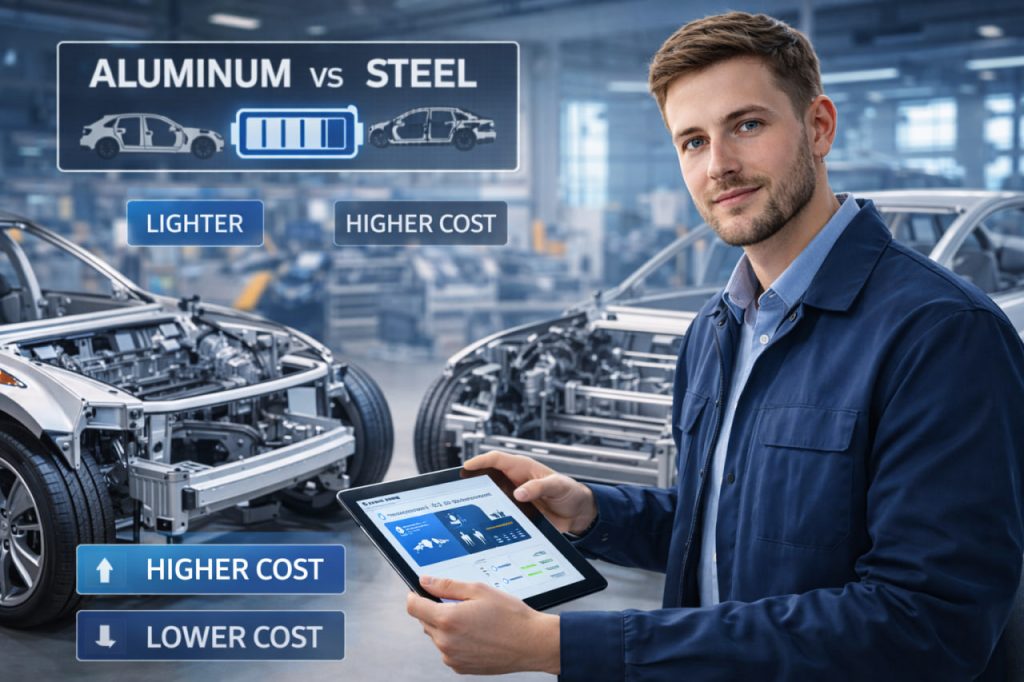
Weight is one of the most critical factors in the design of electric vehicles. Every extra kilogram affects energy consumption, driving range, handling, and even charging efficiency. Unlike combustion cars, electric vehicles carry heavy battery packs, which makes lightweight construction not just desirable but essential. This is why the debate between aluminum and steel has become central to modern EV engineering. Understanding how these materials are used—and why neither is universally “better”—reveals how automakers strategically reduce mass without compromising safety or cost.
Electric vehicles do not aim to be lightweight at all costs. Instead, manufacturers pursue smart weight reduction, removing mass where it hurts efficiency most while preserving structural integrity. Aluminum and steel are the two dominant tools in this strategy, each with distinct advantages and trade-offs.
Why Weight Matters More in Electric Vehicles
In an electric car, additional weight directly reduces range per kilowatt-hour. Heavier vehicles require more energy to accelerate and more energy to maintain speed, particularly in urban driving. Weight also influences braking performance, tire wear, and suspension tuning.
Because batteries are inherently heavy, engineers must compensate elsewhere. Reducing body and chassis weight allows manufacturers to:
- Improve real-world range
- Use smaller battery packs for the same performance
- Enhance driving dynamics
- Lower overall energy costs
“In electric vehicles, mass efficiency is range efficiency,” — Dr. Elena Rossi, vehicle lightweighting specialist.
Steel: Strength, Cost, and Predictability
Steel has been the backbone of automotive manufacturing for over a century. Modern EVs increasingly rely on advanced high-strength steel (AHSS) and ultra-high-strength steel (UHSS), which provide exceptional strength at reduced thickness.
Key advantages of steel include:
- High crash energy absorption
- Excellent fatigue resistance
- Lower material cost
- Established manufacturing infrastructure
- Easy repairability
High-strength steels allow automakers to reduce material thickness while maintaining safety standards. This makes steel especially attractive for crash structures, passenger safety cells, and load-bearing components.
“Steel remains unmatched when it comes to predictable crash behavior and affordability,” — Dr. Thomas Nguyen, automotive safety engineer.
Aluminum: Lightweight Efficiency and Design Freedom
Aluminum is significantly lighter than steel—roughly one-third the density. This makes it highly attractive for reducing vehicle mass, especially in large body panels and structural components.
Benefits of aluminum include:
- Major weight reduction
- Improved corrosion resistance
- High specific strength (strength-to-weight ratio)
- Better efficiency for long-range EVs
Aluminum is commonly used in body panels, subframes, closures, and sometimes even full vehicle structures. Reducing mass high in the vehicle also lowers the center of gravity, improving stability and handling.
“Aluminum is a range multiplier—every kilogram saved extends efficiency across the entire drivetrain,” — Dr. Marcus Lee, EV platform engineer.
The Cost and Manufacturing Trade-Offs
Despite its advantages, aluminum presents challenges. It is more expensive than steel and requires different forming, joining, and repair techniques. Aluminum structures often rely on adhesives, rivets, and specialized welding methods, increasing manufacturing complexity.
Steel, by contrast, benefits from decades of optimized stamping, welding, and global supply chains. For mass-market EVs, steel often offers the best balance between cost and performance.
As a result, many automakers choose hybrid material strategies rather than committing fully to one material.
Mixed-Material Architectures: The Real Industry Standard
Most modern electric vehicles combine aluminum and steel strategically:
- Steel for crash zones and safety cells
- Aluminum for doors, hoods, suspension parts, and subframes
This approach maximizes the strengths of both materials while minimizing their weaknesses. Advanced simulation tools allow engineers to place each material exactly where it delivers the most benefit.
“The future isn’t aluminum versus steel—it’s aluminum and steel working together,” — Dr. Hannah Cole, materials science researcher.
Impact on Range and Performance
Reducing vehicle weight by 10% can improve efficiency by 6–8%, depending on driving conditions. In EVs, this translates directly into:
- Longer range
- Faster acceleration
- Lower energy consumption
- Reduced battery stress
Lightweight structures also allow smaller motors and braking systems, creating a cascading efficiency effect throughout the vehicle.
Sustainability and Recycling Considerations
Both aluminum and steel are highly recyclable, but they differ in energy cost. Producing primary aluminum is energy-intensive, while recycled aluminum requires far less energy. Steel recycling is already well-established and efficient.
Automakers increasingly consider lifecycle emissions, not just tailpipe emissions. Lightweighting must balance operational efficiency with sustainable material sourcing and recycling strategies.
Will One Material Win in the Future?
There is no single winner. As battery technology improves and manufacturing evolves, the optimal material mix will continue to change. Emerging techniques such as gigacasting, structural batteries, and multi-material bonding further blur the line between aluminum and steel dominance.
Future EVs will be defined less by material choice and more by system-level optimization.
Conclusion
Aluminum and steel play complementary roles in reducing the weight of electric vehicles. Steel provides strength, safety, and cost efficiency, while aluminum delivers significant mass reduction and efficiency gains. The most successful EV designs do not choose sides—they integrate both materials intelligently. In the pursuit of lighter, more efficient electric cars, the real innovation lies not in material rivalry, but in engineering balance.


Aight so wen combo EVs droppin😎