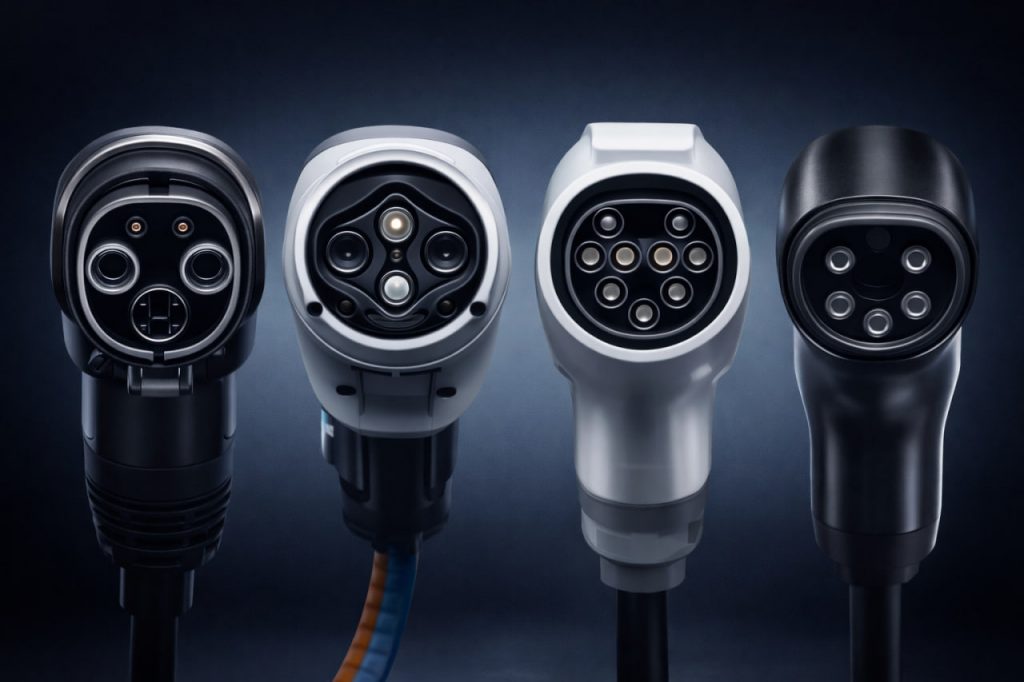
As electric vehicles continue to expand globally, charging standards have become one of the most important — and often confusing — aspects for EV owners. Unlike traditional fuel pumps, EV charging relies on different connector types, regional standards, and power delivery protocols. Understanding how CCS, CHAdeMO, GB/T, and Tesla NACS work is essential for choosing the right vehicle, planning long trips, and evaluating the future of charging infrastructure. This guide explains each connector clearly, breaking down technical terms as they appear.
Why Charging Connector Standards Matter
Charging connectors define how electricity flows from the grid into an electric vehicle. They determine charging speed, compatibility, safety protocols, and infrastructure scalability. Because EV adoption developed regionally rather than globally, different markets introduced their own standards. As a result, connector compatibility directly affects convenience, resale value, and cross-border usability.
“Charging standards shape the entire EV ecosystem, not just user convenience,” — Dr. Thomas Keller, electric mobility infrastructure researcher.
CCS (Combined Charging System)
CCS (Combined Charging System) is currently the most widely adopted fast-charging standard in Europe and North America. It combines AC charging and DC fast charging into a single port by adding two high-power DC pins below a standard AC connector. This design allows vehicles to use one inlet for both slow home charging and high-speed public charging. CCS supports very high power levels — exceeding 350 kW in modern implementations — making it ideal for long-distance travel.
“CCS became dominant because it balances flexibility, scalability, and high power delivery,” — Anna Becker, EV infrastructure analyst.
CHAdeMO
CHAdeMO is one of the earliest DC fast-charging standards, originally developed in Japan. It uses a dedicated DC-only connector separate from the AC charging port. CHAdeMO was a pioneer in bidirectional charging, enabling vehicle-to-grid (V2G) and vehicle-to-home (V2H) applications long before other standards adopted them. However, its maximum charging power has grown more slowly compared to CCS, which has limited its global expansion outside Japan.
“CHAdeMO played a foundational role in fast charging, even if its global influence is now declining,” — Dr. Hiroshi Tanaka, energy systems engineer.
GB/T (China Standard)
GB/T is China’s national charging standard and the most widely used system by volume due to the size of the Chinese EV market. Unlike CCS, GB/T uses separate connectors for AC and DC charging, each with distinct designs. The standard is optimized for China’s grid architecture and regulatory framework, supporting very high power levels in its latest versions. Because GB/T is region-specific, vehicles using this standard are generally not compatible with foreign charging networks without adapters.
“GB/T reflects how infrastructure and policy can shape technical standards at scale,” — Li Wei, EV policy and standards consultant.
Tesla NACS (North American Charging Standard)
Tesla NACS (North American Charging Standard) is Tesla’s proprietary connector, now opened to other manufacturers in North America. It uses a compact, lightweight design that supports both AC and DC charging through a single port. Tesla’s charging ecosystem is tightly integrated with its vehicles, allowing seamless communication, automatic billing, and reliable high-speed charging. With major automakers adopting NACS, it is rapidly becoming a dominant standard in the North American market.
“NACS succeeded by combining elegant hardware with a mature, reliable charging network,” — Michael Ross, EV market strategist.
Compatibility, Adapters, and Real-World Use
While adapters can bridge some standards, they often limit charging speed or functionality. Full compatibility depends not only on physical connectors but also on communication protocols and grid regulations. As markets mature, consolidation around fewer standards is expected, improving user experience and infrastructure efficiency.
The Future of Charging Standards
The EV industry is moving toward standard convergence, particularly in North America and Europe. CCS remains dominant in Europe, while Tesla NACS is gaining traction in the U.S. Hydrogen and wireless charging may complement these systems in the future, but wired DC fast charging will remain the backbone of EV mobility for decades.
“The future is not one connector globally, but fewer connectors used more intelligently,” — Dr. Sofia Müller, sustainable transport researcher.
Conclusion
CCS, CHAdeMO, GB/T, and Tesla NACS each reflect different technological paths shaped by regional priorities and infrastructure realities. CCS offers global scalability, CHAdeMO pioneered innovation, GB/T dominates by scale, and Tesla NACS redefined user experience. Understanding these charging standards empowers EV owners and industry observers to navigate the rapidly evolving electric mobility landscape with confidence.
Bruh they ALWAYS overcomplicatin stuff on purpose 😤 why tf couldnt they just make it normal from the jump?? Watch, once the EU gets their hands on this bs its gonna be the iPhone situation all over again