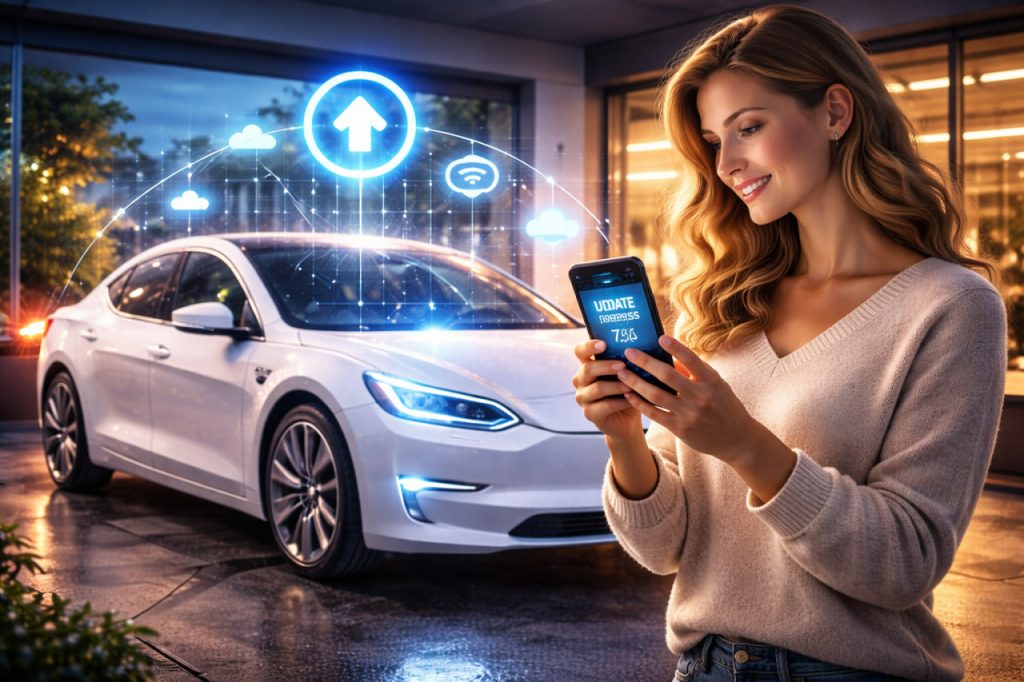
For decades, cars were defined almost entirely by their hardware. Engines, transmissions, suspension systems, and body design determined what a vehicle could do for its entire lifespan. Once a car left the factory, its capabilities were essentially frozen. Today, this paradigm is being overturned. Software has become one of the most important components of modern vehicles, and over-the-air (OTA) updates are redefining what it means to own and use a car. Instead of aging from the first day, cars can now evolve over time.
The shift toward software-defined vehicles is especially pronounced in electric cars, but it is rapidly spreading across the entire automotive industry. Updates delivered wirelessly are changing performance, safety, user experience, and even business models in ways that were impossible just a decade ago.
What Over-the-Air Updates Actually Are
Over-the-air (OTA) updates allow a vehicle to receive new software wirelessly via cellular or Wi-Fi connections, without visiting a service center. These updates can modify or improve systems such as infotainment, navigation, battery management, driver assistance, energy efficiency, and even motor control. In modern vehicles, dozens of electronic control units (ECUs) are connected through centralized computing architectures, making coordinated updates possible.
“OTA updates turn the car from a static product into a continuously improving platform,” — Dr. Marcus Lee, automotive software systems researcher.
From Mechanical Products to Software-Defined Vehicles
Traditional cars were mechanically defined: hardware determined functionality. In contrast, modern vehicles are increasingly software-defined, meaning behavior is controlled by code rather than fixed mechanical limits. Steering feel, acceleration response, regenerative braking strength, and thermal management can all be adjusted through software.
This architectural shift allows manufacturers to optimize vehicles long after production, correcting inefficiencies, improving algorithms, and adapting to real-world usage patterns.
Performance Improvements Without Physical Changes
One of the most striking effects of OTA updates is the ability to improve vehicle performance remotely. Software updates can:
- Optimize motor control algorithms
- Improve acceleration curves
- Increase efficiency and range
- Enhance regenerative braking behavior
In some cases, cars receive noticeable performance gains years after purchase, without any physical modification. This fundamentally challenges the traditional idea that performance degrades steadily over time.
“Software now defines how much of the hardware’s potential is actually unlocked,” — Dr. Elena Rossi, electric powertrain specialist.
Safety and Reliability Through Continuous Updates
OTA updates play a critical role in vehicle safety. Bugs, vulnerabilities, and edge-case failures can be fixed proactively before they cause incidents. Driver-assistance systems benefit especially from continuous refinement, improving object detection, braking behavior, and stability control logic.
Unlike recalls that require physical repairs, software updates can be deployed quickly across entire fleets, dramatically reducing response time to safety issues.
User Experience as a Living System
Infotainment and user interfaces were among the first areas to benefit from OTA updates, but their importance should not be underestimated. Navigation accuracy, voice assistants, display layouts, and app integration can all improve over time. This creates a smartphone-like experience where the car feels modern for longer, reducing perceived obsolescence.
Personalization also improves, as software learns driver preferences and adapts settings automatically.
Energy Management and Battery Longevity
In electric vehicles, OTA updates are deeply connected to battery management systems (BMS). Software refinements can improve charging curves, thermal control, and energy distribution, extending battery life and improving real-world range. Small algorithmic changes can translate into meaningful efficiency gains over millions of vehicles.
“Battery performance is increasingly a software problem, not just a chemistry problem,” — Dr. Hannah Cole, energy systems analyst.
New Business Models and Feature Unlocking
OTA updates enable entirely new business models. Features can be activated, upgraded, or customized after purchase. This includes performance modes, driver-assistance packages, connectivity services, and comfort features. While controversial, this approach allows manufacturers to offer lower entry prices while monetizing optional functionality over time.
From a strategic perspective, cars are becoming service platforms, not one-time products.
Cybersecurity and Trust Challenges
With increased connectivity comes increased risk. OTA-capable vehicles must be protected against hacking, data breaches, and unauthorized access. Secure boot processes, encrypted communication, and strict authentication are essential. Trust in software updates depends on transparency, reliability, and robust security practices.
“A connected car is only as strong as its weakest software link,” — Dr. Jonathan Reed, automotive cybersecurity expert.
Why Electric Vehicles Lead This Transformation
Electric vehicles are particularly suited to OTA-driven evolution because they already rely on centralized electronics and digital motor control. Fewer mechanical dependencies make software changes safer and more impactful. As a result, EVs have become the proving ground for the software-defined vehicle concept, with combustion vehicles following behind.
The Long-Term Impact on Car Ownership
OTA updates fundamentally change how cars age. Instead of slowly falling behind, vehicles can gain features, improve efficiency, and remain competitive longer. This affects resale value, brand loyalty, and sustainability by extending usable vehicle life.
Ownership becomes an ongoing relationship rather than a fixed transaction.
Conclusion
Over-the-air updates have transformed software from a supporting element into a core defining feature of modern vehicles. By enabling continuous improvement in performance, safety, efficiency, and user experience, OTA technology reshapes how cars are built, sold, and owned. In the software-defined era, the most important upgrade a car receives may not come from a wrench—but from a wireless signal.


Lowkey curious tho… imagine actually getting it right the 1 time??🤣🤣