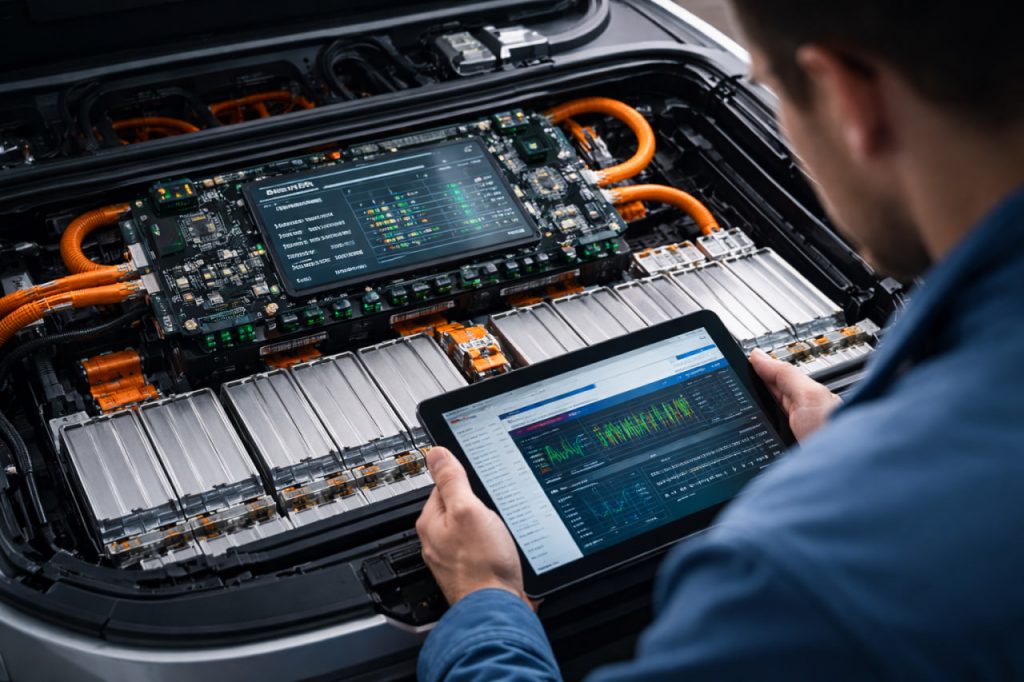
In electric vehicles, the battery is not simply a container for energy but a highly complex system that must operate safely under constantly changing conditions. Voltage levels fluctuate, temperatures rise and fall, and individual cells age at different rates. Managing this complexity is the responsibility of the Battery Management System (BMS), a critical component that determines how efficiently, safely, and reliably the battery performs over its entire lifespan. Without a BMS, modern electric vehicles would be neither practical nor safe for everyday use.
Understanding the Role of a Battery Management System (BMS)
A Battery Management System (BMS) is an electronic control system that continuously monitors and regulates the operation of a battery pack. It tracks key parameters such as cell voltage, current flow, and temperature, ensuring that each battery cell operates within predefined safety limits. Unlike passive monitoring hardware, the BMS actively intervenes when abnormal conditions occur by limiting power output, adjusting charging speed, or disconnecting the battery entirely. This real-time decision-making transforms the battery from a static energy source into an intelligent system capable of self-protection.
“The BMS enables a battery to operate safely under real-world stress conditions that would otherwise cause rapid degradation or failure,” — Dr. Kevin Marshall, battery systems engineer.
Why the BMS Is Considered the Brain of the Battery
The BMS earns its reputation as the “brain” because it continuously analyzes data, makes decisions, and executes control actions without driver involvement. It calculates state of charge (SoC), which estimates how much usable energy remains, and state of health (SoH), which reflects long-term battery aging and degradation. These calculations are not simple measurements but complex algorithms that account for temperature, load, and historical usage patterns. Accurate SoC and SoH estimation is essential for reliable range prediction, performance consistency, and long-term durability.
“A battery without a BMS is blind; it has no awareness of its condition or limits,” — Dr. Elena Fischer, energy storage researcher.
Cell Balancing and Performance Optimization
A battery pack consists of hundreds or even thousands of individual cells connected together, and no two cells behave exactly the same over time. Cell balancing is a core BMS function that ensures all cells maintain similar voltage levels during charging and discharging. Without balancing, weaker cells would reach critical limits earlier, reducing available capacity and accelerating degradation. The BMS corrects these differences using passive balancing, which dissipates excess energy as heat, or active balancing, which redistributes energy between cells. This process directly improves battery lifespan and maintains consistent performance throughout the pack’s life.
Safety Functions and Thermal Protection
Battery safety is one of the most critical responsibilities of the BMS. The system protects against overcharging, over-discharging, short circuits, and overcurrent conditions, all of which can cause irreversible damage or safety hazards. One of the most dangerous risks is thermal runaway, a chain reaction where rising temperatures lead to uncontrollable chemical reactions inside battery cells. The BMS works closely with the vehicle’s thermal management system, controlling cooling and heating to keep the battery within optimal temperature ranges.
“Most serious battery failures are prevented silently by the BMS before drivers ever notice a problem,” — Michael O’Connor, EV safety consultant.
Communication With Vehicle and Charging Systems
The BMS constantly communicates with other vehicle systems through high-speed data networks. It informs the vehicle control unit about safe power limits, influences regenerative braking intensity, and determines maximum acceleration output. During charging, the BMS negotiates with charging stations to control charging current, voltage limits, and charging speed, ensuring efficiency without compromising safety. In modern electric vehicles, the BMS also supports over-the-air software updates, allowing manufacturers to refine battery behavior and improve efficiency long after the vehicle is delivered.
Software Quality and Its Impact on Battery Life
While battery chemistry often receives the most public attention, BMS software quality plays an equally important role in real-world performance. Advanced algorithms can extend usable range, reduce degradation, and adapt behavior based on driving patterns and environmental conditions. Poorly designed BMS logic, by contrast, can limit performance even when high-quality cells are used.
“In many electric vehicles, the difference between average and exceptional battery performance is defined by software intelligence rather than hardware alone,” — Dr. Samuel Lee, EV powertrain specialist.
The BMS Beyond Electric Vehicles
Battery Management Systems are not limited to electric cars. Similar technologies are used in energy storage systems, renewable power grids, and industrial backup solutions, where reliability and safety are equally critical. Advances in EV BMS development often influence these industries, accelerating innovation across the entire energy ecosystem.
Conclusion
The Battery Management System truly functions as the brain of the battery by monitoring, protecting, and optimizing every aspect of battery operation. Through intelligent algorithms, safety controls, and continuous communication with vehicle systems, the BMS transforms raw battery cells into a reliable, long-lasting energy source. In electric vehicles, no component plays a more decisive role in balancing safety, performance, and durability than the BMS.