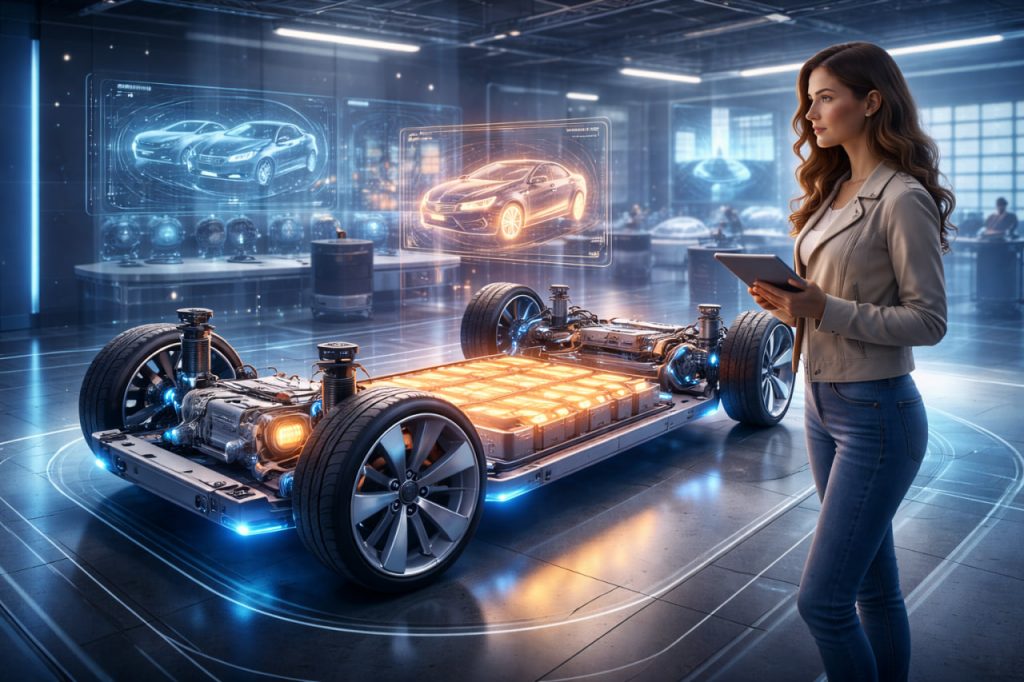
The transition from internal combustion vehicles to electric mobility did not just change how cars are powered—it fundamentally reshaped how cars are designed and engineered. One of the most important outcomes of this shift is the emergence of the skateboard platform, a vehicle architecture that places the battery, electric motors, and core electronics into a flat, modular base. This approach has quietly transformed automotive development, enabling faster innovation, lower costs, and entirely new vehicle concepts. Understanding why skateboard platforms are revolutionary requires looking beyond aesthetics and into system-level engineering.
What a Skateboard Platform Actually Is
A skateboard platform is a vehicle architecture where the main functional components—battery pack, electric motors, power electronics, cooling systems, and suspension mounting points—are integrated into a flat chassis that resembles a skateboard. The passenger cabin and body are then mounted on top as a largely independent structure. Unlike traditional car platforms, where the engine, transmission, fuel system, and exhaust dictate layout, skateboard platforms are electrically centered and mechanically simplified.
“The skateboard platform decouples propulsion from the body, which is something combustion vehicles could never fully achieve,” — Dr. Markus Weber, automotive platform engineer.
Why Combustion Platforms Were a Constraint
Traditional automotive platforms evolved around bulky, rigid components such as engines, gearboxes, and driveshafts. These elements forced compromises in cabin space, weight distribution, crash structure, and design flexibility. Even so-called “modular” combustion platforms still required significant redesign for different vehicle types. This rigidity slowed innovation and increased development costs.
Skateboard platforms eliminate these constraints by replacing complex mechanical systems with compact electric components that can be distributed more freely across the chassis.
Battery-as-Structure: A Fundamental Shift
At the heart of the skateboard platform lies the battery pack, often integrated as a structural element rather than a passive load. Positioned low between the axles, the battery lowers the center of gravity, improves handling, and increases vehicle stability. Structural battery designs also enhance torsional rigidity, improving safety and ride quality.
“Using the battery as part of the vehicle structure turns dead weight into functional engineering,” — Dr. Elena Rossi, electric vehicle systems researcher.
Modular Motors and Drivetrain Flexibility
Skateboard platforms allow electric motors to be placed at the front, rear, or both axles with minimal redesign. This enables easy configuration of front-wheel drive, rear-wheel drive, or all-wheel drive using the same base architecture. Manufacturers can scale performance—from city cars to high-performance SUVs—without rebuilding the entire platform. This modularity dramatically reduces time-to-market and manufacturing complexity.
Manufacturing Efficiency and Cost Reduction
One of the most disruptive aspects of skateboard platforms is how they simplify manufacturing. A single platform can support multiple vehicle models, body styles, and market segments. This reduces tooling costs, streamlines supply chains, and enables higher production volumes per platform.
For new automakers and startups, skateboard platforms lower the barrier to entry by allowing rapid product development without decades of platform evolution. For established manufacturers, they enable faster transitions away from combustion technology.
“Platform reuse at this level is what makes EV scaling economically viable,” — James Thornton, automotive manufacturing analyst.
Design Freedom and Interior Space
Because skateboard platforms remove bulky drivetrains from the cabin area, designers gain unprecedented freedom. Flat floors, longer wheelbases, and shorter overhangs create more interior space without increasing vehicle length. This is why many EVs feel more spacious than similarly sized combustion cars.
Designers can also experiment with new layouts—rotating seats, lounge-style interiors, or purpose-built autonomous cabins—without being constrained by engine placement.
Safety and Crash Performance Advantages
Skateboard platforms improve safety through predictable load paths and large front and rear crumple zones. With no engine block to intrude into the cabin during a crash, energy can be absorbed more effectively. The rigid battery enclosure adds structural strength while remaining isolated from deformation zones.
“EV skateboard platforms allow engineers to design crash structures around energy absorption rather than around mechanical survival,” — Dr. Thomas Nguyen, automotive safety specialist.
Software-Defined Vehicles and Future Readiness
Skateboard platforms are inherently compatible with software-defined vehicles. Centralized electronics, over-the-air updates, and sensor integration are easier when the vehicle is built around an electric and digital core. This architecture supports future upgrades such as improved autonomy, new battery chemistries, and enhanced driver-assistance systems without fundamental redesign.
Limitations and Engineering Trade-Offs
Despite their advantages, skateboard platforms are not without challenges. Battery weight, floor height, and thermal management require careful optimization. Repair complexity can increase if the structural battery is damaged. Additionally, not all vehicle types—such as ultra-lightweight sports cars—benefit equally from this architecture. These trade-offs are actively being addressed through advances in materials, cell design, and modular repair strategies.
Why Skateboard Platforms Are a True Revolution
Skateboard platforms represent a shift from vehicle-centric engineering to system-centric engineering. They treat the car as a scalable energy and software platform rather than a fixed mechanical product. This change accelerates innovation, reduces costs, and enables a level of flexibility that combustion-era architectures could never match.
Conclusion
Skateboard platforms are revolutionary because they redefine how cars are built, not just how they are powered. By integrating batteries, motors, and electronics into a modular, flat foundation, they unlock design freedom, manufacturing efficiency, and future-ready software integration. As electric mobility continues to evolve, skateboard platforms will remain the structural backbone of the next generation of vehicles.


hope all thing work out for they.😄