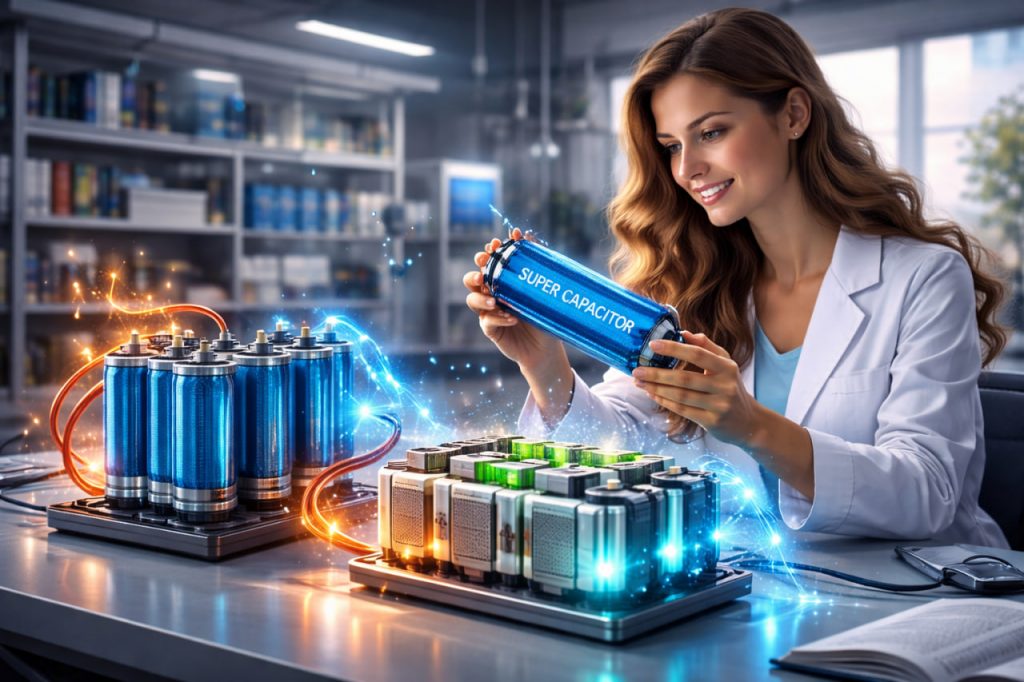
As electric vehicles, renewable energy systems, and high-performance electronics evolve, the limits of traditional batteries become increasingly visible. Charging speed, power delivery, lifespan, and thermal stress remain persistent challenges, especially in applications that demand rapid energy exchange. This has drawn renewed attention to supercapacitors—energy storage devices that operate on fundamentally different physical principles than batteries. The key question is not only whether supercapacitors can replace batteries, but whether they can work together to create more efficient and resilient energy systems.
What Supercapacitors Actually Are
Supercapacitors, also known as ultracapacitors, are energy storage devices that store energy through electrostatic charge separation rather than chemical reactions. Unlike batteries, which rely on slow ion movement and chemical bonding, supercapacitors accumulate charge at the interface between an electrode and an electrolyte. This allows them to charge and discharge extremely quickly—often in seconds—without significant degradation.
“Supercapacitors trade energy density for power density, excelling where speed and durability matter most,” — Dr. Robert Lin, energy storage systems researcher.
How Supercapacitors Differ From Batteries
The most important distinction lies in energy density versus power density. Batteries store a large amount of energy relative to their size, making them suitable for long-duration power delivery. Supercapacitors store far less energy but can deliver or absorb power at much higher rates. This means batteries are better for sustained operation, while supercapacitors are ideal for short, intense bursts of power.
Additionally, supercapacitors can withstand hundreds of thousands to millions of charge cycles with minimal wear, whereas batteries degrade gradually with each cycle.
Charging Speed and Efficiency Advantages
One of the most compelling advantages of supercapacitors is their ultra-fast charging capability. Because no chemical reactions are involved, charging is limited mainly by electrical resistance rather than reaction kinetics. This makes supercapacitors highly efficient, with round-trip efficiencies often exceeding 95%. Heat generation is also significantly lower, reducing thermal management requirements.
“From an efficiency standpoint, supercapacitors are among the cleanest energy storage technologies available,” — Dr. Elena Rossi, electric powertrain specialist.
Why Supercapacitors Cannot Fully Replace Batteries
Despite their advantages, supercapacitors face a critical limitation: low energy density. Even the most advanced supercapacitors store far less energy per kilogram than lithium-ion batteries. This makes them impractical as the sole energy source for electric vehicles or long-duration applications. Replacing a battery with supercapacitors alone would dramatically increase size, weight, and cost for the same usable range.
Supercapacitors as Battery Companions
Where supercapacitors truly shine is as complementary systems. In hybrid energy architectures, supercapacitors handle rapid power fluctuations—such as acceleration, regenerative braking, or grid stabilization—while batteries provide steady, long-term energy. This division of labor reduces stress on batteries, slows degradation, and improves overall system efficiency.
“Hybrid battery–supercapacitor systems allow each technology to operate in its optimal zone,” — Dr. Michael Turner, hybrid energy systems engineer.
Applications in Electric Vehicles
In electric vehicles, supercapacitors can enhance regenerative braking, capturing sudden bursts of energy that batteries might accept less efficiently. They can also supply short bursts of high power during acceleration, reducing peak load on the battery. Some experimental buses, trams, and performance vehicles already use supercapacitors to improve efficiency and extend battery life. However, widespread adoption depends on cost, integration complexity, and system-level benefits.
Grid Storage and Industrial Use
Beyond vehicles, supercapacitors play an important role in grid stabilization, industrial machinery, and backup power systems. They respond in milliseconds to voltage or frequency fluctuations, making them ideal for smoothing renewable energy output. In these roles, supercapacitors often work alongside batteries or other storage technologies to deliver both responsiveness and endurance.
Emerging Materials and Future Potential
Research into graphene, carbon nanotubes, and advanced electrolytes aims to increase supercapacitor energy density while preserving fast response times. While incremental improvements are likely, most experts agree that supercapacitors will not overtake batteries entirely. Instead, they will become increasingly important as part of multi-layer energy storage systems.
“The future is not a single storage technology, but intelligent combinations tailored to specific use cases,” — Dr. Hannah Cole, energy materials scientist.
Batteries vs Supercapacitors: A Strategic Perspective
Rather than framing the debate as competition, it is more accurate to view batteries and supercapacitors as strategic partners. Batteries excel at storing energy over time; supercapacitors excel at moving energy quickly. Together, they can deliver systems that are faster, more durable, and more efficient than either technology alone.
Conclusion
Supercapacitors are unlikely to replace batteries as primary energy storage, but they have enormous potential to complement them. By handling high-power, short-duration tasks, supercapacitors reduce battery stress, improve efficiency, and enable smarter energy systems. As electrification accelerates across transportation and energy infrastructure, hybrid battery–supercapacitor architectures may become a defining feature of next-generation designs.


How can you even compare them? They are complete different!🤣