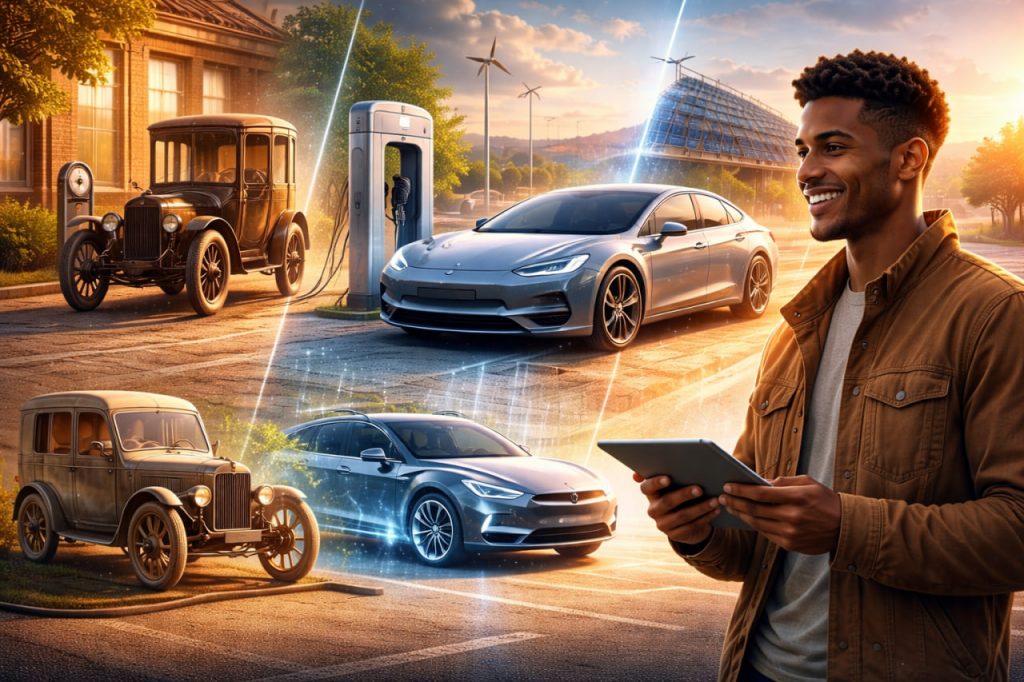
The history of electric cars is far longer and more complex than many people realize. Contrary to popular belief, electric vehicles are not a modern invention but one of the earliest forms of automotive transportation. Their rise, decline, and rebirth closely follow advances in energy storage, infrastructure, and societal needs. Understanding this history reveals why electric cars disappeared for decades—and why they are now returning stronger than ever.
The Birth of Electric Vehicles in the 19th Century
The first electric vehicles (EVs) appeared in the early 19th century, long before gasoline cars became dominant. Inventors in Europe and the United States experimented with battery-powered carriages as early as the 1830s. By the late 1800s, electric cars were quiet, easy to operate, and did not require manual gear shifting or hand-cranking to start. At the turn of the century, electric vehicles accounted for a significant share of urban transportation, especially in cities where short distances and clean operation mattered.
“At the dawn of the automobile age, electric cars were often preferred for their reliability and ease of use,” — Dr. James Whitfield, automotive historian.
Early Competition With Steam and Gasoline
In the early automotive era, three technologies competed: steam, electric, and internal combustion engines. Electric cars excelled in comfort and simplicity but suffered from limited range and long charging times. Gasoline vehicles, while noisy and difficult to operate at first, benefited from higher energy density and faster refueling. As road networks expanded and people began traveling longer distances, the limitations of early batteries became more apparent. This shift gradually tilted the balance in favor of gasoline-powered cars.
The Decline of Electric Cars in the Early 20th Century
Several key developments led to the decline of electric vehicles after 1910. The invention of the electric starter motor eliminated the need to hand-crank gasoline engines, removing one of EVs’ main advantages. At the same time, mass production techniques dramatically reduced the cost of gasoline cars, making them accessible to a much wider audience. Oil discoveries and expanding fuel infrastructure further reinforced the dominance of internal combustion vehicles.
“Electric cars didn’t fail—they were outpaced by an ecosystem built around oil,” — Dr. Laura Simmons, transportation systems researcher.
Electric Vehicles in the Mid-20th Century: A Niche Existence
For much of the 20th century, electric cars survived only in specialized roles. They were used in industrial settings, delivery fleets, and environments where emissions or noise were critical concerns. Limited battery technology and low energy density prevented EVs from becoming mainstream. Research continued quietly, but without strong economic or regulatory incentives, electric mobility remained marginal.
The Environmental Awakening and Renewed Interest
Interest in electric vehicles resurfaced during periods of fuel shortages and environmental awareness, particularly in the 1970s. Concerns about air pollution and oil dependence led governments and researchers to revisit electric propulsion. However, battery technology was still insufficient to support mass adoption, and most projects remained experimental. These early efforts nonetheless laid important groundwork for future breakthroughs.
The Lithium-Ion Breakthrough
The real turning point came with the development and commercialization of lithium-ion batteries in the late 20th century. These batteries offered significantly higher energy density, longer lifespan, and better efficiency than previous technologies. Originally developed for consumer electronics, lithium-ion cells eventually became viable for automotive use. This technological leap reopened the door for practical, long-range electric vehicles.
The Modern EV Renaissance
The 21st century marked the true rebirth of electric cars. Advances in battery management systems, power electronics, and software control transformed EVs into competitive alternatives to combustion vehicles. Modern electric cars deliver high performance, long range, fast charging, and advanced safety features. Governments introduced emissions regulations and incentives that further accelerated adoption.
“Modern electric vehicles succeeded because technology, policy, and market demand finally aligned,” — Dr. Elena Rossi, electric mobility expert.
Electric Cars Today and the Road Ahead
Today, electric vehicles are no longer niche products but central to the future of transportation. Automakers worldwide are investing heavily in electrification, charging infrastructure is expanding rapidly, and battery costs continue to decline. Electric cars now represent not just an environmental choice but a technological evolution toward software-defined, energy-efficient mobility systems.
Conclusion
The history of electric cars is a story of early promise, long dormancy, and powerful resurgence. From 19th-century experiments to modern high-performance EVs, electric vehicles have evolved alongside society’s technological and environmental priorities. Their return is not a trend but the continuation of a long journey—one finally supported by the technology and infrastructure needed to succeed.


As you have mentioned, biggest turn point for EV’s are popularization and invention of Lithium Ion Batteries. However, they are still not enough to justify EV’s replacing CV’s. As an Example, a gasoline can create 12000 WH/KG but an ion battery can do around 250-300 WH/KG. So the gasoline is 40x more efficient *at the moment*. With new technologies and if you consider the current funding on power (I suggest you checking nuclear fusion trucks which currently being researched to use on super-computer farms) I believe, all this discussions will be laid to rest as soon as we can start creating nuclear fusion core’s that can power EV’s. And to be honest, its not that far on the future, with the current investments on AGI, scientists are working double shift on solving the power issue.
back then these were experiments, but now its industrial production.