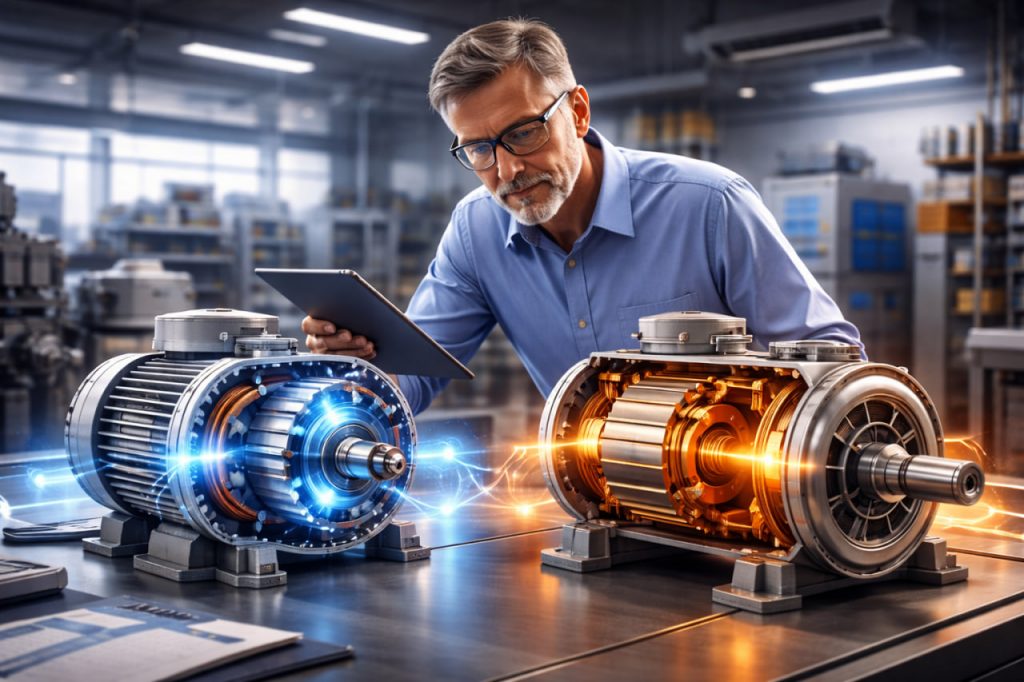
Electric motors are at the heart of modern industry, electric vehicles, household appliances, and energy systems. Among the many motor types, synchronous motors and asynchronous motors (also known as induction motors) are the most widely used and most frequently compared. While both convert electrical energy into mechanical motion, they operate on different physical principles and are optimized for different use cases. Understanding their differences is essential for grasping how electric drivetrains, industrial machinery, and EV powertrains are designed.
The Basic Principle of Electric Motor Operation
All electric motors rely on the interaction between a magnetic field and an electric current to produce torque. When alternating current flows through stator windings, it creates a rotating magnetic field. The rotor reacts to this field and begins to turn. The key difference between synchronous and asynchronous motors lies in how the rotor follows this rotating magnetic field and whether it stays perfectly aligned with it or not.
“The distinction between synchronous and asynchronous motors is fundamentally about how motion locks—or fails to lock—to the magnetic field,” — Dr. Heinrich Müller, electrical machines researcher.
What Is a Synchronous Motor?
A synchronous motor is a motor in which the rotor rotates at exactly the same speed as the rotating magnetic field produced by the stator. This means there is no slip between the magnetic field and the rotor. The rotor’s magnetic field is typically created using permanent magnets or, in some designs, electrically excited windings. Because the rotor is magnetically locked to the stator field, speed remains constant regardless of load, as long as the motor stays within its operating limits.
Advantages of Synchronous Motors
Synchronous motors offer high efficiency, precise speed control, and excellent performance at low and high speeds. These characteristics make them ideal for applications where efficiency and control matter, such as electric vehicles, precision industrial drives, and robotics. Permanent-magnet synchronous motors (PMSMs) are especially popular in EVs because they deliver high torque density and fast dynamic response.
“Synchronous motors are favored when efficiency and controllability are critical design priorities,” — Dr. Elena Rossi, electric drivetrain specialist.
Limitations of Synchronous Motors
Despite their advantages, synchronous motors have trade-offs. Permanent magnets increase cost and introduce dependency on rare-earth materials. These motors also require more sophisticated control electronics, including precise position sensing or advanced estimation algorithms. At very high temperatures, magnet performance can degrade, requiring careful thermal management.
What Is an Asynchronous (Induction) Motor?
An asynchronous motor, commonly called an induction motor, operates differently. In this design, the rotor does not rotate at the same speed as the stator’s magnetic field. Instead, a small difference in speed—known as slip—is required to induce current in the rotor. This induced current creates its own magnetic field, which interacts with the stator field to produce torque.
“Induction motors generate torque through controlled inefficiency—slip is not a flaw but a feature,” — Dr. James Carter, industrial motor systems engineer.
Advantages of Asynchronous Motors
Asynchronous motors are known for their robustness, simplicity, and lower cost. They do not require permanent magnets, making them less sensitive to material supply constraints. Their mechanical design is extremely durable, which is why induction motors dominate industrial environments. In EVs, induction motors are valued for their ability to tolerate high speeds and overload conditions without magnet-related risks.
Limitations of Asynchronous Motors
The main downside of asynchronous motors is lower efficiency, especially at partial loads. Energy is lost as heat due to rotor currents, which slightly reduces overall performance compared to synchronous designs. Speed control is also more complex, requiring advanced inverters to manage slip precisely. While these drawbacks are manageable, they influence where induction motors are most effectively used.
Key Differences in Efficiency and Control
The most important practical difference between the two motor types is efficiency and control behavior. Synchronous motors maintain exact speed alignment and typically achieve higher efficiency across a wider operating range. Asynchronous motors sacrifice some efficiency for simplicity and robustness. In applications where energy efficiency directly impacts range or operating cost—such as electric vehicles—this distinction becomes critical.
Applications in Electric Vehicles
Modern EVs use both motor types depending on design goals. Many manufacturers favor permanent-magnet synchronous motors for primary drive units due to their efficiency and compact size. Some vehicles combine them with induction motors on secondary axles, benefiting from robustness and reduced reliance on rare-earth materials. This hybrid approach balances performance, cost, and supply-chain resilience.
Which Motor Is “Better”?
There is no universally better motor—only better choices for specific applications. Synchronous motors excel where precision, efficiency, and compactness matter. Asynchronous motors shine in environments demanding durability, cost efficiency, and tolerance to extreme operating conditions. Engineering decisions are driven by system-level trade-offs rather than isolated performance metrics.
“Motor selection is about context, not superiority—every design reflects a compromise,” — Dr. Thomas Nguyen, automotive power systems expert.
Conclusion
Synchronous and asynchronous motors differ primarily in how their rotors interact with the stator’s magnetic field. Synchronous motors lock directly to the field, offering high efficiency and precise control, while asynchronous motors rely on slip, delivering robustness and simplicity. Both play critical roles in modern technology, and understanding their differences reveals why electric drivetrains are engineered the way they are.


Wow, its heally hard🤯