As electric vehicles become mainstream, one of the most debated topics among EV owners is the difference between fast charging and slow charging. While both methods deliver electricity to the battery, they differ significantly in power level, charging speed, infrastructure requirements, and long-term effects on battery health. Understanding these differences helps drivers make smarter decisions that balance convenience, cost, and battery longevity. This guide explains the technical aspects in simple terms while highlighting real-world implications.
What Is Slow Charging?
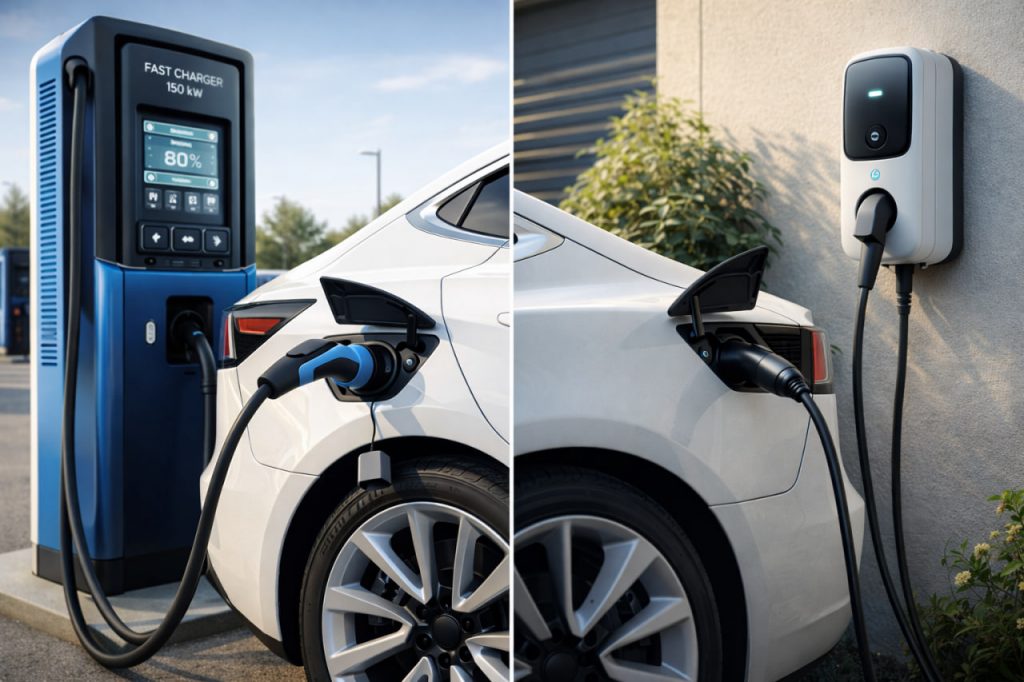
Slow charging, often referred to as AC charging, typically takes place at home or workplace charging stations. Power levels usually range between 3.7 kW and 22 kW, depending on the electrical setup and the vehicle’s onboard charger. In this process, electricity flows into the car in alternating current form and is converted into direct current inside the vehicle by the onboard charger. Because power delivery is moderate, heat generation within the battery remains relatively low.
“For daily use, slow charging is generally the healthiest option for lithium-ion batteries,” — Dr. Laura Bennett, battery systems engineer.
What Is Fast Charging?
Fast charging, also known as DC fast charging, uses direct current supplied directly to the battery at much higher power levels—typically between 50 kW and 350 kW. Unlike AC charging, power conversion happens outside the vehicle, allowing significantly faster energy transfer. Fast charging can restore a large portion of battery capacity in as little as 20–40 minutes, making it ideal for long-distance travel. However, higher power delivery results in increased thermal stress on battery cells.
How Charging Speed Affects Battery Chemistry
Most modern EVs use lithium-ion batteries, which rely on chemical reactions to store and release energy. During fast charging, lithium ions move rapidly between the anode and cathode. High charging rates can increase internal resistance and temperature, potentially accelerating battery degradation over time. The vehicle’s Battery Management System (BMS) regulates charging speed and temperature to minimize damage.
“Heat is the primary factor influencing long-term battery degradation during high-power charging,” — Dr. Samuel Lee, EV powertrain specialist.
Advantages of Slow Charging
Slow charging is gentler on the battery and often more cost-effective. Because it produces less heat and operates at lower current levels, it reduces long-term stress on battery cells. It also allows drivers to charge overnight when electricity rates may be lower. Additionally, home charging provides convenience and eliminates reliance on public infrastructure for everyday needs.
Advantages of Fast Charging
Fast charging offers unmatched convenience during road trips and in situations where time is limited. It enables long-distance travel with minimal downtime and supports commercial fleets that require rapid turnaround. Modern battery systems are designed to handle fast charging safely, especially when used occasionally rather than as a primary charging method.
Disadvantages and Trade-Offs
Slow charging, while battery-friendly, requires longer waiting times and may not suit drivers with high daily mileage and no home charging access. Fast charging, although convenient, can increase battery wear if used excessively. Additionally, public fast chargers are typically more expensive per kilowatt-hour than residential electricity.
Charging Strategy for Battery Longevity
Experts generally recommend using slow AC charging for routine daily charging and reserving fast charging for long-distance travel or emergencies. Maintaining the battery between 20% and 80% state of charge also helps preserve long-term capacity.
“Balanced charging habits are more important than avoiding fast charging entirely,” — Dr. Michael Turner, electric mobility researcher.
Real-World Perspective
Modern EV batteries are engineered to withstand occasional fast charging without significant performance loss. Studies show that moderate use of DC fast charging has limited impact when combined with responsible charging habits. Temperature control, software updates, and intelligent battery design significantly mitigate long-term risks.
Conclusion
Fast charging and slow charging each serve distinct purposes in electric mobility. Slow charging supports battery longevity and cost efficiency, while fast charging provides flexibility and travel freedom. The key to optimal battery health lies not in avoiding fast charging entirely, but in adopting a balanced charging strategy tailored to daily driving patterns and travel needs.