One of the most common questions among electric vehicle owners is how long charging will actually take in real life. Charging time often seems confusing because it involves unfamiliar units such as kilowatts (kW) and kilowatt-hours (kWh), which are frequently mixed up. In reality, understanding charging time does not require technical education—only a clear explanation of how energy and power relate to each other. This article breaks everything down step by step, using simple logic and practical examples.
What kWh Means: Energy Stored in the Battery
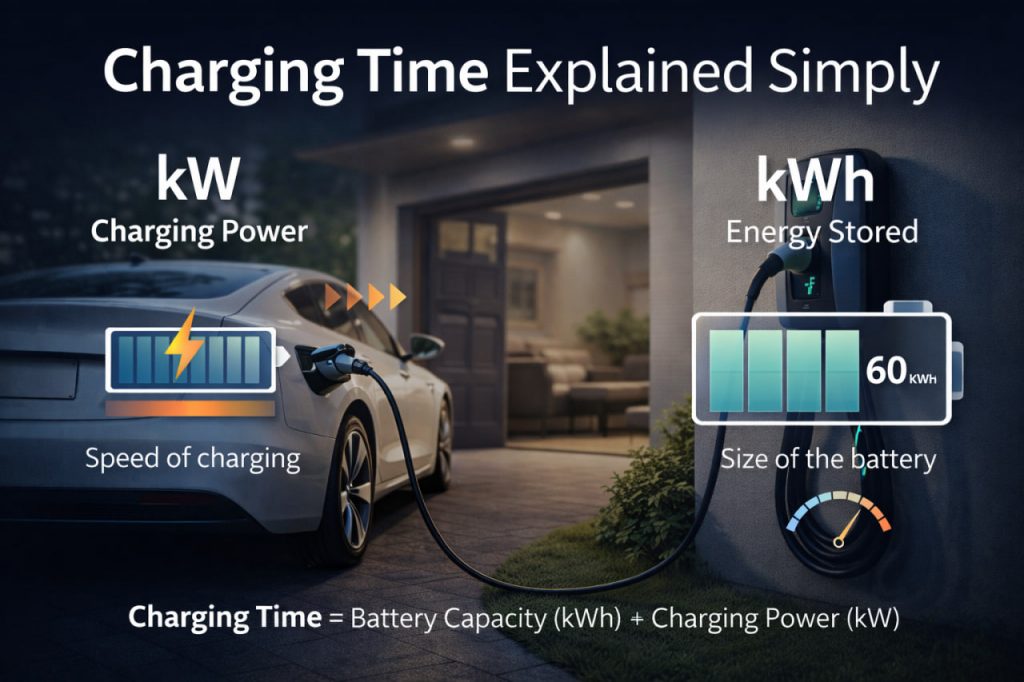
Kilowatt-hour (kWh) is a unit of energy, not speed. It describes how much electricity a battery can store or use over time. For example, if an electric car has a 60 kWh battery, it means the battery can deliver 60 kilowatts of power for one hour, or 30 kilowatts for two hours, or 10 kilowatts for six hours. In simple terms, kWh represents the size of the fuel tank in an electric car. The larger the kWh value, the more energy the battery can hold and the farther the vehicle can drive.
What kW Means: Charging Power
Kilowatt (kW) measures power, which is the rate at which energy is transferred. When applied to charging, kW indicates how fast electricity flows into the battery. A 7 kW charger delivers energy much more slowly than a 150 kW fast charger. Think of kW as the speed of filling the tank, while kWh is the tank’s total capacity. Charging time depends directly on how many kilowatts the charger can deliver and how many kilowatt-hours the battery can accept.
The Simple Charging Time Formula
Charging time can be estimated using a very simple formula:
Charging time (hours) = Battery capacity (kWh) ÷ Charging power (kW)
For example, if a car has a 60 kWh battery and is connected to a 10 kW charger, the theoretical charging time is:
60 ÷ 10 = 6 hours
This calculation assumes ideal conditions and constant charging power, which helps establish a baseline understanding before accounting for real-world variables.
Why Real Charging Takes Longer Than the Formula
In practice, charging almost always takes longer than the basic calculation suggests. This is because charging power is not constant throughout the session. As the battery fills up, the Battery Management System (BMS) gradually reduces power to protect battery health. Charging slows significantly after about 70–80% state of charge, especially on fast chargers. Temperature, battery condition, and vehicle software also influence charging speed.
“The final 20% of charging can take nearly as long as the first 50%,” — Dr. Emily Carter, EV battery systems specialist.
AC Charging vs DC Fast Charging
AC charging (home and workplace chargers) typically delivers between 3.7 kW and 22 kW, depending on the electrical system and charger. DC fast charging, used at public stations, can range from 50 kW to over 350 kW, dramatically reducing charging time. However, even if a charger is rated at 150 kW, the vehicle may accept less power due to onboard limitations. Charging speed is always limited by the lowest-rated component in the system.
A Real-Life Charging Example
Imagine an EV with a 75 kWh battery charging at home using an 11 kW wallbox.
75 ÷ 11 = 6.8 hours
In real conditions, accounting for charging taper and minor losses, the full charge may take around 7.5 to 8 hours. This explains why overnight charging is ideal for most EV owners and why home charging covers the majority of daily needs.
Why Understanding kW and kWh Matters
Knowing the difference between kW and kWh helps drivers choose the right charger, plan trips realistically, and avoid unrealistic expectations at public stations. It also prevents confusion when comparing vehicles with different battery sizes and charging capabilities.
“Clear understanding of energy and power is the foundation of stress-free EV ownership,” — Michael Turner, electric mobility educator.
Common Mistakes New EV Owners Make
A frequent mistake is assuming that a higher-power charger will always result in faster charging. In reality, the vehicle’s onboard charger, battery temperature, and state of charge all play major roles. Another common misunderstanding is equating battery size directly with charging speed, even though these are independent characteristics. Recognizing these distinctions helps drivers make informed decisions and avoid frustration.
Conclusion
Charging time becomes easy to understand once the difference between kW (charging speed) and kWh (battery size) is clear. By using a simple formula and accounting for real-world factors such as charging taper and vehicle limits, EV owners can accurately estimate charging time. This knowledge removes uncertainty, improves trip planning, and makes electric vehicle ownership far more predictable and comfortable.