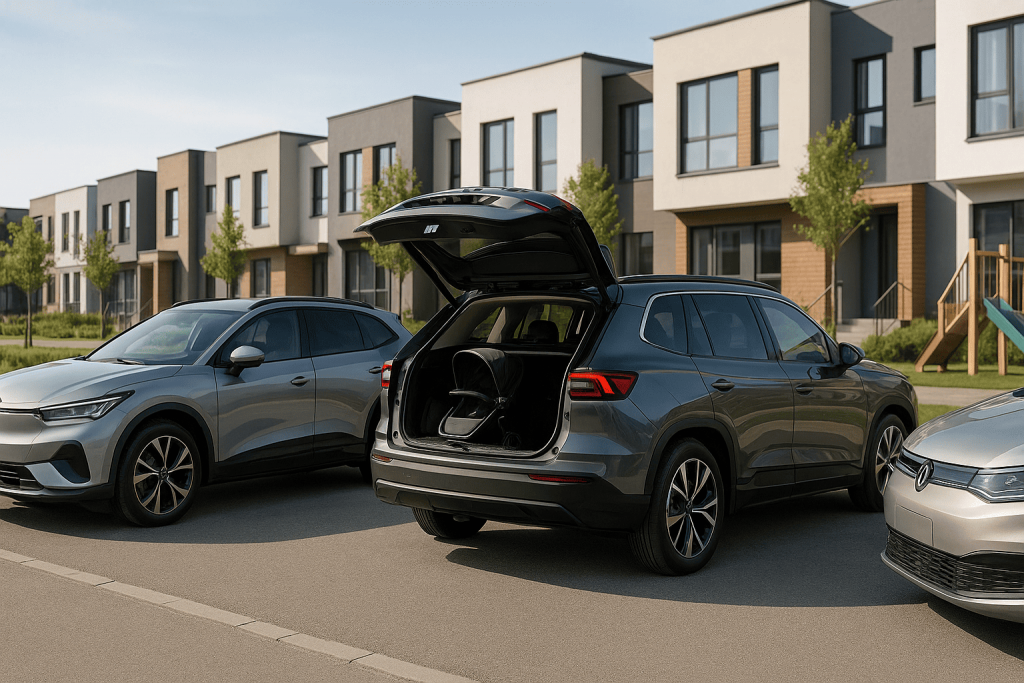
Choosing a family EV is less about 0–100 km/h and more about real life: fitting three child seats across, surviving a snowstorm school run, packing a stroller plus a week’s groceries, and doing it all safely, quietly, and affordably. This guide focuses on what matters for families—cabin space, crash safety, child-seat ergonomics, charging convenience, and ownership costs—then highlights the stand-out electric models that deliver.
What “family-ready” really means
A great family EV starts with a roomy second row and a usable third row if you need it. Look for wide-opening rear doors, flat floors, and at least two ISOFIX/LATCH anchors (three is better). Sliding or reclining second-row seats make mixed adult/kid duty easier. Big, square cargo openings beat flashy styling for loading prams and scooters. On the road, a calm ride, excellent visibility, and simple controls reduce fatigue; heated windscreen elements and a reliable heat pump are lifesavers in winter. Software should be your servant, not your hobby: clear menus, physical shortcuts for climate, and good voice control matter more than benchmark graphics.
Safety first: scorecards to trust
Families should prioritize models with recent Euro NCAP ratings, robust driver-assistance suites (AEB with vulnerable road-user detection, lane-keep assist that’s gentle not bossy, blind-spot intervention, rear cross-traffic braking), and solid structural protection for the second and third rows. Active driver-monitoring (camera-based attention checks) is more meaningful than hands-on wheel nags. Check for proper rear-seat belt reminders, rear-occupant alerts, and ISOFIX locations that don’t interfere with buckle access.
Charging without drama
For school-week life, AC charging at home, work, or a nearby curbside post will do most of the lifting; fast DC is for road trips and busy weekends. What matters is a predictable charge curve, smart pre-conditioning of the battery on the way to a fast charger, and 11–22 kW onboard AC for flexible overnight top-ups. If your city driving includes frequent short hops, efficiency (kWh/100 km), not peak kW, saves money and time.
Running costs and battery chemistry
Families value predictability. Cobalt-free LFP batteries are ultra-robust for daily 20–80% charging and tolerate frequent top-ups; NMC/NCA chemistries deliver more range and punch but like a bit more care at high state-of-charge. A heat pump, efficient cabin pre-heat, and good winter tires matter more for cost control than an extra 50 km of brochure range. Look for long battery and drive-unit warranties and transparent service schedules.
Best midsize family all-rounders (two kids, big boot, road-trip ready)
Tesla Model Y remains the pragmatic benchmark for space-to-footprint, charging network access, and efficiency. The flat load floor swallows strollers, the frunk adds messy-gear storage, and software-driven pre-conditioning makes fast charging reliably quick. If you want fuss-free long-distance travel, it’s a top pick.
Škoda Enyaq is the family whisperer: huge rear legroom, thoughtful storage, physical climate knobs on many trims, and a calm ride. It’s an easy recommendation for parents who value comfort and practicality over headline acceleration.
Nissan Ariya brings an exceptionally quiet cabin, supportive seats, a refined ride, and intuitive controls. The rear bench is adult-friendly, and ProPILOT assistance is confidence-inspiring rather than intrusive—ideal for tired commutes after kids’ activities.
Best large/3-row options (bigger crews, car-pool captains, multi-kid seats)
Kia EV9 sets the bar for true family flexibility: adult-usable third row, sliding/reclining second row, abundant USB-C everywhere, and clever storage. Its 800-V platform means short, predictable fast-charge stops on holiday migrations, and the square cargo bay is minivan-like when rows are folded.
Volvo EX90 blends a safety-first philosophy with a serene, high-quality interior. The driver-monitoring and sensor suite are among the segment’s best, and the third row suits kids comfortably. If you want the quietest cabin and top-tier assistance, it’s a standout.
Mercedes-Benz EQB offers a compact footprint with an optional child-friendly third row for occasional use. Easy ingress/egress and a practical boxy shape make school runs and tight city parking simpler than bigger seven-seaters.
Best van-shaped/MPV picks (box rules, gear haulers, weekend warriors)
Volkswagen ID. Buzz is the family charmer: sliding doors, a cavernous square cargo hold, and a bright, kid-friendly cabin. It’s as much rolling living room as car, and the upright seating is a gift on long drives. If your family life involves bikes, dogs, or DIY runs, the Buzz’s shape simply works.
Mercedes-Benz EQV suits big families or shuttle duty with limo-like space and a premium interior. It’s not the most efficient option, but for maximum seats and comfort without a diesel smell, it’s compelling.
Best value plays (smart money, urban families, low-stress ownership)
MG4 proves you don’t need a giant budget for a capable family EV: compact outside, roomy inside, efficient, and straightforward to live with. For two kids and city-first driving, it’s an easy recommendation.
Renault Scenic E-Tech focuses on family-friendly packaging, light, airy design, and strong efficiency. With sensible software and a quiet ride, it punches above its size for everyday comfort.
Nice-to-have features that actually help families
Three true ISOFIX points across the second row remove daily Tetris. Rear-zone climate with physical temperature toggles stops back-seat battles. A low cargo sill and a flat floor save your back. Vehicle-to-Load (V2L) runs a breast pump, laptop, or campsite kettle without hunting for sockets. A wipeable frunk keeps muddy boots and footballs out of the cabin. And don’t underestimate a good rear camera washer—winter grime is real.
Road-trip sanity: making holidays easy
For stress-free holidays, prioritize cars with reliable pre-conditioning to hit top charge power, accurate range prediction, and route planners that include weather and elevation. Arrive near 10–20% state of charge, leave around 80–85%, and schedule stops at kid-friendly hubs with play areas and clean facilities. If you tow, check rated towing capacity and that the charge network you plan to use has pull-through bays so you don’t need to unhitch.
Software, updates, and screen sanity
Over-the-air updates should fix bugs, not rewrite your muscle memory every month. Look for models with steady, well-supported software, physical shortcuts for defrost and temperature, and CarPlay/Android Auto if you prefer your own apps. Parental controls for speed/geo-fencing are a bonus when teens start learning.
Used family EVs worth a look
Good second-hand choices include earlier Tesla Model Y and Škoda Enyaq builds, the Hyundai Ioniq 5 for lounge-like space and 800-V charging, and the Volkswagen ID.4 for pragmatic value. Always request a battery health report, confirm heat-pump fitment for cold climates, and test child-seat installation before you buy.
Bottom line: pick the shape, then the spec
Start with the body style that matches your life—midsize crossover, true 3-row SUV, or van-shaped MPV—then filter by safety, second-row width, cargo access, winter features, and charging convenience. For many families, Tesla Model Y, Škoda Enyaq, and Nissan Ariya are the stress-free midsize choices; for bigger crews, Kia EV9 and Volvo EX90 lead; for box-first practicality, VW ID. Buzz is hard to beat. Value seekers should test MG4 and Renault Scenic E-Tech.
Conclusion
The best family EV is the one that removes friction from daily life: easy child-seat installs, quiet comfort on rough streets, predictable charging, and safety tech that watches your blind spots without nagging. Focus on space, safety, and simplicity first; let range and power follow. Do that, and the car becomes what it should be for a family—calm, capable background magic that makes every day a little easier.

HAH this aint 0–100 talk, its 3 kid seats + ISOFIX x3, wide doors, flat floor, square trunk