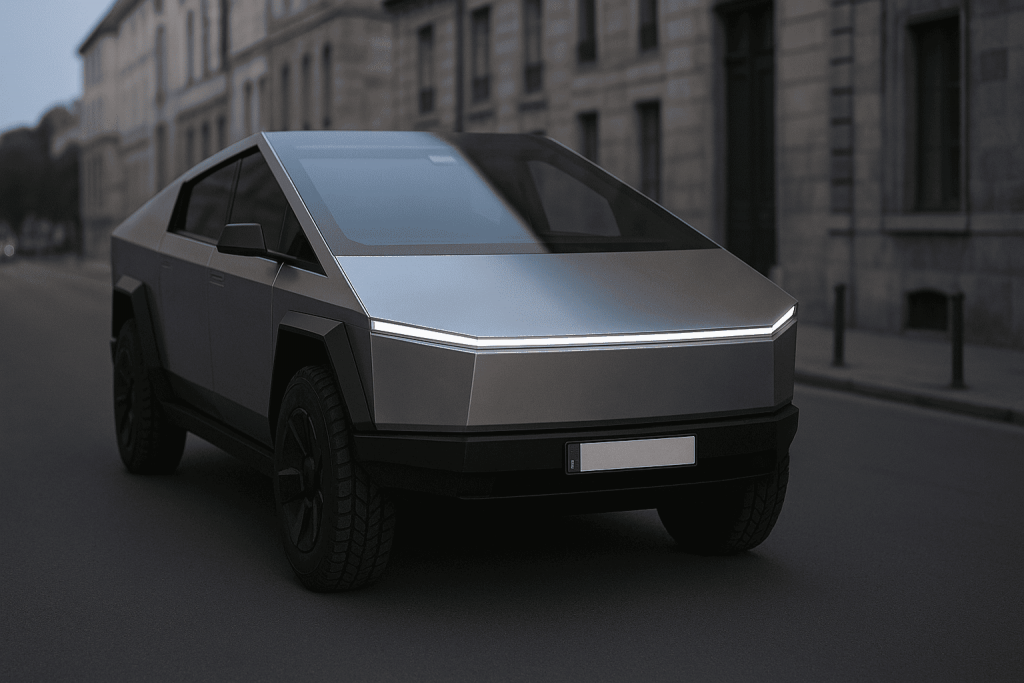
Can Tesla’s stainless-steel wedge actually roam European roads? The answer is: only after it clears a dense maze of safety rules, dimensional limits, and type-approval steps that differ sharply from the U.S. regime. Below is a practical, no-nonsense map of what would have to change (or be proven) for the Cybertruck to be legally sold or individually registered in EU and UK markets—and where the biggest hurdles lie.
First fork in the road: vehicle category (M1 vs N1)
Europe classifies cars by what they carry. If Cybertruck is approved as an M1 passenger car (most Teslas today), it faces the toughest pedestrian-protection and interior-safety bar. If it goes N1 light commercial (pickup as a work vehicle), some tests shift, but it then inherits commercial-vehicle limits (licensing, speed rules in some countries, tax treatment). The strategic choice affects everything from crash tests to company-car taxation.
General Safety Regulation (GSR2): mandatory ADAS baseline
For new EU type approvals (already in force) and soon all new registrations, vehicles must include: autonomous emergency braking (cars + VRU detection), intelligent speed assist (ISA), lane-keeping warning/assist, driver drowsiness/attention monitoring, reversing detection, event data recorder (EDR “black box”), and enhanced occupant-protection updates. Cybertruck’s software-heavy DNA helps, but each function must pass standardized performance tests, not just exist in menus.
Pedestrian protection and “soft” front-end design
EU pedestrian-safety tests use headforms and legforms to measure energy absorption across the bumper, bonnet leading edge, and bonnet surface. Ultrastiff, sharp-edged exteriors struggle here. Stainless body skins with minimal deformability must still deliver low head injury criteria (HIC) values and protect pelvis/leg zones. That typically demands engineered crush space, foam/pyro-latches, active-hood pop-up systems, and generous edge radii. Any “hard” styling line near the bonnet’s front edge is a red flag until it’s proven compliant.
External projections & edge radii
Protrusions, corners, and exterior trims are regulated for minimum radius and energy absorption. A planar, folded-metal aesthetic must be validated panel by panel so no leading edge counts as a hazardous projection. Expect detail re-tooling or local reinforcement + padding under skins to pass these checks.
Crashworthiness, airbags, and interiors
Beyond pedestrian protection, M1 approval requires full-frontal, offset, side, side-pole, whiplash, belt-reminder coverage, and robust airbag deployment logic for large cabins. Any unconventional steering yoke or single-screen UX must still deliver clear tell-tales, mandatory buttons (hazard, horn, defrost), and fail-safe ergonomics under UNECE rules—minimalism is fine but regulatory tell-tales and reachability can’t be sacrificed.
Cybersecurity & software updates
OTA is an advantage only if it meets UNECE cybersecurity (management system + threat analysis) and software-update regulations. That means secure boot, update integrity, version control, and traceability. Tesla already certifies these on other EU models; Cybertruck would need the same compliance documentation pack.
Mirrors, cameras, lighting, and signals
Camera-mirror systems are allowed, but they must pass strict field-of-view, latency, luminance, and failure-mode tests. Lighting needs E-marked components, correct beam patterns, auto-levelling where applicable, and mandatory amber rear turn signals (common U.S. red indicators won’t pass). Europe also requires rear fog lamps, side repeaters, reflective markers, and specific daytime running light behavior. Headlamp washers are required only for certain high-intensity systems—details depend on the fitted optics.
Acoustic Vehicle Alerting System (AVAS)
All EVs must emit a standardized low-speed sound profile forward and in reverse. Cybertruck would need an AVAS meeting the required frequency and volume windows up to prescribed speeds.
Dimensions, mass, licenses: the “will it fit?” questions
• Width: The EU general width limit for light vehicles is 2.55 m (excluding mirrors). Cybertruck’s body-in-white sits well under that, so width alone isn’t a blocker.
* Length & height: No special issues—urban parking and turning circles are practical concerns, not regulatory ones.
* Mass (GVWR): If the EU-spec GVWR exceeds 3,500 kg, standard B-license drivers and passenger-car tax/insurance classes become trickier in many countries (C1 licensing, different tolls/speed rules). Strategically keeping GVWR ≤3.5 t simplifies life, but payload/towing ratings must be engineered accordingly.
Towing, hitches, and trailer electrics
EU-approved tow bars require type-approval, specific D-values, and a 13-pin trailer socket with lamp-out detection. Trailer stability assistance is expected on family vehicles. If Cybertruck targets heavy towing, it must show compatible cooling, braking reserves, and rear-underrun geometry that won’t breach pedestrian or rear-impact rules.
Brakes, tyres, splash protection
Large, heavy EVs must evidence fade resistance, regenerative-to-friction blending safety, and tyre load indexes that match axle weights. Some countries require rear mud-guards/splash protection geometry that pickups from the U.S. don’t natively include—small but common homologation tweak.
Charging hardware and connector standards
Europe expects CCS2 (IEC 62196-3) for DC fast charging and Type 2 for AC, with approved inlet, proper locking, and standardized communication (ISO 15118 “Plug & Charge” optional but increasingly common). A U.S. NACS-only port would not pass EU whole-vehicle type approval; either a CCS2 inlet or a manufacturer-level, certified adapter solution would be needed. Onboard AC of 11–22 kW is typical; DC charge curves must be thermally stable and interoperable with EU stations.
Noise, eCall, and misc. obligations
Mandatory eCall (emergency-call) is required for M1; specific exterior noise tests apply (EVs are quiet but still tested). Windscreen, glazing, wipers, demist/defrost performance, and interior materials flammability/markings are all checked against UNECE annexes—routine for an established OEM but each variant must be documented.
Type-approval pathways: WVTA, small-series, or IVA
• EU Whole Vehicle Type Approval (WVTA): full commercial sale across member states—most demanding, most valuable.
* Small-series (SSV): caps the number of units per year with some test relaxations—useful bridge for niche trucks.
* Individual Vehicle Approval (IVA/SVA): case-by-case national registration—common for early grey imports but not a scalable sales plan.
Where Cybertruck likely needs re-engineering
1) Front-end “softening” for pedestrian head/leg impacts—hidden crush structures, active bonnet, larger radii on leading edges.
2) Lighting/signals package with EU-spec E-marked components and amber rears.
3) Connector strategy (CCS2 port and interop validation).
4) Mass management to hit the 3.5-tonne GVWR sweet spot if M1 aspirations remain, or a clear N1 strategy with commensurate positioning.
5) Detail trims (mud-flaps/splash geometry, reflectors, rear fog, trailer electrics), plus any minor interior tell-tales/controls differences.
Timing & market reality
Even with Tesla’s EU compliance experience (Model 3/Y/S/X), a radically different body concept means a fresh certification program—component, system, and whole-vehicle—plus Euro NCAP testing if Tesla wants the safety-rating halo that drives family sales. A small-series or national route could appear earlier, but full EU WVTA for volume requires that front-end and mass questions be decisively answered.
Bottom line for Europe
Nothing in EU law bans a stainless, angular pickup per se. The gatekeepers are measurable injury criteria, ADAS performance, interoperable charging, and weight/licensing thresholds. If Tesla adapts the Cybertruck’s front-end energy absorption, finalizes an EU-native lighting/CCS2 package, and manages GVWR, certification is a complex but solvable engineering project—not an impossibility. The wedge can make it to Europe, but only after it gets a little softer where it counts and a little more European in the details.
Conclusion
Cybertruck’s European journey is less a courtroom drama and more an engineering audit. Meet GSR2’s ADAS rules, tame the front-end for pedestrians, fit EU-spec lights and connectors, and mind the 3.5-tonne line—and doors open to WVTA and real sales. Skip those steps, and the truck remains a curiosity on special plates. Europe doesn’t ask Cybertruck to lose its identity; it asks it to prove safety, play nicely with the grid, and fit inside a well-defined rulebook.