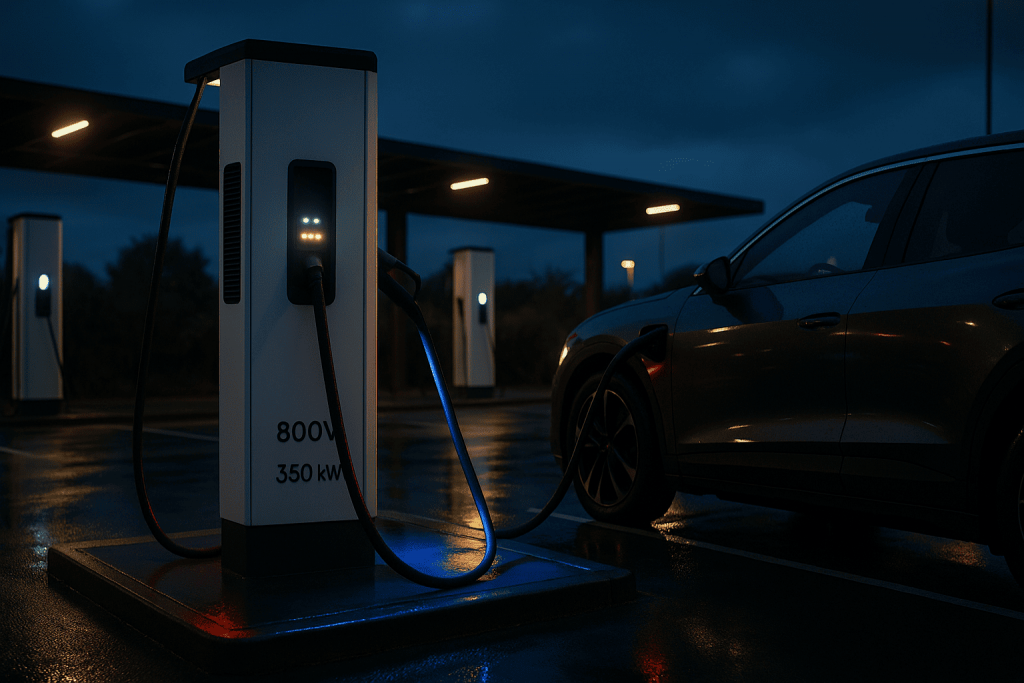
Ultra-fast charging (UFC) aims to shrink a coffee break into the time it takes to order one. Delivering 10–80% in roughly 10–15 minutes is no longer a moonshot—it’s an engineering problem spanning electrochemistry, thermal physics, power electronics, and grid orchestration. This article unpacks how batteries accept such intense power, what actually limits charge speed, and which technologies are breaking the bottlenecks.
The physics of “why it slows down”
Every lithium-ion cell fights three charging bottlenecks: ohmic resistance in current collectors and electrolyte; charge-transfer kinetics at the electrode/electrolyte interface; and mass transport inside porous electrodes. Early in a charge, ions cruise through with relatively low resistance. As voltage rises and the anode fills with lithium, the interfacial reaction and diffusion through tortuous pores become limiting. To avoid damage, the charger tapers from high constant-current (CC) to a constant-voltage (CV) soak—hence the familiar “fast at first, slow at the top.”
Cold batteries hate fast charging
Below roughly 15 °C, lithium ions intercalate sluggishly into graphite. Push current too hard and lithium plates as metallic whiskers on the anode surface—an irreversible loss of capacity and, in worst cases, a safety hazard. The universal remedy is pre-heating: modern EVs warm the pack en route to a fast charger, shifting from diffusion-limited to kinetics-friendly conditions so higher current is safe.
C-rates, current density, and what “350 kW” really means
Power headlines (150–350 kW) mask the cell-level reality: current density per square centimeter of electrode. Thicker electrodes raise energy but slow ion transport; thinner electrodes enable higher C-rates but add inactive materials and cost. The art is balancing electrode thickness, porosity, and tortuosity so cells can absorb multi-C bursts without starving internal regions of ions.
Electrolytes, additives, and the SEI
Charging creates and reforms the solid-electrolyte interphase (SEI) on the anode. A robust SEI lets lithium shuttle quickly while blocking solvent breakdown. Additives like FEC and VC, high-concentration and localized high-concentration electrolytes (HCE/LHCE), and LiFSI salts tune viscosity, ionic conductivity, and interfacial chemistry so high-current pulses don’t shred the SEI. The goal is a low-impedance, stable interphase that survives thousands of fast-charge events.
Graphite today, silicon tomorrow, lithium metal later
Graphite remains the workhorse for its stability and cost, but it limits peak charge rate. Silicon-rich anodes store far more lithium, unlocking higher power and better cold-weather acceptance—provided swelling is controlled with nano-structuring, elastic binders, and smart SEI chemistry. Lithium-metal anodes in solid-state batteries promise a step-change in energy and potentially fast charge, but require solid electrolytes and interfaces that suppress dendrites at high current.
Cathodes and cobalt-lean directions
On the cathode side, high-nickel NMC/NCA chemistries deliver energy but can heat up under heavy currents. LFP and LMFP trade some energy density for excellent thermal behavior, long life, and increasingly impressive fast-charge curves when paired with advanced pack designs. Material choice now reflects not just range, but how much power a pack can swallow repeatedly without aging out.
Electrode architecture: where minutes are won or lost
Fast-charge-ready cells engineer pore networks for straight-through ion highways, reduce tortuosity with tailored particle sizes, and use conductive additives to de-bottleneck electron pathways. Tabless current collectors, thicker foils where needed, and low-resistance coatings trim ohmic losses so less heat is generated per amp delivered.
Thermal management is the silent hero
At 300 kW, even a few milliohms create significant heat. Packs that charge quickly use aggressive thermal strategies: large-area cold plates, dual-loop liquid circuits, refrigerant-direct cooling, or immersion cooling with dielectric fluids. Uniform temperature prevents local hot spots that catalyze side reactions, allowing higher average current before tapering is required.
Charging curves: beyond basic CC-CV
Classic CC-CV works, but smarter profiles go further. Pulsed currents relax concentration gradients; staged currents hit the envelope aggressively, then back off just before interfacial limits; model-predictive control adapts in real time to cell impedance and temperature. The result is the same delivered energy with fewer seconds spent tapering at the top of charge.
The 400 V vs 800 V question
Higher system voltage halves current for the same power, reducing cable and busbar losses and making heat easier to manage. That’s why 800 V platforms routinely post the best fast-charge times: less I²R loss, leaner wiring, lighter connectors, and happier power electronics. 400 V cars can still charge rapidly with booster converters, but at a packaging and cost penalty.
Chargers, cables, and contactors
Station hardware matters as much as the car. Liquid-cooled cables keep conductor cross-sections reasonable at 500 A+, while wide-bandgap semiconductors (SiC) in rectifiers and DC/DC stages raise efficiency and shrink cabinets. Accurate handshake protocols negotiate max current in milliseconds, and contactors sized for repeated high-power cycling close the loop safely.
Degradation under the microscope
Fast charging ages cells primarily via lithium plating, SEI thickening, micro-cracking (especially in silicon), and transition-metal dissolution at high cathode potentials. The antidote is to operate in a “goldilocks window”: warm-not-hot temperatures, shallow-not-deep SOC swings for the fastest segments, and minimal time parked at very high SOC. With these guardrails, the lifetime hit from regular high-power use can be surprisingly modest.
What owners can do to consistently see “coffee-break” times
Precondition the pack before arrival. Start low (10–20% SOC) so the session spends more time in the high-power zone. Unload roof boxes and big aero add-ons before road trips to reduce energy backfill. Charge to what you need (often 70–85%), not to 100%, unless the next leg requires it. In winter, prefer back-to-back shorter hops over a single deep discharge to keep the pack warm and power-hungry.
Safety engineering you don’t see—but benefit from
Fast-charge-capable packs layer safety: ceramic-coated separators, current-interrupt devices, pressure relief, cell-level fusing, and high-resolution sensing. Pack controllers cross-check voltage, temperature gradients, and impedance rise to spot early signs of plating or gas generation. If any parameter drifts, the car silently tapers power or pauses, protecting longevity and safety.
From cells to packs to platforms
Cell chemistry is only the first act. The second is pack integration—cell-to-pack/chassis (CTP/CTC) architectures shave inactive mass so cooling hardware can be upsized without weight penalties. The third is the vehicle platform—short, low-resistance DC paths and power electronics designed for sustained high current. When all three align, the stopwatch looks impressive.
Megawatt charging and the truck frontier
For heavy-duty vehicles, the physics stay the same but the scale jumps. Megawatt Charging System (MCS) connectors, beefy liquid-cooled cables, and buffer batteries at depots smooth brutal grid peaks. Cell designs favor immense power density, fierce thermal systems, and smart scheduling so trucks arrive preconditioned and leave within mandated rest windows.
Grid reality: where all those kilowatts come from
High-power hubs increasingly pair with on-site storage, solar canopies, and dynamic load management. Buffer batteries soak up midday renewables and discharge during the evening rush, keeping the local feeder happy. Price signals nudge drivers toward off-peak windows, and as V2X matures, parked fleets may return power to stabilize the same grid that just fueled them.
Solid-state and other horizons
Solid-state promises safer, denser packs and potentially shorter charge times if interfaces can handle high current without dendrites. Meanwhile, silicon-heavy anodes, LMFP cathodes, advanced electrolytes, and tabless collectors are already moving the needle. Expect incremental gains—two minutes here, five minutes there—compounding into genuinely “refuel-like” experiences by the end of the decade.
The user experience layer
Great hardware can be undone by mediocre UX. The best systems route you to working stalls, pre-condition automatically, show truthful power curves, and bill per kWh with no mystery fees. Reservation windows, pull-through bays for trailers, and reliable tap-to-pay trim the friction that used to make fast charging feel anything but fast.
Myths to retire
Ultra-fast charging does not always mean 350 kW flat; smart tapering is a feature, not a bug. Big batteries are not mandatory for fast charge; thermal design and cell architecture matter more. Frequent fast charging does not doom a pack if temperature and SOC windows are controlled. And 800 V isn’t just marketing—it’s physics helping you leave sooner.
What “good” looks like on a trip
Arrive with a warm pack near 10–20%, plug into a reliable high-power stall, watch power ramp fast, and leave between 70–85% after a short break. Repeat once or twice depending on distance and weather. You spend more time driving and less time waiting because the car, the charger, and the grid worked as a coordinated system.
Conclusion
Ultra-fast charging succeeds when chemistry, architecture, cooling, software, and infrastructure pull in the same direction. Pre-heated packs avoid plating, low-impedance cells welcome high current, advanced profiles minimize taper, 800 V platforms slash losses, and smart hubs keep the grid composed. Piece by piece, these advances are turning minutes saved into the default—making EV pit stops feel less like a workaround and more like the natural rhythm of electric travel.


why charge fast then sloooow down at the top 📈