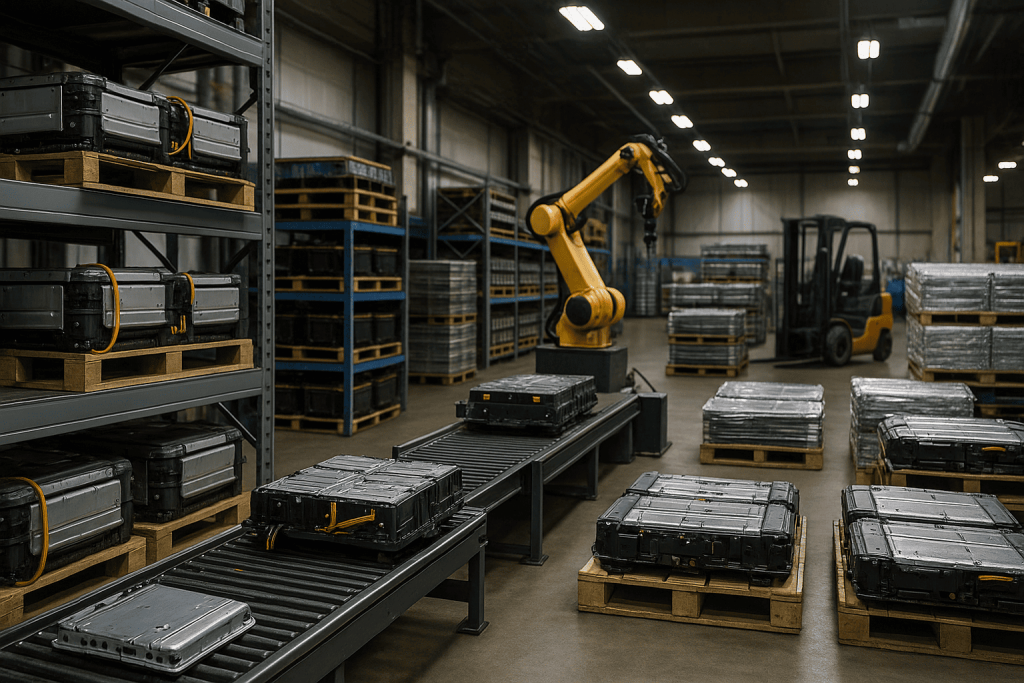
Electric vehicles are scaling fast, but their true sustainability will be judged not only by zero tailpipe emissions, but by what happens to their batteries after the first drive cycle. The good news: an emerging circular ecosystem—spanning diagnostics, repurposing, and high-yield recycling—is transforming EV packs from future waste into long-lived energy assets. This article maps the full journey from end-of-vehicle life to second life and back into raw materials, explaining the technology, economics, and design choices that make battery circularity work at scale.
From “End of Life” to “End of First Life”
Most EV packs retain 70–80% of original capacity when vehicles are retired or when owners demand longer range. That does not make them “dead”; it makes them perfect for less power-dense applications. The industry is shifting its language accordingly: the first life is traction; subsequent lives are stationary storage, backup power, and other applications that value capacity over peak power output.
Why Second Life Matters
Repurposing extends useful life, defers the energy and emissions tied to recycling, and cuts the levelized cost of storage for homes, buildings, and grids. It also smooths critical-mineral demand by getting more service out of each kilogram of lithium, nickel, manganese, and copper already mined. For automakers, it turns a potential liability into a revenue stream and strengthens ESG outcomes through measurable waste avoidance.
Inside the Assessment: From Pack to Cell
Before a battery earns a second career, it passes through a triage process. Non-invasive diagnostics read the pack’s BMS to estimate state of health (SoH), impedance growth, and cycle history. If the pack is promising, technicians perform module-level tests and, where needed, open the enclosure for cell sampling. The result is a grading map: A-grade modules head to stationary storage, B-grade may serve in lower-duty applications, and failed units are tagged for material recovery.
Top Second-Life Use Cases
Residential storage: retired EV modules empower solar self-consumption and provide backup during grid outages. Home systems value capacity and modest power levels, matching aged cells well.
Commercial and industrial peak shaving: sites with demand charges use second-life racks to limit costly spikes. Thermal management is simpler than in vehicles, further easing aging stress.
Grid services: distributed batteries earn revenue from frequency regulation, voltage support, and local flexibility tenders—especially when aggregated by software platforms.
Microgrids and remote sites: second-life storage paired with solar or wind displaces diesel generation, cutting fuel costs and emissions in islands, mines, and rural communities.
Engineering a Safe Second Life
Repurposed modules are placed in new enclosures with purpose-built battery management systems, fusing, contactors, and isolation monitoring. Firmware is retuned for lower C-rates, narrower state-of-charge windows, and conservative temperature limits. Thermal systems are often simpler—air or mild liquid cooling—because stationary cycling is gentler. Safety cases follow IEC/UL standards for stationary storage and include fire detection, off-gas venting, and clear service procedures for first responders.
Design for Disassembly: Building Tomorrow’s Circular Packs
Battery makers are redesigning packs so they come apart quickly. Fasteners replace permanent adhesives where possible; connectors are keyed and labeled; modules are standardized; and QR-coded “battery passports” store origin, chemistry, and service data. Immersive cooling plates, while great for fast charging, are being rethought to simplify module extraction. Every minute saved on disassembly lowers repurposing and recycling costs at scale.
Chemistry Considerations
LFP (lithium iron phosphate) packs are durable, cobalt-free, and thermally stable—excellent candidates for extended second life. NMC/NCA packs deliver higher energy density in vehicles but may show faster impedance growth; with careful derating they still serve well in stationary roles. Sodium-ion is emerging for low-cost storage with strong cold-weather performance, and its element abundance eases supply constraints. Each chemistry needs tailored BMS limits and thermal strategies in second life.
Economics That Add Up
The second-life business model balances module acquisition cost, testing and refurbishment labor, enclosure and BMS integration, and warranty provisions, against multiple revenue streams: energy arbitrage, demand-charge reduction, capacity payments, and ancillary services. Where grid tariffs reward flexibility, repurposed systems can hit competitive levelized costs of storage. Fleet owners benefit most: they control pack provenance, logistics, and residual values, and can design vehicles with second-life in mind.
Recycling: Closing the Loop When Reuse Is Done
When modules finally fall below useful thresholds—or arrive damaged—recycling begins. Modern, high-yield pathways now dominate:
Hydrometallurgy: mechanical shredding produces “black mass,” then aqueous leaching and selective precipitation recover lithium, nickel, cobalt, manganese, and graphite with high purity.
Pyrometallurgy: smelting concentrates valuable metals but may sacrifice lithium and graphite; many plants now hybridize with hydromet steps to raise overall recovery.
Direct recycling: emerging lines preserve cathode crystal structure for relithiation and re-coating, cutting energy use and allowing near-closed-loop material flows.
Output streams feed directly back into new cathode active materials, copper foils, aluminum, and graphite, shrinking the carbon footprint of next-generation cells.
Logistics, Compliance, and Safety
Transporting high-voltage batteries requires UN38.3-tested packaging, hazardous-goods documentation, and trained handlers. Repurposing facilities invest in fire-safe storage, cell isolation procedures, and automated discharge bays. Clear chain-of-custody records protect both sellers and refurbishers, while digital passports simplify compliance and speed insurance approvals.
Warranty and Responsibility
Second-life providers typically warranty capacity retention and cycle life under specified duty profiles. Automakers increasingly partner with recyclers and energy companies to retain ownership or buyback rights, ensuring responsible end-of-life handling. Transparent data sharing—charge counts, temperatures, fault codes—underpins credible warranties and fair pricing.
Quality Assurance and Analytics
AI-driven diagnostics correlate impedance spectra, temperature histories, and usage patterns to predict future performance. Module matching—pairing units with similar health—keeps pack balance tight and extends life. Continuous monitoring flags drift early and schedules preventive maintenance before faults propagate.
Policy Levers That Accelerate the Loop
Effective regulations align incentives around high recovery and safe reuse: clear definitions of waste vs. product, harmonized testing standards for repurposed systems, extended producer responsibility that allows credit for second life, and targets for recycled content in new cells. Public procurement can jump-start demand by specifying second-life storage for schools, depots, and municipal buildings.
Social and Environmental Impact
Second-life deployments bring resilience—keeping lights on during outages and buffering community solar. Recycling reduces mining pressure, water use, and habitat disruption. Transparent supply chains and circular jobs in refurbishing, logistics, and chemistry create local economic value while cutting global externalities.
Practical Playbook for Fleets and Developers
Capture pack data from day one; standardize module formats across models; design enclosures for rapid removal; set up buyback and refurbishment partnerships early; co-locate second-life assembly near de-fleeting hubs; and prequalify recycling partners with demonstrated recovery yields and environmental controls. Treat the pack as an asset that will change roles over time, not as a consumable.
The Road Ahead
As volumes surge, second-life and recycling will professionalize into parallel industries with shared data rails. Battery passports will make traceability routine. Direct recycling will mature, shrinking energy use and enabling high recycled content in new cathodes. Vehicle-to-everything (V2X) will blur lines between first and second life as cars themselves deliver grid services during their driving years.
Conclusion
Batteries are not disposable; they are multi-decade energy assets. With rigorous diagnostics, thoughtful repurposing, and high-recovery recycling, the EV ecosystem can minimize waste, stabilize grids, and curb dependence on virgin materials. The sustainable EV future is not only about cleaner miles—it is about keeping every electron of material working harder and longer, from the first drive to the final crystal reborn in a brand-new cell.

so my old ev battery aint dead, its just on its “2nd life” lol 💀