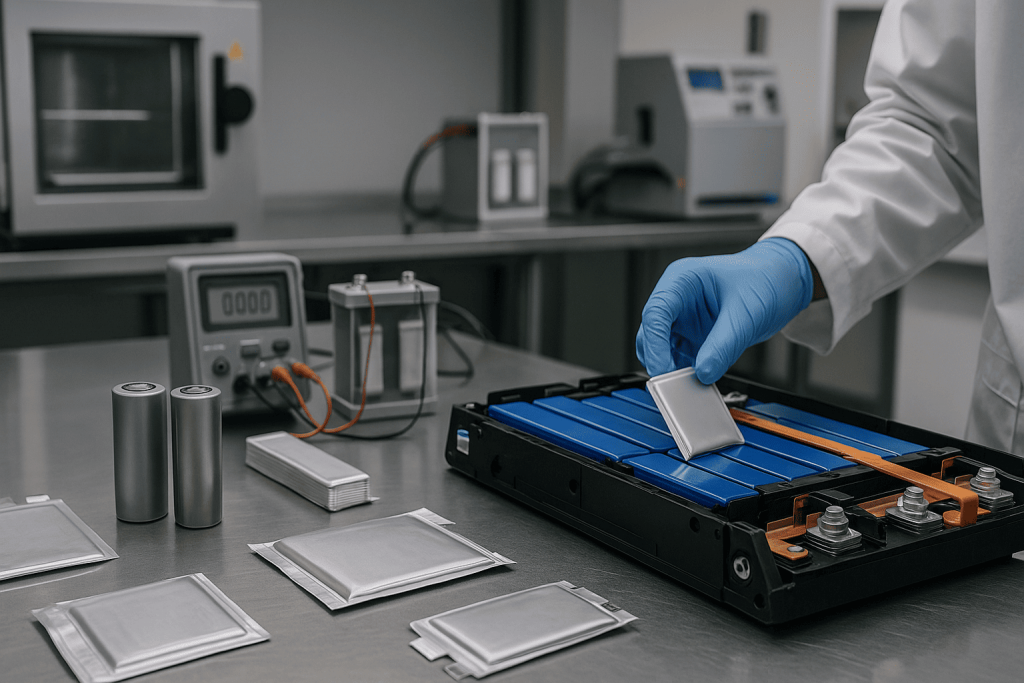
For more than a decade, lithium-ion (Li-ion) has been the workhorse of electric vehicles, steadily improving in cost, safety, and performance. But as EVs push toward longer range, faster charging, lower prices, and lighter packs, a new class of chemistries and architectures is moving from lab benches to pilot lines. From solid-state cells to sodium-ion and lithium-sulfur, the post–Li-ion landscape is taking shape—and it could redefine how we design, build, and recycle electric cars.
Why look beyond today’s lithium-ion?
Conventional Li-ion cells (NMC, NCA, LFP) are converging on impressive metrics—sub-$100/kWh at pack level for some formats, rapid 10–80% charging in ~20 minutes, and 1,000–3,000 full cycles. Yet physics and materials constraints remain: flammable liquid electrolytes, graphite anodes that limit charge rate, nickel/cobalt cost and sourcing issues, and a trade-off between energy density and longevity. Next-gen batteries aim to break these trade-offs: higher specific energy, safer operation, abundant materials, and manufacturing routes that scale without exotic supply chains.
Solid-state batteries (SSB): high energy, safer by design
SSBs replace flammable liquid electrolyte with a solid (sulfide, oxide, or polymer). The holy grail pairing is a lithium-metal anode and high-voltage cathode, promising 30–80% higher energy density and much lower thermal-runaway risk. The challenges are interfacial resistance, dendrite suppression, stack pressure, and manufacturability at automotive speeds. Two major paths are emerging: sulfide-based SSBs targeting high power and fast charging for performance EVs, and oxide/polymer variants prioritizing manufacturability and cycling stability. Expect early deployments first in premium or short-range niche vehicles and then broader rollouts as costs fall and gigafactory tooling matures.
Silicon-rich anodes: turbocharging today’s cells
Even without going fully solid-state, swapping part of the graphite anode for silicon can boost energy density and fast-charge capability. Silicon binds far more lithium than graphite, but it swells dramatically and can crack. The industry answer is silicon-oxide blends, nano-structuring, and clever binders/electrolyte additives. Results: 10–30% energy-density gains, strong cold-weather performance, and 10–80% charging in the low-teens of minutes—ideal for mass-market EVs that must balance cost and performance.
LFP 2.0 and LMFP: cobalt-free gets a power boost
Lithium iron phosphate (LFP) won the affordability race with long cycle life and strong safety—but historically lagged in energy density. Cell-to-pack (CTP/CTB) architectures, elongated “blade” formats, and manganese-doped cathodes (LMFP) are closing the gap, targeting mid-range EVs with robust durability and excellent fast-charge behavior. Expect LMFP to sit between LFP and high-nickel NMC on energy, while keeping costs and supply-chain risks low.
Sodium-ion (Na-ion): lithium-free and winter-friendly
Sodium is abundant and cheap, and Na-ion cells work well at low temperatures, making them attractive for compact city EVs and hybrids of battery + supercapacitor. Today’s Na-ion packs trade energy density (roughly LFP-minus-20–30%) for cost resilience and supply diversity. Blended packs—mixing Na-ion and LFP modules—could deliver balanced performance in price-sensitive segments while easing lithium demand during boom cycles.
Lithium-sulfur (Li-S): ultralight ambitions
Li-S replaces heavy metal oxides with sulfur, promising very high specific energy and ultra-light packs for long-range or off-road EVs. The roadblocks are the polysulfide “shuttle” effect, volumetric expansion, and limited cycle life. Advances in cathode confinement, interlayers, and electrolyte design are promising, but Li-S is likely to start in drones, aviation, or specialty vehicles before mainstream cars.
Lithium-air and multivalent batteries: the long game
Concepts like lithium-air (Li-O₂) or magnesium/calcium-ion target energy densities rivaling liquid fuels. They remain early-stage due to oxygen management, parasitic reactions, and sluggish ion transport. Their main contribution today is pushing the frontier on catalysts, electrolytes, and membranes—research that often flows back into more near-term chemistries.
Architectural revolutions: cell formats and pack integration
Breakthroughs don’t end at chemistry. Large-format cylindricals (e.g., 46-series), prismatic “long cells,” and true cell-to-chassis integration reduce inactive mass and cost. Immersed-cooling and shared cold plates enable ultra-fast charging without thermal stress. Advanced BMS with physics-informed state-of-health models, impedance tracking, and cell-level fusing improve safety and longevity—especially important for silicon-rich and solid-state cells.
Fast charging without compromise
Next-gen EVs will normalize 10–80% in 10–15 minutes. That requires anodes that accept ions quickly (silicon blends or lithium-metal with engineered interfaces), electrolytes that curb plating, precise thermal management, and grid-friendly charging profiles. On the grid side, buffer batteries and dynamic pricing will keep depots and hubs from spiking demand as fast-charge power rises.
Sustainability, supply chains, and battery passports
New chemistries must win not just on specs but also on carbon and ethics. Cobalt-lean or cobalt-free cathodes, sodium-based options, and recyclable solid electrolytes help. “Battery passports” that track origin, carbon intensity, and repairability will reward designs that simplify disassembly (fewer adhesives, more fasteners), enable cell replacement, and support high-yield material recovery (Ni, Li, Mn, Cu, Al, graphite/silicon). Closed-loop feedstocks will be crucial as EV volumes scale.
Second life and V2X readiness
Next-gen cells will be designed for their second career: stationary storage. Chemistries with gentle aging curves (LFP/LMFP, Na-ion) slot neatly into community batteries and solar buffering. Meanwhile, solid-state and silicon-rich packs with robust cycle life can serve vehicle-to-home (V2H) and vehicle-to-grid (V2G), earning revenue and stabilizing renewables while preserving warranty limits via smart depth-of-discharge windows.
Manufacturing reality: from pilot to gigafactory
The winners will be those that retrofit into existing lines or require minimal new capex. Silicon-enhanced graphite drops into current anode lines. LFP/LMFP leverage mature iron/manganese supply and established coating processes. Solid-state must prove high-speed stacking, dry-room compatibility, and long-life interfaces at automotive yields. Cost curves will bend as learning rates compound and materials move from specialty to commodity markets.
What it means for drivers
In the near term, expect three parallel tracks: affordable cobalt-free packs (LFP/LMFP) in mass-market models; silicon-boosted NMC for long-range and fast-charge premium EVs; and early solid-state entries at the high end. By late decade, sodium-ion will anchor value EVs and commercial fleets in colder regions, while maturing solid-state migrates down-market. Range anxiety fades, charging becomes a coffee break, and battery warranties extend as software and materials co-evolve.
Conclusion
The future of EV batteries is not a single silver bullet but a toolkit. Solid-state promises step-change energy and safety; silicon delivers near-term speed and density; LFP/LMFP and sodium-ion bring affordability and resilient supply; and emerging chemistries like Li-S hint at ultralight possibilities. Layered with smarter pack design, rigorous recycling, and V2X integration, these advances will push EVs beyond parity into clear superiority—cleaner, cheaper, and more capable than any combustion alternative.