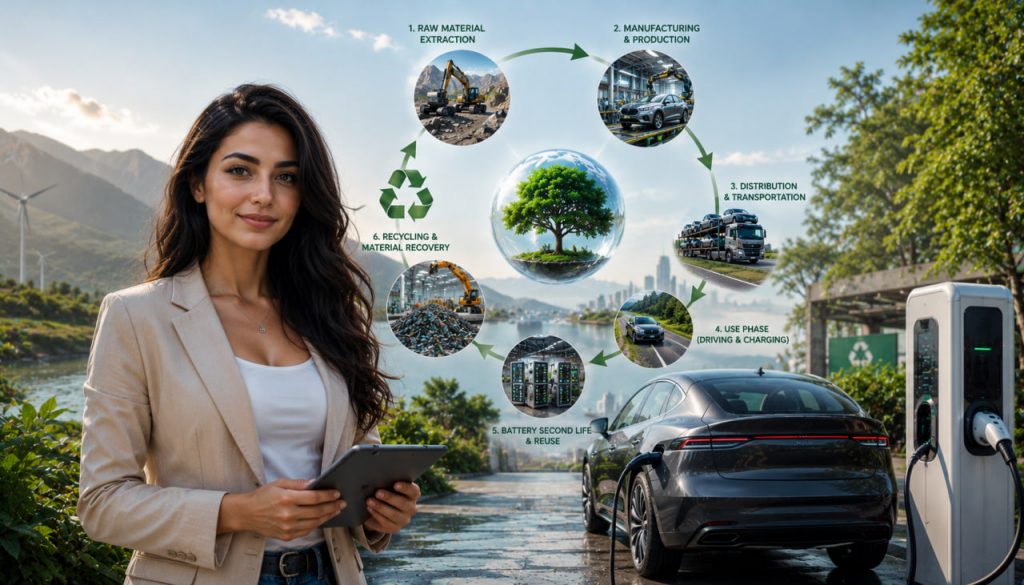
Electric vehicles are often presented as one of the most important technologies for reducing greenhouse gas emissions and combating climate change. Governments around the world are promoting EV adoption, automakers are investing billions in electrification, and consumers increasingly view electric cars as a cleaner alternative to traditional vehicles.
However, assessing the true environmental impact of an electric vehicle requires looking beyond the absence of tailpipe emissions. A complete evaluation must consider the entire life cycle of the vehicle—from raw material extraction and manufacturing to daily operation, battery recycling, and end-of-life processing.
This approach is known as Life Cycle Assessment (LCA), and it provides a far more accurate picture of environmental sustainability.
The reality is more complex than the simple question of whether EVs are “green” or “not green.” Instead, the environmental impact depends on how vehicles are produced, powered, used, and recycled.
What Is a Vehicle Life Cycle Assessment?
A Life Cycle Assessment examines every major stage of a vehicle’s existence.
These stages typically include:
- raw material extraction
- component manufacturing
- vehicle assembly
- transportation and distribution
- daily operation
- maintenance
- battery recycling
- end-of-life processing
The goal is to measure the total environmental footprint rather than focusing on a single phase.
For electric vehicles, this broader perspective is essential because some impacts occur during production, while major benefits occur during operation.
The environmental story of an EV cannot be understood by looking at emissions alone.
Stage One: Raw Material Extraction
The life cycle begins with mining and resource extraction.
Electric vehicles require materials such as:
- lithium
- nickel
- cobalt
- graphite
- copper
- aluminum
- steel
Extracting these resources can result in:
- habitat disruption
- land use changes
- water consumption
- energy use
- emissions from mining equipment
Battery materials often receive the most attention because they are critical to EV production.
However, conventional vehicles also require extensive mining for steel, aluminum, oil extraction infrastructure, and numerous industrial materials.
The environmental impact at this stage depends heavily on mining practices, regulations, and energy sources.
Stage Two: Manufacturing and Battery Production
Vehicle manufacturing is one of the most carbon-intensive phases of an EV’s life cycle.
Battery production requires:
- energy-intensive refining
- advanced processing facilities
- chemical manufacturing
- transportation of raw materials
As a result, a newly produced electric vehicle often begins its life with a larger manufacturing carbon footprint than a comparable gasoline vehicle.
This difference primarily comes from battery production.
However, the size of this footprint varies dramatically depending on:
- battery chemistry
- factory efficiency
- electricity sources
- supply chain design
Factories powered by renewable energy can significantly reduce manufacturing emissions.
Many automakers are investing in cleaner production facilities to lower the environmental impact of battery manufacturing.
Stage Three: Transportation and Distribution
Before reaching customers, vehicles and components must be transported through complex global supply chains.
This process may involve:
- ships
- trucks
- rail systems
- warehouses
- distribution centers
Transportation contributes additional emissions to both EVs and conventional vehicles.
Manufacturers are increasingly attempting to shorten supply chains and improve logistics efficiency.
Although this stage is not usually the largest contributor to total emissions, it remains an important part of the overall life cycle.
Stage Four: Daily Operation
This is where electric vehicles typically gain their largest environmental advantage.
Unlike gasoline and diesel vehicles, EVs produce no direct tailpipe emissions.
Benefits include:
- reduced carbon emissions
- lower air pollution
- reduced nitrogen oxides
- fewer particulate emissions
- improved urban air quality
The environmental impact of operation depends largely on the electricity source.
Charging an EV using:
- solar power
- wind energy
- hydroelectric power
- nuclear energy
results in significantly lower emissions than charging with electricity generated primarily from coal.
According to the International Energy Agency, electric vehicles generally produce lower lifecycle emissions than conventional vehicles in most regions, particularly where cleaner electricity generation is available.
The longer an EV is driven, the more its operational advantages offset manufacturing emissions.
The Carbon Payback Period
A key concept in EV sustainability is the carbon payback period.
Because EV manufacturing can generate more emissions initially, there is a point at which lower operational emissions compensate for that difference.
This point varies depending on:
- vehicle size
- battery capacity
- driving distance
- electricity mix
In many cases, studies suggest EVs recover their manufacturing emissions disadvantage after several years of normal driving.
After that point, the environmental benefits continue growing.
Maintenance and Long-Term Use
Electric vehicles generally require less maintenance than conventional vehicles.
They have fewer moving parts and do not require:
- oil changes
- exhaust system repairs
- fuel system maintenance
- transmission servicing
This can reduce:
- replacement parts
- maintenance waste
- resource consumption
Longer vehicle lifespans can further improve sustainability by spreading manufacturing impacts across more years of use.
Battery Longevity and Second-Life Applications
Modern EV batteries often retain substantial capacity even after vehicle service ends.
Instead of immediate disposal, batteries may be reused in:
- home energy storage
- commercial backup systems
- renewable energy projects
- grid stabilization systems
These second-life applications extend the usefulness of battery materials and improve overall lifecycle efficiency.
The concept is becoming increasingly important as EV adoption grows globally.
Stage Five: Recycling and End-of-Life Processing
The final stage of the life cycle involves recovery and recycling.
Modern recycling technologies can recover materials including:
- lithium
- nickel
- cobalt
- copper
- aluminum
- steel
Benefits include:
- reduced mining demand
- lower resource consumption
- improved supply security
- waste reduction
Battery recycling remains an evolving industry, but recovery rates continue improving.
Many experts believe future battery supply chains will increasingly depend on recycled materials.
A circular economy is becoming one of the most important goals of the EV industry.
Comparing EVs and Internal Combustion Vehicles
When evaluating total lifecycle emissions, electric vehicles often outperform conventional vehicles despite higher manufacturing emissions.
This occurs because:
- operational emissions are lower
- renewable electricity continues expanding
- recycling technologies are improving
- vehicle efficiency is increasing
Gasoline vehicles continue producing emissions throughout their entire operating life.
Electric vehicles shift much of their environmental impact toward manufacturing, where improvements can be achieved through cleaner energy and better industrial processes.
Expert Perspective
According to the International Council on Clean Transportation, lifecycle analyses consistently show that electric vehicles generate substantially lower greenhouse gas emissions than comparable gasoline vehicles over their full lifespan, especially in regions with cleaner electricity grids.
Many environmental researchers emphasize that no vehicle is completely impact-free.
Instead, the goal is reducing total environmental impact across the entire lifecycle.
Challenges That Still Remain
Despite significant advantages, EV sustainability challenges remain.
Key issues include:
- mining impacts
- battery material demand
- charging infrastructure
- grid modernization
- recycling capacity
- supply chain transparency
Addressing these challenges will require continued innovation and investment.
The industry is already making progress, but further improvements remain essential.
The Future of Sustainable Electric Mobility
Future developments are expected to improve lifecycle sustainability through:
- solid-state batteries
- cleaner mining practices
- renewable-powered factories
- higher recycling rates
- lightweight materials
- circular manufacturing systems
Artificial intelligence and advanced analytics may also help optimize resource use across supply chains.
As these technologies mature, the environmental footprint of EVs is likely to continue shrinking.
Conclusion
The environmental sustainability of an electric vehicle can only be understood through a complete lifecycle perspective. While battery production and material extraction create environmental impacts, electric vehicles typically offset these disadvantages through lower operational emissions, improved energy efficiency, and growing opportunities for recycling.
The transition to electric mobility is not a perfect solution, but lifecycle analysis shows that EVs generally represent a significant improvement over conventional vehicles in terms of total greenhouse gas emissions and long-term sustainability.
As battery technology, recycling systems, renewable energy, and manufacturing practices continue advancing, the environmental performance of electric vehicles is expected to improve even further.
The future of transportation is not simply electric—it is increasingly circular, efficient, and designed around the principles of long-term sustainability.