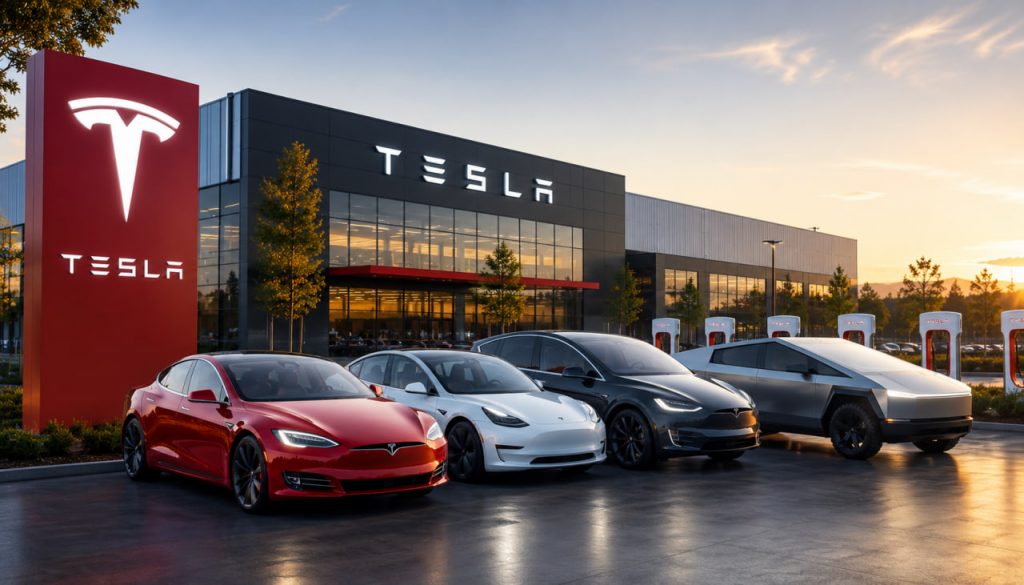
Tesla is one of the world’s most influential technology and automotive companies, playing a central role in accelerating the global transition to sustainable energy. What began as a niche electric vehicle startup has evolved into a multinational corporation that manufactures electric cars, battery systems, energy storage solutions, solar products, and artificial intelligence technologies.
Today, Tesla is recognized not only for its innovative vehicles but also for its software ecosystem, autonomous driving research, advanced manufacturing processes, and extensive fast-charging infrastructure. The company’s influence extends far beyond the automotive industry, shaping the future of transportation, renewable energy, and intelligent mobility.
Tesla has fundamentally changed public perception of electric vehicles by proving they can outperform traditional gasoline-powered cars in performance, technology, and everyday usability.
The History of Tesla
Tesla was founded in 2003 by a group of engineers with the goal of demonstrating that electric vehicles could be superior to conventional automobiles.
The company’s first production vehicle, the Roadster, launched in 2008 and proved that an electric sports car could offer impressive acceleration and practical driving range.
Over the following years, Tesla expanded its lineup with several successful models, transforming itself from a startup into one of the world’s largest electric vehicle manufacturers.
Major milestones include:
- Launch of the Roadster
- Introduction of the Model S
- Expansion into SUVs with the Model X
- Mass-market success with the Model 3
- Global popularity of the Model Y
- Development of energy storage and solar products
- Expansion of Gigafactories worldwide
Tesla’s Vehicle Lineup
Tesla currently offers several electric vehicles designed for different market segments.
Tesla Model 3
The Model 3 is Tesla’s best-selling sedan.
Key features include:
- Long driving range
- Fast acceleration
- Minimalist interior
- Advanced software
- Excellent energy efficiency
Tesla Model Y
The Model Y has become one of the world’s best-selling electric vehicles.
Advantages include:
- Spacious interior
- Strong efficiency
- Flexible cargo capacity
- Advanced driver assistance
- Access to Tesla’s charging network
Tesla Model S
The Model S remains Tesla’s flagship sedan.
Highlights include:
- Exceptional acceleration
- Premium interior
- Long driving range
- High-performance Plaid variant
Tesla Model X
Known for its distinctive Falcon Wing doors, the Model X combines luxury with practicality.
Features include:
- Three-row seating
- Advanced safety systems
- Powerful dual-motor drivetrain
- High towing capability
Tesla Cybertruck
The Cybertruck introduces a bold design and durable stainless-steel construction.
Key capabilities include:
- Adaptive air suspension
- High payload capacity
- Strong towing performance
- Advanced onboard technology
Software as Tesla’s Competitive Advantage
Unlike many traditional automakers, Tesla develops much of its vehicle software in-house.
Its digital ecosystem includes:
- Over-the-air software updates
- Intelligent navigation
- Energy optimization
- Mobile app integration
- Remote diagnostics
- Continuous feature improvements
Tesla vehicles regularly receive new functions and performance enhancements without requiring dealership visits.
Supercharger Network
One of Tesla’s greatest strengths is its global fast-charging infrastructure.
The Supercharger network provides:
- High-speed DC charging
- Route-integrated navigation
- Reliable charging availability
- Convenient long-distance travel
The continued expansion of charging stations has significantly improved the practicality of electric vehicle ownership.
Artificial Intelligence and Autonomous Driving
Tesla invests heavily in artificial intelligence and machine learning.
Its AI technologies support:
- Driver assistance
- Computer vision
- Object recognition
- Navigation
- Traffic analysis
- Autonomous driving research
The company continues developing its Full Self-Driving (Supervised) software, although drivers must remain attentive and responsible for vehicle operation.
Energy and Sustainability
Tesla’s business extends beyond automobiles.
The company also develops:
- Home battery storage
- Utility-scale energy storage
- Solar panels
- Solar roof systems
- Grid stabilization technologies
These products support the broader transition toward renewable energy generation and storage.
Manufacturing Innovation
Tesla has introduced several manufacturing innovations.
Examples include:
- Gigafactories
- Large-scale aluminum casting
- Battery production optimization
- Highly automated assembly lines
- Vertical integration
These approaches help improve production efficiency while reducing manufacturing costs.
Challenges Facing Tesla
Despite its success, Tesla continues to face several challenges.
Increasing Competition
Nearly every major automotive manufacturer now produces electric vehicles, creating intense competition across multiple price segments.
Autonomous Driving Regulation
Governments continue evaluating regulations surrounding advanced driver assistance and autonomous driving technologies.
Supply Chain Management
Battery materials and semiconductor availability remain important considerations for long-term production growth.
Expert Perspective: Tesla’s Lasting Industry Impact
According to Sandy Munro, Tesla has fundamentally influenced modern automotive manufacturing through simplified vehicle architecture, large-scale casting technologies, and software-focused engineering.
Researchers at International Energy Agency have likewise noted that Tesla has played a significant role in accelerating global electric vehicle adoption, encouraging both established manufacturers and new entrants to invest heavily in electrification.
Their assessment reflects a widely recognized industry view: Tesla’s greatest contribution extends beyond its own vehicles—it has accelerated the entire automotive industry’s transition toward electric mobility.
The Future of Tesla
Tesla continues investing in several strategic areas, including:
- Next-generation battery technology
- Artificial intelligence
- Robotics
- Autonomous driving systems
- Energy storage
- Manufacturing automation
Future developments are expected to further strengthen Tesla’s position as both a technology company and an automotive manufacturer.
Conclusion
Tesla has evolved from an ambitious startup into one of the world’s most influential technology companies. Through continuous innovation in electric vehicles, battery systems, software, artificial intelligence, and renewable energy, the company has reshaped expectations for modern transportation.
While competition continues to intensify, Tesla remains a benchmark for innovation, efficiency, and digital integration within the global automotive industry.
Tesla’s impact reaches far beyond electric vehicles—it has helped redefine how the world thinks about sustainable transportation, intelligent software, and the future of mobility.