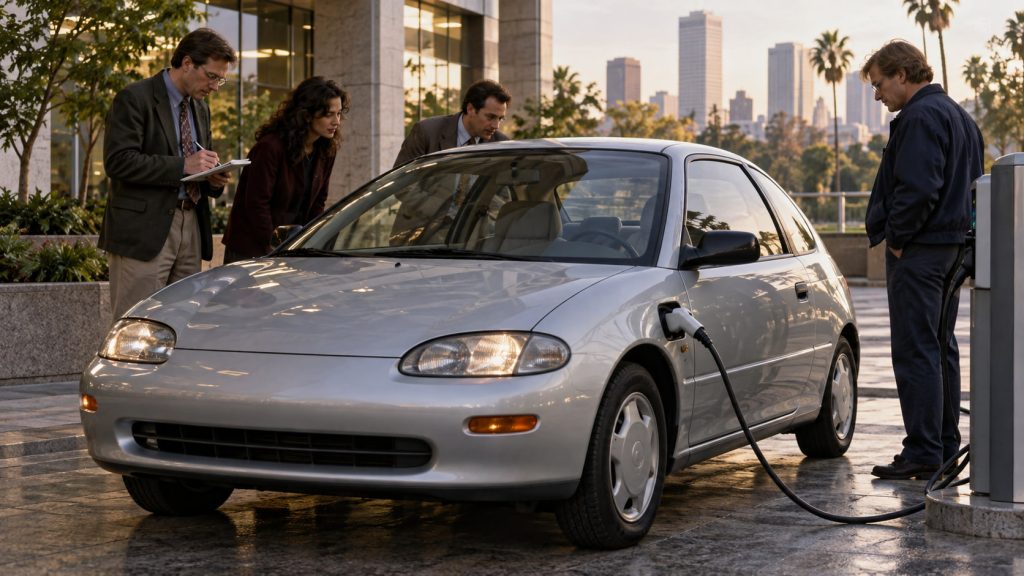
When people discuss the history of electric cars, they often begin with Tesla, the Nissan Leaf, or the arrival of modern lithium-ion batteries. However, the foundations of today’s electric vehicle revolution were already being developed during the 1990s.
Long before electric SUVs became common and public fast-charging networks appeared across major highways, manufacturers were experimenting with battery-powered sedans, electric pickup trucks, compact city cars, and sophisticated hybrid powertrains.
General Motors developed the futuristic EV1. Toyota introduced an electric RAV4 years before electric crossovers became fashionable. Honda built the innovative EV Plus. Nissan experimented with lithium-ion batteries, while European manufacturers quietly introduced electric versions of familiar family cars.
Some vehicles reached paying customers. Others remained experimental prototypes or limited-production models.
The surprising truth is that many technologies associated with modern electric mobility were already being tested more than 30 years ago.
So why did these vehicles almost disappear from automotive history, and what prevented the electric revolution from happening sooner?
Why Electric Cars Returned in the Early 1990s
Electric cars were not invented during the 1990s. Battery-powered automobiles existed in the nineteenth century and competed with gasoline vehicles during the early years of the automotive industry.
However, limited battery capacity, improving internal combustion engines, and the development of gasoline infrastructure gradually pushed electric vehicles out of the mainstream.
Interest returned during the late twentieth century because of air pollution, energy security concerns, and technological progress.
California played a particularly important role.
In 1990, the California Air Resources Board introduced regulations requiring major automakers to begin offering zero-emission vehicles.
The original targets called for zero-emission vehicles to represent 2 percent of applicable manufacturers’ California sales in 1998, increasing to 5 percent in 2001 and 10 percent in 2003.
These requirements were subsequently modified, including changes in 1996 that removed the earlier phase-in targets.
Nevertheless, the original regulation encouraged significant investment in electric vehicle research.
Automakers suddenly had a strong reason to investigate alternatives to gasoline engines.
What Electric Vehicle Technology Looked Like in 1990
Electric cars faced several technical challenges that made mass adoption difficult.
Most vehicles relied on batteries that were substantially heavier and less energy-dense than modern automotive lithium-ion packs.
The main technologies included:
- Lead-acid batteries
- Nickel-cadmium batteries
- Nickel-metal hydride batteries
- Experimental sodium-based batteries
- Early automotive lithium-ion systems
Lead-acid technology was relatively inexpensive and familiar, but its weight severely limited vehicle performance and driving range.
Nickel-cadmium batteries offered some improvements but introduced environmental and operational disadvantages.
Nickel-metal hydride technology provided greater energy density and became important in several advanced electric vehicles and hybrids.
Lithium-ion batteries were still emerging as a practical automotive technology.
The biggest obstacle was not the electric motor. It was storing enough energy economically, safely, and reliably inside a passenger vehicle.
General Motors EV1: The Electric Car That Became a Legend
The General Motors EV1 remains one of the most recognizable electric vehicles of the 1990s.
Its origins can be traced to the GM Impact concept, unveiled in 1990.
The production EV1 appeared in 1996 as a two-seat electric coupe designed specifically around an electric drivetrain rather than converted from an existing gasoline car.
Its aerodynamic body looked radically different from ordinary American vehicles.
The EV1 featured:
- A lightweight two-seat body
- Extremely aerodynamic styling
- Front-wheel electric propulsion
- Regenerative braking
- Electronic power management
- Inductive charging technology
- An electrically driven climate-control system
Early examples used lead-acid batteries, providing approximately 70–100 miles of range depending on conditions and configuration.
Later models introduced nickel-metal hydride batteries, increasing the potential range significantly.
Performance was respectable for its era, while the quiet operation and immediate electric-motor response impressed many drivers.
According to the Smithsonian’s National Museum of American History, General Motors built 1,117 EV1 vehicles beginning in 1996, leasing most to customers in California, Arizona, and Georgia.
However, the vehicles were generally leased rather than sold outright.
GM ended the program in the early 2000s, citing production costs and limited market demand. Most leased vehicles were recovered, and many were subsequently destroyed.
The decision generated considerable controversy, particularly among customers who wanted to keep their cars.
The EV1 demonstrated that a dedicated modern electric passenger car was technically possible, but it also revealed how vulnerable early EV programs were to commercial and regulatory changes.
Toyota RAV4 EV: An Electric SUV Before Its Time
Modern electric SUVs dominate much of the global EV market, but Toyota explored this concept decades earlier.
The first-generation Toyota RAV4 EV entered limited sales in Japan in 1996 and reached the United States in 1997.
Unlike the conventional RAV4, the electric version used a front-wheel-drive electric powertrain and nickel-metal hydride batteries.
Its practical characteristics included:
- Seating for up to five passengers
- An electric motor
- Regenerative braking
- A battery pack positioned beneath the cabin
- Conventional SUV practicality
- Approximately 80–120 miles of driving range, depending on version and conditions
For the 1990s, this was an ambitious combination.
The vehicle was suitable for commuting and many ordinary daily journeys.
Toyota primarily supplied vehicles to government organizations, utilities, and fleet operators, although some later became available to private customers.
Toyota’s historical records indicate that approximately 1,900 first-generation RAV4 EVs were sold through 2003 across the program’s markets.
Some examples survived for many years after production ended.
The RAV4 EV proved that electrification was not limited to unusual sports cars or experimental city vehicles.
Honda EV Plus: The Forgotten Electric Hatchback
Honda also developed an advanced battery electric vehicle during the 1990s.
Introduced in 1997, the Honda EV Plus was a compact four-seat hatchback designed specifically for electric propulsion.
Instead of building a conventional gasoline car and simply replacing its engine, Honda created a dedicated EV package.
It used nickel-metal hydride batteries, an electric motor, and an interior designed to maximize passenger space.
The EV Plus offered an estimated driving range of around 80–110 miles under typical contemporary assessments, although official ratings varied.
Its strongest qualities were practical rather than spectacular.
The vehicle offered quiet driving, convenient city performance, and the possibility of commuting without gasoline.
However, it was expensive to manufacture and available only through a limited leasing program.
Production remained small, and the project eventually ended.
Honda nevertheless gained valuable experience in battery management, electric motors, and energy-efficient vehicle engineering.
That knowledge contributed to later electrified vehicles.
Ford Ranger EV: The Electric Pickup Nobody Remembers
Electric pickup trucks are often presented as a relatively recent innovation.
However, Ford introduced the Ranger EV in 1998.
The vehicle was based on the familiar Ford Ranger compact pickup, making it more conventional in appearance than the futuristic GM EV1.
It was designed primarily for fleet customers, government organizations, and utility companies.
Early Ranger EV models used lead-acid batteries. Later versions adopted nickel-metal hydride technology.
Depending on battery configuration and driving conditions, range was generally measured in tens of miles rather than hundreds.
The truck demonstrated that electric propulsion could support light commercial transportation.
However, high manufacturing costs, battery limitations, and maintenance challenges restricted its commercial potential.
The program ended during the early 2000s.
Nevertheless, it anticipated a concept that would return decades later: electric pickup trucks could be useful for predictable commercial routes even before battery technology became suitable for every long-distance journey.
Nissan Prairie Joy EV and Altra EV: Early Lithium-Ion Pioneers
Nissan deserves particular attention because it experimented with lithium-ion automotive batteries earlier than many people realize.
In 1997, the company introduced the Prairie Joy EV, which used lithium-ion battery technology.
It was deployed through a limited leasing program in Japan, particularly for institutional and fleet applications.
Nissan then developed the Altra EV, also known as the R’nessa EV in Japan.
The Altra entered limited production in 1998 and combined a practical wagon-like body with a lithium-ion battery pack.
Approximately 200 Altra EVs were produced between 1998 and 2002.
Many were used by electric utilities and public organizations.
These vehicles helped Nissan investigate technology that would later become central to modern EV development.
The company’s historical records identify the Prairie Joy EV and Altra EV as important milestones in the development of automotive lithium-ion propulsion.
Nissan was investigating lithium-ion electric vehicles more than a decade before introducing the mass-market Leaf in 2010.
Peugeot 106 Electric: Europe’s Quiet Electric Pioneer
The American EV1 attracted considerable publicity, but Europe had its own early electric mobility programs.
One of the most important was the Peugeot 106 Electric.
Peugeot began public testing in La Rochelle, France, during the early 1990s.
Commercial sales to private customers started in July 1995.
Unlike the EV1, the electric 106 looked almost identical to its gasoline-powered counterpart.
It was a small, practical hatchback intended for urban driving.
The vehicle used nickel-cadmium batteries and offered a driving range of approximately 50–60 miles under favorable conditions.
Its modest performance was acceptable for city transportation, where many journeys were relatively short.
Peugeot’s historical production figures indicate that 3,542 electric 106 models were manufactured between 1993 and 2003.
This made it a significant early European production EV, even though its sales were tiny compared with conventional vehicles.
The Citroen AX Electric and later Saxo Electric followed similar principles.
These vehicles demonstrated that electric propulsion could work in ordinary small cars without requiring radical futuristic designs.
Fiat Panda Elettra: A Practical Idea with Serious Limitations
Italy also participated in the early electric vehicle movement.
Fiat introduced the Panda Elettra in 1990.
Based on the conventional Panda, the electric version was intended primarily for urban mobility.
It used lead-acid batteries and offered a relatively short driving range.
The battery installation added considerable weight and reduced practicality.
Performance was limited, but the vehicle showed that manufacturers were already thinking about small electric city cars as alternatives to gasoline-powered urban transport.
Unfortunately, the technology was expensive relative to the vehicle’s capabilities.
For most buyers, the conventional Panda remained far more practical.
The Panda Elettra illustrates a recurring problem of the era: electric conversion was technically achievable, but affordability and energy storage remained difficult obstacles.
BMW E1: The Electric City Car That Predicted the Future
BMW introduced the E1 electric concept at the Frankfurt Motor Show in 1991.
The small vehicle looked very different from BMW’s traditional luxury sedans and performance coupes.
It was designed specifically for efficient urban transportation.
The E1 incorporated lightweight construction, an electric drivetrain, and experimental battery technology.
Early versions used sodium-sulfur batteries, while later development explored alternative high-energy battery systems.
BMW’s historical specifications described a city-driving range of approximately 150 kilometers, or 93 miles.
The E1 never became a mass-produced passenger car.
However, it revealed BMW’s interest in dedicated electric vehicle architecture long before the introduction of the BMW i3 in 2013.
Its compact dimensions, lightweight engineering, and emphasis on energy efficiency anticipated several principles used in later urban EVs.
Audi Duo: A Plug-In Hybrid from 1997
One of the most surprising forgotten vehicles was the Audi Duo.
Audi began experimenting with hybrid technology in 1989, using an Audi 100 Avant with a gasoline engine driving the front wheels and an electric motor assisting at the rear.
Further development led to a limited-production version based on the Audi A4 Avant in 1997.
This vehicle combined a 1.9-liter turbocharged diesel engine with an electric motor.
Its battery could be recharged from an external electrical outlet.
That made the Duo an early plug-in hybrid, years before the technology became familiar to mainstream consumers.
The electric system could also recover energy during deceleration.
According to Audi’s own technical history, the 1997 Duo could reach approximately 80 kilometers per hour in electric mode.
However, the vehicle was expensive and technically complex.
Production remained extremely limited.
The Audi Duo demonstrated that plug-in hybrid technology existed in practical automotive form long before modern plug-in hybrids became popular.
Toyota Prius: The Hybrid That Finally Found a Market
Not every electrified vehicle of the 1990s disappeared.
Toyota’s Prius became the most commercially influential hybrid of its generation.
Introduced in Japan in December 1997, the first-generation Prius combined a gasoline engine, electric motor, battery, and sophisticated power-management system.
Its series-parallel hybrid architecture could use engine and electric power in different combinations depending on driving conditions.
Unlike a battery electric vehicle, the Prius did not require external charging.
The battery recovered energy during braking and received power through the hybrid system.
This removed one of the largest barriers facing electric vehicles: limited charging infrastructure.
Toyota’s original announcement emphasized significantly improved fuel economy compared with conventional gasoline vehicles.
The Prius reached international markets in 2000.
Its success demonstrated that electrification could attract mainstream buyers when it delivered practical advantages without requiring major changes in driving habits.
Honda Insight: A Different Approach to Hybrid Efficiency
Honda introduced the original Insight in November 1999.
It was a lightweight, aerodynamic two-seat hybrid with distinctive rear wheel covers and an aluminum-intensive body.
Rather than using the same hybrid architecture as Toyota, Honda developed its Integrated Motor Assist system.
The electric motor primarily assisted the gasoline engine and recovered energy during deceleration.
Honda emphasized low weight, aerodynamic efficiency, and reduced fuel consumption.
The original Insight achieved exceptional fuel-economy figures under contemporary Japanese testing.
Its unusual body and limited seating capacity restricted its mainstream appeal, but its engineering was remarkable.
The Prius demonstrated how hybrids could become practical family transportation, while the Insight showed how far efficiency could be pushed through lightweight design and careful aerodynamics.
Why Most 1990s Electric Cars Failed Commercially
The disappearance of many early EVs cannot be explained by one factor.
Several challenges reinforced one another.
Battery technology remained expensive, heavy, and limited in energy capacity. Public charging infrastructure was scarce, while charging systems lacked the standardization and convenience found in modern networks.
Production volumes were extremely small, increasing manufacturing costs.
Many EVs were supplied through lease programs or fleet trials rather than conventional retail sales.
Low gasoline prices in some major markets also reduced financial incentives to switch.
Regulatory changes complicated long-term planning, while manufacturers continued investing heavily in conventional gasoline and diesel vehicles.
Consumer interest existed, as demonstrated by enthusiastic EV1 drivers and long-lasting RAV4 EV ownership.
However, enthusiastic early adopters were not enough to overcome battery costs, limited production scale, and inadequate infrastructure.
What the 1990s EV Revolution Left Behind
Although many models disappeared, their engineering lessons proved valuable.
The experiments demonstrated the importance of:
- Dedicated electric vehicle architecture
- Efficient motor control
- Regenerative braking
- Advanced battery management
- Lightweight construction
- Aerodynamic optimization
- Battery thermal management
- Reliable charging equipment
- Real-world fleet testing
- Long-term battery durability
Manufacturers also learned that customers valued quiet operation, smooth acceleration, and lower local emissions.
The transition to lithium-ion batteries, advances in electronics, and improved manufacturing economics eventually made many earlier ideas commercially viable.
Modern electric vehicles did not emerge from nowhere.
They represent decades of accumulated research, failed experiments, technological improvements, and lessons learned from real customers.
Could Electric Cars Have Become Popular Earlier?
It is tempting to imagine an alternative automotive history in which manufacturers expanded their 1990s EV programs instead of discontinuing them.
Earlier investment might have accelerated battery research, charging infrastructure, and consumer familiarity.
However, it would be misleading to assume that modern electric mobility could simply have appeared in 1997.
Battery energy density, manufacturing methods, semiconductor technology, and production economics were substantially less developed than today.
Many challenges were technical and economic, not merely the result of corporate decisions.
The more realistic conclusion is that earlier programs demonstrated substantial potential but lacked the combination of technology, scale, and market conditions needed for widespread adoption.
Conclusion
The forgotten electric cars and hybrids of the 1990s reveal a fascinating period in automotive history.
General Motors demonstrated dedicated electric vehicle engineering with the EV1. Toyota introduced an electric SUV and pioneered mass-produced hybrid technology. Honda developed the EV Plus and Insight. Nissan explored lithium-ion propulsion, while Peugeot, Fiat, BMW, and Audi experimented with practical electric and hybrid transportation.
Some vehicles were technologically impressive but commercially unsuccessful. Others, especially the Toyota Prius, established foundations for an entirely new automotive market.
Their limitations were real, but so were their achievements.
The electric vehicle revolution did not begin with today’s electric cars. Its modern foundations were already being established during the 1990s by engineers who were attempting to solve many of the same problems the automotive industry continues to address today.
What once looked like an uncertain experiment has become a central part of the industry’s future.
And without these largely forgotten pioneers, the modern electric vehicle landscape might look very different.