Electric vehicles are becoming increasingly common in cities and suburbs, where charging infrastructure is expanding rapidly and daily driving distances are often predictable. However, life with an electric vehicle can be very different in rural areas.
For many drivers living outside major population centers, owning an EV presents unique opportunities as well as significant challenges. While electric vehicles offer lower operating costs, quieter driving, and reduced emissions, rural environments often expose limitations that urban drivers rarely encounter.
The good news is that EV technology continues improving every year. Battery capacity is increasing, charging networks are expanding, and governments are investing heavily in rural infrastructure.
Still, understanding the realities of EV ownership in the countryside is essential before making the transition.
The biggest challenge for rural EV drivers is not the vehicle itself—it is the surrounding infrastructure.
Limited Charging Infrastructure
The most frequently cited challenge is access to charging stations.
Urban areas often offer:
- public fast chargers
- workplace charging
- shopping center chargers
- dedicated charging hubs
In rural regions, charging options may be far more limited.
Drivers can face situations where:
- charging stations are dozens of miles apart
- only slow chargers are available
- charging networks have incomplete coverage
- some locations have only a single charger
This makes route planning significantly more important than it is for gasoline vehicles.
A missed charging opportunity can sometimes result in long detours or extended waiting periods.
Longer Travel Distances
Rural residents often travel farther on a daily basis.
Common reasons include:
- commuting to nearby towns
- shopping trips
- healthcare visits
- agricultural operations
- business travel
Unlike city drivers who may travel only short distances each day, rural drivers often cover much greater mileage.
This can create additional range concerns, especially during:
- winter conditions
- towing operations
- mountainous travel
- high-speed highway driving
Although many modern EVs offer ranges exceeding 300 miles, real-world conditions can significantly affect performance.
Home Charging Becomes Essential
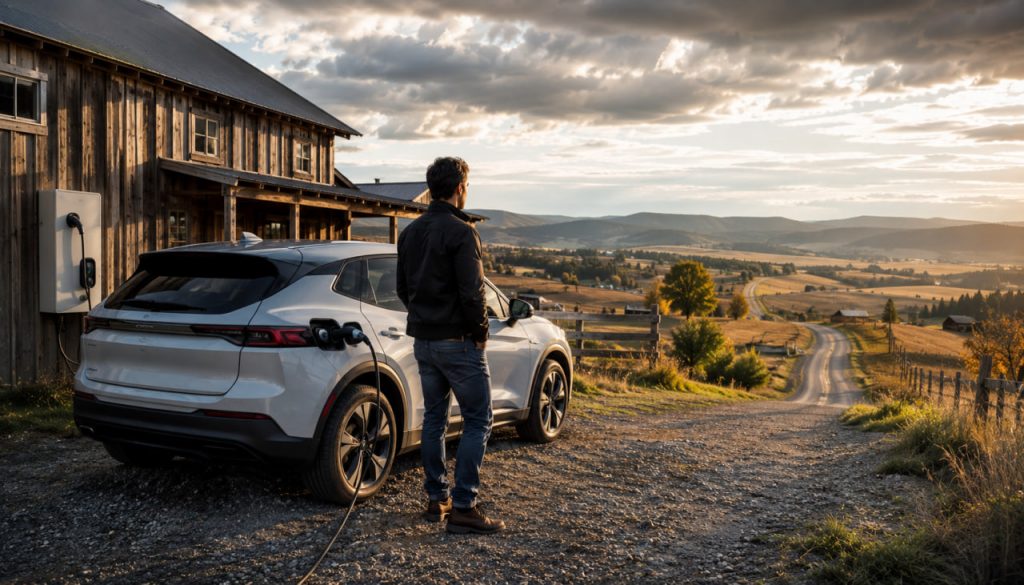
For many rural EV owners, home charging is not simply convenient—it is necessary.
A dedicated home charging setup offers several advantages:
- overnight charging
- lower electricity costs
- reduced dependence on public infrastructure
- greater travel flexibility
Many rural drivers quickly discover that home charging becomes the foundation of successful EV ownership.
Without reliable home charging, operating an EV in remote areas can become much more challenging.
In rural environments, a home charger often matters more than public charging availability.
Winter Weather Can Reduce Range
Cold weather affects all electric vehicles.
Battery performance can decline because energy is required for:
- cabin heating
- battery temperature management
- defrosting systems
- seat heating
In rural regions where winters are severe, range reductions can become particularly noticeable.
Drivers may experience:
- lower efficiency
- longer charging times
- increased energy consumption
This is especially important because rural trips often involve greater distances between charging opportunities.
Proper planning becomes essential during winter months.
Towing and Heavy Loads
Many rural vehicle owners regularly use their vehicles for work-related tasks.
Examples include:
- towing trailers
- transporting equipment
- hauling livestock supplies
- carrying agricultural materials
Towing significantly increases energy consumption.
In some situations, towing can reduce range by 30–50% or more depending on:
- vehicle design
- trailer size
- terrain
- weather conditions
While electric pickup trucks are becoming more capable, towing remains one of the most demanding applications for current EV technology.
Off-Road and Unpaved Roads
Rural drivers frequently encounter:
- gravel roads
- dirt roads
- mud
- snow-covered routes
- uneven terrain
Although many EVs perform well on rough roads, some challenges remain.
Heavy battery packs may affect:
- suspension wear
- tire wear
- energy efficiency
Additionally, some charging infrastructure may be less accessible in remote off-road locations.
Manufacturers are increasingly designing electric SUVs and trucks specifically for these environments.
Emergency Charging Situations
Running out of fuel in a gasoline vehicle is inconvenient.
Running out of battery power in a remote rural area can be considerably more complicated.
Challenges may include:
- limited roadside charging options
- long distances to service providers
- poor cellular coverage
- difficult recovery logistics
This makes maintaining a charging buffer particularly important.
Many experienced rural EV owners avoid allowing battery levels to drop too low.
Electricity Reliability
In some rural regions, electrical infrastructure may be less robust than in urban centers.
Potential issues include:
- power outages
- storm damage
- grid instability
- limited electrical capacity
Home charging becomes difficult during extended outages.
Some EV owners address this issue through:
- solar energy systems
- battery storage systems
- backup generators
As energy resilience becomes more important, EV ownership increasingly overlaps with home energy planning.
Charging Times Remain Longer Than Refueling
Even with fast-charging technology, charging generally takes longer than filling a gasoline tank.
This becomes more noticeable in rural areas because:
- chargers may be less common
- travel distances are longer
- alternative charging locations may be unavailable
Drivers often need to incorporate charging into their travel schedules more carefully than traditional refueling stops.
However, overnight home charging offsets much of this inconvenience for daily driving.
Economic Benefits in Rural Areas
Despite infrastructure challenges, rural EV ownership also offers important advantages.
Electric vehicles typically have:
- lower fuel costs
- reduced maintenance expenses
- fewer moving parts
- lower operating costs
For drivers covering large annual mileages, these savings can be substantial.
Electricity is often considerably cheaper than gasoline on a per-mile basis.
Over time, lower operating costs can help offset higher purchase prices.
Renewable Energy Opportunities
Many rural properties have unique opportunities for renewable energy integration.
Homeowners may install:
- solar panels
- battery storage systems
- smart energy management systems
This allows EV charging using self-generated electricity.
Some rural households are creating integrated energy ecosystems where solar power supports:
- home energy use
- battery storage
- electric vehicle charging
This approach can significantly reduce long-term energy costs.
Expert Perspective
According to the International Energy Agency, expanding charging infrastructure remains one of the most important factors supporting widespread EV adoption, particularly in underserved and rural regions.
Many transportation experts believe rural charging expansion will play a crucial role in the next phase of electric vehicle growth.
Infrastructure development may ultimately determine how quickly EV adoption spreads beyond major metropolitan areas.
Technology Is Improving Rapidly
Many of today’s challenges are already being addressed.
Current trends include:
- larger battery packs
- faster charging speeds
- improved cold-weather performance
- expanded charging networks
- better route-planning software
Future developments may include:
- ultra-fast charging stations
- wireless charging systems
- vehicle-to-grid technology
- enhanced battery chemistry
As these technologies mature, rural EV ownership is expected to become significantly easier.
Conclusion
Electric vehicles offer many advantages for rural drivers, including lower operating costs, reduced maintenance, quiet operation, and compatibility with renewable energy systems. However, challenges involving charging infrastructure, long-distance travel, cold weather, towing, and remote-area logistics remain important considerations.
The good news is that EV technology continues advancing rapidly, while governments and private companies invest heavily in charging networks and grid modernization.
For many rural residents, successful EV ownership already depends on careful planning and reliable home charging. In the coming years, improved batteries and expanded infrastructure are likely to make electric vehicles increasingly practical for countryside living.
The future of electric mobility will not be limited to cities. As technology evolves, rural communities may become an important part of the global transition toward cleaner transportation.