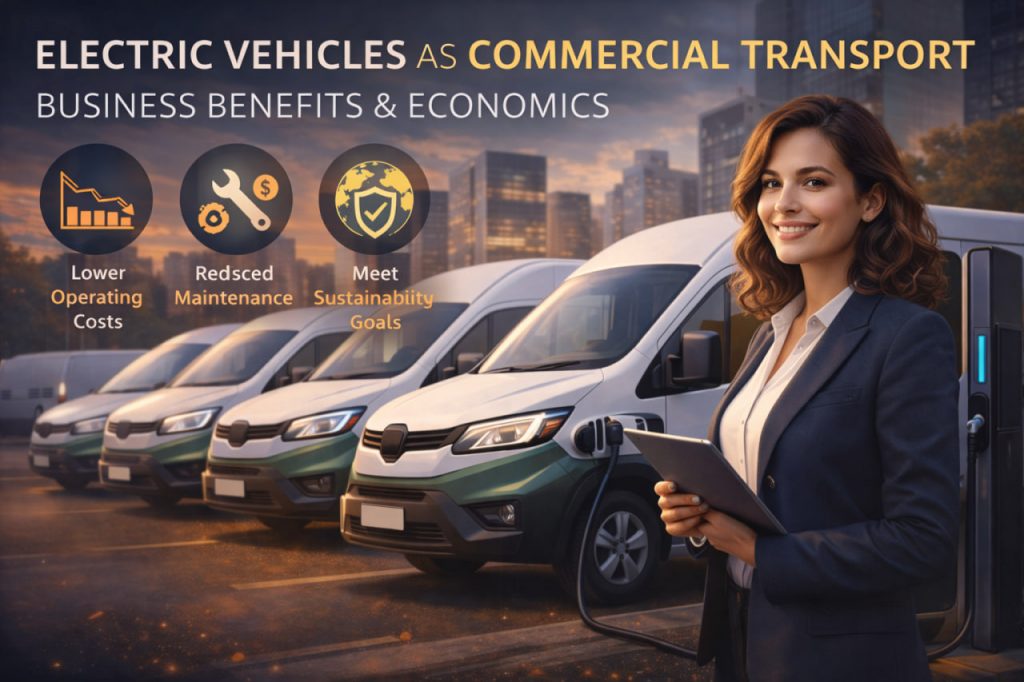
The transition to electric vehicles is not only transforming personal mobility but also redefining commercial transportation. From delivery vans and taxis to corporate fleets and logistics operations, businesses are increasingly adopting EVs to reduce costs, improve efficiency, and meet sustainability goals. While the upfront investment can be higher, the long-term economic advantages are becoming difficult to ignore.
Why Businesses Are Switching to EVs
For commercial use, vehicles are not just transportation—they are cost centers. Every kilometer driven directly affects operational expenses. EVs offer a compelling advantage because they significantly reduce running costs, which is critical for businesses operating large fleets.
Key drivers of adoption include:
- lower energy costs
- reduced maintenance
- government incentives
- sustainability commitments
Fuel Savings: The Biggest Advantage
One of the most important benefits of EVs in commercial transport is the dramatic reduction in energy costs.
Typical comparison:
- diesel/gasoline fleet → high and volatile fuel costs
- EV fleet → stable and significantly lower electricity costs
For high-mileage operations (e.g., delivery services), savings scale quickly.
Example:
- Delivery van: 30,000 km/year
- Fuel cost (ICE): ~$0.12/km → $3,600/year
- Electricity cost (EV): ~$0.04/km → $1,200/year
👉 Savings: ~$2,400 per vehicle annually
Multiply that across a fleet of 50 vehicles → $120,000/year savings
Lower Maintenance Costs
EVs have fewer moving parts compared to internal combustion vehicles. This results in:
- no oil changes
- fewer mechanical failures
- reduced brake wear (thanks to regenerative braking)
- less downtime
For businesses, this means:
- lower service costs
- higher fleet availability
- more predictable maintenance planning
Total Cost of Ownership (TCO)
While EVs may cost more upfront, businesses focus on Total Cost of Ownership (TCO) rather than purchase price.
TCO includes:
- purchase cost
- energy/fuel
- maintenance
- downtime
- resale value
In many commercial scenarios, EVs become cheaper than ICE vehicles within 2–4 years, especially with high utilization.
Predictability and Cost Stability
Fuel prices fluctuate due to global markets, while electricity prices are generally more stable. Businesses benefit from:
- predictable operating expenses
- easier financial planning
- reduced exposure to market volatility
This is particularly valuable for logistics and delivery companies with tight margins.
Government Incentives and Tax Benefits
Many countries support EV adoption through:
- purchase subsidies
- tax reductions
- reduced tolls
- access to restricted urban zones
For commercial fleets, these incentives can significantly reduce initial investment costs.
Urban Advantages and Regulations
Cities are increasingly introducing:
- low-emission zones
- restrictions on diesel vehicles
- congestion charges
EVs often receive:
- free or discounted access
- priority parking
- exemption from certain fees
This gives businesses a competitive advantage in urban operations.
Charging Infrastructure for Businesses
Commercial EV adoption requires proper charging strategy:
Options:
- depot charging (overnight)
- workplace charging
- public fast charging
Fleet operators often install private charging stations, optimizing costs and ensuring availability.
Use Cases Where EVs Excel
EVs are particularly effective in:
- last-mile delivery (Amazon, DHL, etc.)
- taxi and ride-hailing services
- corporate fleets
- urban logistics
- public transport (electric buses)
These use cases benefit from:
- predictable routes
- high daily mileage
- frequent stop-and-go driving
Challenges Businesses Must Consider
Despite the benefits, there are challenges:
- higher upfront costs
- charging infrastructure investment
- range limitations (for long-haul transport)
- operational transition
However, these barriers are gradually decreasing as technology improves.
The Future of Commercial EVs
The commercial EV market is rapidly evolving:
- better batteries → longer range
- faster charging → reduced downtime
- fleet management software → improved efficiency
- autonomous EV fleets (future potential)
Businesses that adopt early can gain cost advantages and brand positioning.
Conclusion
Electric vehicles are becoming a strategic asset for businesses, not just an environmental choice. Lower operating costs, reduced maintenance, and regulatory advantages make EVs especially attractive for commercial transport. While initial investment remains a consideration, the long-term financial benefits are clear—particularly for high-mileage fleets.
As infrastructure expands and technology advances, EVs are set to become the standard for commercial mobility.