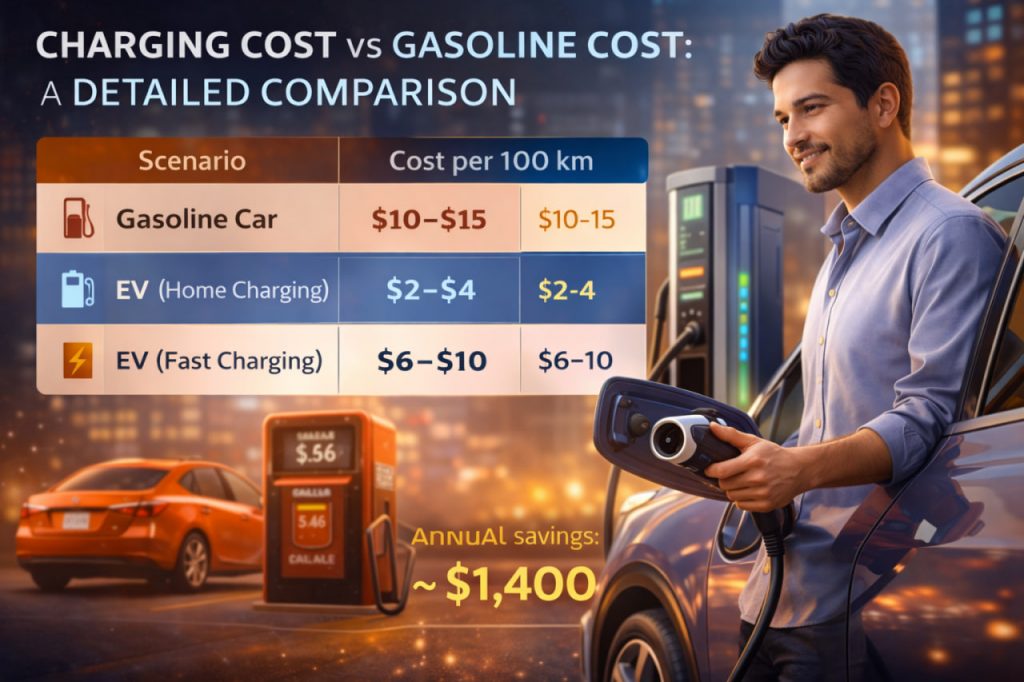
As electric vehicles (EVs) become more popular, one of the most common questions is: is it actually cheaper to drive on electricity than gasoline?
The short answer is yes—but the real picture depends on multiple factors such as energy prices, driving habits, and charging methods. Let’s break it down with a clear and practical comparison.
Understanding the Basics: Units of Measurement
To compare costs fairly, we need consistent metrics:
- Gasoline cars: liters per 100 km (or mpg)
- Electric vehicles: kWh per 100 km
Typical averages:
- Gasoline car: 7–10 liters per 100 km
- Electric car: 15–20 kWh per 100 km
Step 1: Cost of Driving on Gasoline
Let’s assume:
- Fuel consumption: 8 L/100 km
- Fuel price: $1.50 per liter
Calculation:
8 × 1.50 = $12 per 100 km
So, driving a gasoline car costs approximately $12 per 100 km.
Step 2: Cost of Charging an EV (Home Charging)
Let’s assume:
- Consumption: 18 kWh/100 km
- Electricity price: $0.15 per kWh
Calculation:
18 × 0.15 = $2.70 per 100 km
That’s about $2.70 per 100 km, which is significantly cheaper.
Step 3: Cost of Fast Charging (Public Stations)
Fast charging is more expensive:
- Electricity price: $0.30–$0.50 per kWh
Calculation (average $0.40/kWh):
18 × 0.40 = $7.20 per 100 km
So:
- Home charging → ~$2.7
- Fast charging → ~$7.2
- Gasoline → ~$12
Real-World Comparison Table
| Scenario | Cost per 100 km |
|---|---|
| Gasoline car | $10–$15 |
| EV (home charging) | $2–$4 |
| EV (fast charging) | $6–$10 |
Annual Cost Comparison
Let’s assume:
- Driving distance: 15,000 km/year
Gasoline:
15,000 × $12 / 100 = $1,800/year
EV (home charging):
15,000 × $2.7 / 100 = $405/year
Savings:
👉 $1,400 per year
What Affects the Cost?
1. Electricity Prices
- Night tariffs can be cheaper
- Solar charging can reduce cost close to zero
2. Fuel Prices
- Highly volatile and region-dependent
3. Driving Style
- Aggressive driving increases consumption (both EV and ICE)
4. Climate
- Cold weather increases EV energy use
Hidden Advantages of EVs
Beyond energy cost, EVs also save money on:
- maintenance (no oil, fewer moving parts)
- brakes (regenerative braking reduces wear)
- engine repairs (no engine)
When EVs Are NOT Cheaper
There are scenarios where savings shrink:
- exclusive use of fast chargers
- very high electricity prices
- low annual mileage
Even then, EVs are usually still competitive.
Key Insight
The biggest factor is where you charge:
- Home charging → maximum savings
- Public charging → moderate savings
Conclusion
Electric vehicles are generally 2–4 times cheaper to run per kilometer compared to gasoline cars, especially when charged at home. While upfront costs of EVs may still be higher, the long-term operational savings are significant.
As electricity becomes cleaner and cheaper—and fuel prices remain unstable—the economic advantage of EVs will continue to grow.