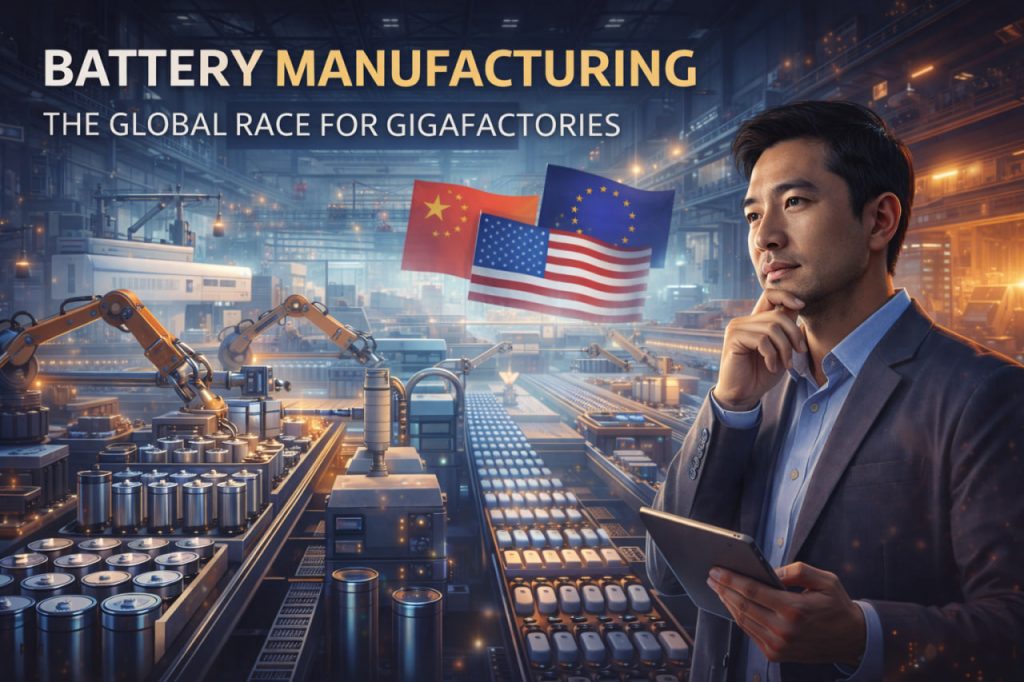
The rapid expansion of electric vehicles (EVs) has triggered a global industrial transformation centered around one critical component: the battery. At the heart of this transformation is the race to build gigafactories—large-scale battery production facilities capable of supplying the massive demand for energy storage. These factories are not just manufacturing sites; they are strategic assets shaping the future of mobility, energy, and global economic power.
As governments push for decarbonization and automakers shift toward electrification, battery production capacity has become one of the most important constraints—and opportunities—in the global economy.
What Is a Gigafactory
A gigafactory is a high-capacity manufacturing facility designed to produce batteries at gigawatt-hour (GWh) scale annually. The term was originally popularized by Tesla, but it is now widely used across the industry.
To understand the scale:
- 1 GWh can power tens of thousands of electric vehicles
- modern gigafactories often target 20–100+ GWh per year
These facilities integrate multiple stages of production, including:
- raw material processing
- electrode manufacturing
- cell assembly
- battery pack integration
The goal is efficiency, scale, and cost reduction through vertical integration.
Why Gigafactories Matter
Battery production is the key bottleneck in the transition to electric mobility. Without sufficient supply, EV production cannot scale.
Gigafactories are critical because they:
- enable mass production of batteries
- reduce cost per kWh through economies of scale
- improve supply chain resilience
- support national energy and industrial strategies
As demand for EVs grows, battery production capacity must expand even faster to keep up.
The Global Race for Capacity
Countries and corporations are investing billions to secure leadership in battery manufacturing.
China currently leads the industry, with companies like CATL and BYD dominating global production. The country benefits from:
- strong government support
- established supply chains
- control over key raw materials
Europe is rapidly scaling up its own capacity to reduce dependency on imports. New gigafactories are being built across Germany, Sweden, and France, often supported by public-private partnerships.
The United States is also accelerating investment through policy measures and industrial incentives. Major automakers and technology companies are building domestic production capacity to strengthen supply chains.
This competition is not just economic—it is also geopolitical, as battery production is closely tied to energy security.
Key Industry Players
The gigafactory race involves both specialized battery manufacturers and automakers.
Major players include:
- CATL — the largest global battery producer
- BYD — vertically integrated EV and battery company
- LG Energy Solution — a major international supplier
- Panasonic — a long-time technology partner for EV manufacturers
- Tesla — aggressively expanding its own battery production
These companies compete on:
- production scale
- cost efficiency
- technological innovation
Technology Competition
Battery technology is evolving rapidly, and gigafactories must adapt to new chemistries and designs.
Current dominant technologies include:
- lithium-ion batteries
- lithium iron phosphate (LFP) for cost efficiency
- nickel-based chemistries (NMC) for higher energy density
Future developments focus on:
- solid-state batteries
- improved energy density
- faster charging capabilities
The ability to quickly integrate new technologies into production is a major competitive advantage.
Raw Materials and Supply Chains
Battery production depends on critical materials such as:
- lithium
- nickel
- cobalt
- graphite
Securing these resources is one of the biggest challenges in scaling production.
Supply chain risks include:
- limited availability
- geopolitical tensions
- environmental concerns
To address this, companies are:
- investing in mining operations
- developing recycling technologies
- exploring alternative materials
Control over raw materials is becoming as important as manufacturing capacity itself.
Environmental and Sustainability Challenges
While EVs reduce emissions during operation, battery production is energy-intensive and has environmental impacts.
Key concerns include:
- carbon emissions from manufacturing
- water consumption
- mining-related environmental damage
In response, companies are investing in:
- renewable energy-powered factories
- closed-loop recycling systems
- sustainable sourcing practices
Sustainability is becoming a competitive factor, not just a regulatory requirement.
Workforce and Automation
Gigafactories rely on a combination of highly skilled workers and advanced automation.
Key elements include:
- robotics for precision manufacturing
- AI-driven quality control
- digital monitoring systems
At the same time, there is growing demand for specialists in:
- battery engineering
- materials science
- industrial automation
The workforce is evolving alongside the technology.
Challenges in Scaling Production
Despite massive investment, building gigafactories is complex and expensive.
Major challenges include:
- high capital costs (often billions of dollars)
- technical precision requirements
- supply chain dependencies
- rapid changes in battery technology
Delays or inefficiencies can significantly impact production timelines and profitability.
The Future of Gigafactories
The next phase of the gigafactory race will focus on:
- increasing production capacity
- improving efficiency
- integrating new battery technologies
- localizing supply chains
We are also likely to see:
- greater vertical integration by automakers
- expansion of recycling and second-life battery markets
- increased use of AI in manufacturing optimization
Battery production is expected to grow exponentially over the next decade.
Conclusion
The race for gigafactories is one of the defining industrial competitions of our time. As the world transitions toward electric mobility and renewable energy, battery manufacturing has become a strategic priority for both companies and governments.
Gigafactories are more than just production facilities—they are the foundation of a new energy and transportation ecosystem. Their development will determine not only the speed of EV adoption but also the balance of economic and technological power in the coming decades.