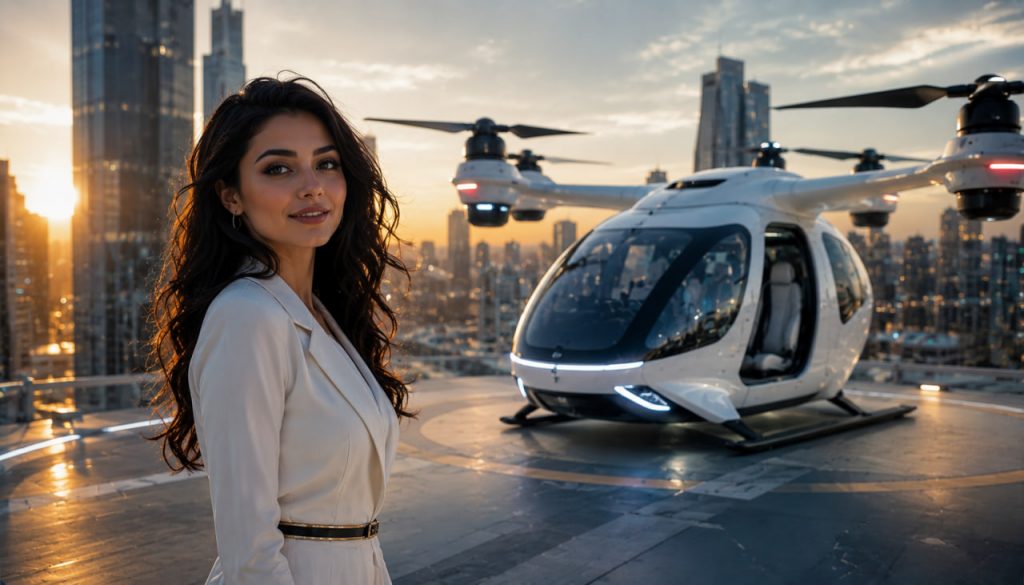
For decades, flying cars existed mainly in science fiction movies and futuristic concepts. But today, the idea is no longer purely fantastic. Around the world, dozens of aerospace companies, automotive startups, and technology firms are developing electric flying vehicles that could eventually transform urban transportation.
The rise of electric propulsion, lightweight batteries, autonomous navigation systems, and AI-powered flight control has accelerated progress dramatically. What once seemed impossible is now entering the early stages of commercial reality.
However, the question remains: when will electric cars truly learn to fly in everyday life?
The answer is more complicated than many people expect.
Flying Cars Already Exist — But Not in the Way People Imagine
One of the biggest misconceptions is that flying cars are still theoretical.
In reality, several companies have already developed working electric vertical takeoff and landing aircraft, often called eVTOLs.
These vehicles can:
- take off vertically like helicopters
- fly using electric motors
- carry passengers
- operate autonomously or semi-autonomously
- land in compact urban areas
Major companies in this sector include:
- Joby Aviation
- Archer Aviation
- Lilium
- Vertical Aerospace
- EHang
- Wisk Aero
Most modern “flying cars” are actually closer to compact electric aircraft rather than traditional road cars with wings.
The industry is evolving toward urban air mobility instead of literal flying automobiles driving on highways and then taking off.
Why Electric Technology Changed Everything
Previous flying car concepts struggled because traditional combustion engines were too heavy, complex, and inefficient for practical urban aviation.
Electric propulsion changed the equation.
Modern electric flight systems offer several advantages:
- fewer moving parts
- quieter operation
- distributed propulsion systems
- improved efficiency
- lower maintenance
- better control systems
Electric motors are especially useful for vertical takeoff because multiple small propellers can provide stability and redundancy.
Battery improvements also made short-range electric flight more realistic.
While battery energy density still limits long-distance flight, current technology is already sufficient for many urban transportation scenarios.
The Role of AI and Autonomous Flight
Artificial intelligence is becoming one of the most important technologies in the flying vehicle industry.
Future flying electric vehicles will likely depend heavily on AI for:
- autonomous navigation
- obstacle detection
- flight optimization
- traffic coordination
- emergency management
- weather analysis
- route planning
Human-controlled urban air traffic at large scale would be extremely difficult to manage safely.
This is why many companies are designing systems where AI handles much of the flight operation automatically.
Advanced sensors, machine learning systems, and real-time environmental mapping are helping make autonomous flight increasingly realistic.
Urban Air Mobility Could Arrive First
Experts believe the first large-scale deployment of flying electric vehicles will happen in cities.
This concept is known as Urban Air Mobility (UAM).
The goal is to create short-range aerial transportation systems connecting:
- airports
- business districts
- suburban areas
- transportation hubs
- high-density urban zones
Instead of replacing regular cars entirely, flying electric vehicles may initially function more like premium aerial taxi services.
For example:
- a 90-minute traffic commute could become a 15-minute flight
- airport transfers could bypass traffic congestion
- emergency transportation could become faster
Several companies already conducted successful test flights in major cities.
Why Fully Flying Personal Cars Are Still Difficult
Despite rapid progress, true flying cars for mass consumers still face major obstacles.
The biggest challenges include:
- battery limitations
- safety regulations
- air traffic control
- noise management
- infrastructure costs
- weather reliability
- public acceptance
- certification complexity
Flying safely requires far stricter standards than driving.
A small software failure in a car may cause inconvenience. In aviation, failures can become catastrophic.
This is why regulators move cautiously.
The technological challenge is no longer only about making vehicles fly — it is about making them safe enough for large-scale daily use.
Battery Technology Remains the Biggest Limitation
Battery energy density is currently one of the largest barriers to practical flying electric cars.
Aircraft require enormous energy because flight consumes far more power than driving on roads.
Current lithium-ion batteries still have limitations involving:
- weight
- charging speed
- flight range
- thermal management
Most current eVTOL aircraft are designed for relatively short trips.
Future breakthroughs may involve:
- solid-state batteries
- ultra-light materials
- hydrogen-electric systems
- hybrid propulsion
- advanced energy management
Without major battery improvements, fully mainstream flying personal vehicles may remain limited.
Infrastructure Must Be Built First
Even if flying electric vehicles become technologically mature, cities still need infrastructure.
Future urban air mobility systems may require:
- rooftop landing stations
- charging hubs
- autonomous traffic networks
- dedicated flight corridors
- AI-controlled navigation systems
- emergency response infrastructure
This infrastructure could take years or decades to develop at scale.
Governments and aviation authorities must also establish new legal frameworks for urban air transportation.
Safety Will Define the Industry
Safety remains the single most important factor for public adoption.
Future flying EV systems must prove they can operate safely under:
- bad weather
- heavy traffic
- technical failures
- communication interruptions
- cyberattack risks
Most companies are designing aircraft with multiple backup systems and redundant electric motors.
Some eVTOL designs can continue flying even if several motors fail.
AI-powered flight management systems may also reduce human error, which is one of the leading causes of traditional aviation accidents.
Expert Opinions on the Future of Flying EVs
Many technology leaders believe electric flight will become a real industry over the next decade.
Elon Musk has previously discussed the difficulties of flying cars, especially around noise, energy density, and safety, while acknowledging that electric propulsion makes new aviation possibilities more realistic than before.
Meanwhile, aerospace companies and investors continue pouring billions into the sector.
Morgan Stanley analysts previously estimated that the urban air mobility market could eventually become worth trillions of dollars globally.
Autonomous Air Taxis May Arrive Before Consumer Flying Cars
One of the most likely scenarios is that autonomous air taxis become common before privately owned flying cars.
This is because fleet-based systems are easier to:
- regulate
- maintain
- monitor
- insure
- standardize
Consumers may initially access flying transportation through ride-sharing services rather than owning personal aircraft.
This model resembles how ride-hailing transformed urban transportation over the last decade.
Military and Industrial Applications Will Accelerate Development
Military and industrial investment may also speed up innovation.
Electric autonomous aircraft could become valuable for:
- logistics
- surveillance
- emergency response
- cargo delivery
- disaster operations
Technologies developed for commercial aviation often improve faster when supported by defense and industrial funding.
This may indirectly accelerate civilian flying vehicle systems.
So When Will Electric Cars Truly Fly?
The answer depends on what “flying cars” actually means.
If referring to eVTOL air taxis:
- early commercial deployments are already beginning in some regions
If referring to widespread urban aerial transportation:
- meaningful expansion may happen within the next 5–15 years
If referring to fully mainstream personal flying cars replacing traditional vehicles:
- that likely remains decades away
The biggest barriers are no longer imagination or engineering prototypes. They are infrastructure, regulation, economics, energy systems, and safety certification.
Conclusion
Electric flying vehicles are moving from science fiction toward early commercial reality. Advances in electric propulsion, artificial intelligence, autonomous navigation, and battery systems are rapidly transforming urban aviation.
However, the future will likely look different from classic movie visions of flying sedans.
Instead of ordinary cars suddenly taking off from highways, the first major wave will probably involve AI-assisted electric air taxis operating within structured urban mobility networks.
The long-term success of flying electric vehicles will depend on solving major challenges involving infrastructure, energy density, safety, regulation, and public trust.
Even so, one thing is increasingly clear: the age of electric flight is no longer theoretical. The transition has already begun.