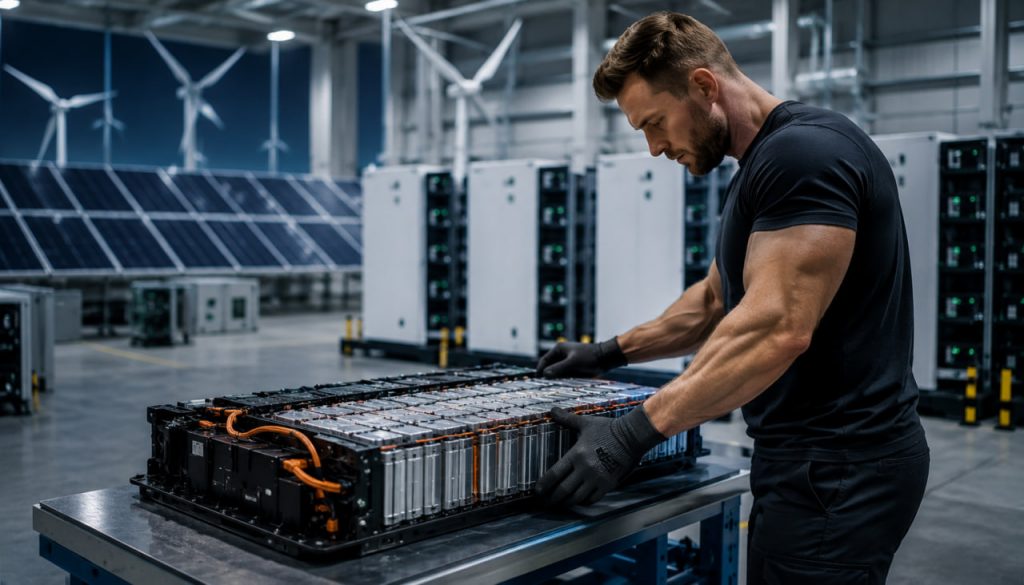
As electric vehicles become more common worldwide, millions of lithium-ion batteries are entering the market. But what happens when these batteries can no longer power a car efficiently?
Contrary to popular belief, most electric vehicle batteries are not “dead” when they are removed from cars. Even after years of driving, many still retain around 70–80% of their original capacity. While this may no longer be ideal for long-range transportation, it is often more than enough for stationary energy storage.
This has created one of the fastest-growing trends in clean energy technology: second-life batteries.
Instead of immediately recycling used EV batteries, companies are repurposing them into energy storage systems for homes, businesses, renewable power grids, and industrial applications. The concept helps reduce waste, lower energy storage costs, and support the transition toward renewable electricity.
Today, second-life battery technology is becoming an important part of the global clean energy ecosystem.
Why EV Batteries Still Have Value
Electric vehicle batteries degrade gradually over time. Factors such as charging cycles, fast charging, temperature changes, and heavy usage slowly reduce battery performance.
However, degradation does not mean total failure.
Most EV batteries are removed from vehicles because:
- driving range decreases
- charging becomes less efficient
- automakers maintain performance standards
- warranties expire
Yet many batteries still function well for less demanding tasks.
For stationary energy storage, requirements are very different than for vehicles. Energy storage systems usually:
- remain in one location
- operate at stable temperatures
- experience slower charging cycles
- do not require rapid acceleration power
Because of this, batteries unsuitable for cars can still work effectively for years in energy storage applications.
This creates a second economic life for EV batteries before final recycling.
What Are Second-Life Battery Systems?
Second-life battery systems are energy storage units built using previously used electric vehicle batteries.
These systems can store electricity from:
- solar panels
- wind farms
- electrical grids
- backup power systems
- industrial facilities
The stored electricity can later be used during:
- peak demand hours
- power outages
- nighttime energy use
- renewable energy fluctuations
This technology is especially valuable because renewable energy sources like solar and wind are intermittent. Energy storage helps stabilize supply and improve grid reliability.
Second-life batteries are increasingly used in:
- residential backup systems
- commercial buildings
- renewable energy farms
- EV charging stations
- microgrids
- emergency power infrastructure
Why the Energy Industry Is Interested
The global energy sector urgently needs affordable storage solutions.
Renewable electricity production is growing rapidly, but renewable energy alone is not enough. Grids also need reliable storage to balance supply and demand.
New lithium-ion batteries remain expensive because they require raw materials such as:
- lithium
- nickel
- cobalt
- graphite
Second-life batteries offer a cheaper alternative.
Repurposing used batteries can significantly reduce storage system costs while extending the useful life of existing materials.
According to International Energy Agency, battery storage will play a critical role in modernizing electrical grids and supporting renewable energy adoption worldwide.
Second-life batteries help make large-scale energy storage more economically viable.
How Batteries Are Repurposed
The repurposing process is highly technical.
When EV batteries are removed from vehicles, specialists first evaluate their condition.
This process includes:
- capacity testing
- thermal analysis
- voltage inspection
- safety diagnostics
- module separation
Batteries that pass testing are reorganized into new storage systems.
Engineers then integrate:
- battery management systems
- cooling systems
- safety controls
- monitoring software
- power electronics
The result is a stationary energy storage unit capable of operating for several additional years.
Some second-life battery systems may continue functioning for another 5–10 years depending on usage conditions.
Major Companies Investing in Second-Life Batteries
Many automakers and energy companies are now investing heavily in second-life battery technology.
Examples include:
- Nissan
- BMW
- Mercedes-Benz
- Renault
- Tesla ecosystem partners
- energy utilities
- grid infrastructure companies
Several automakers already use retired EV batteries for:
- solar energy storage
- stadium backup systems
- industrial facilities
- charging infrastructure
Nissan became one of the early pioneers in second-life battery projects using retired Leaf batteries for commercial and municipal applications.
Meanwhile, large utility companies are testing massive battery storage installations to stabilize renewable energy grids.
Environmental Benefits of Battery Reuse
One of the biggest advantages of second-life batteries is sustainability.
Battery manufacturing requires significant amounts of:
- mining
- water
- energy
- rare materials
Extending battery lifespan reduces the environmental impact associated with producing new storage systems.
The main environmental benefits include:
- less battery waste
- reduced raw material demand
- lower carbon emissions
- improved resource efficiency
- delayed recycling requirements
This aligns with the broader concept of a circular economy, where products and materials remain useful for as long as possible.
Second-life batteries help transform EV batteries from disposable products into long-term energy assets.
Challenges Facing the Industry
Despite strong potential, the industry still faces several major challenges.
Battery degradation varies significantly between vehicles depending on:
- climate
- charging behavior
- driving conditions
- battery chemistry
- manufacturing quality
This makes standardization difficult.
Other challenges include:
- transportation safety regulations
- high testing costs
- battery disassembly complexity
- inconsistent battery formats
- uncertain long-term performance
- recycling logistics
Safety is also critical because damaged lithium-ion batteries can pose fire risks if improperly handled.
As a result, companies must invest heavily in monitoring systems and safety engineering.
The Role of AI in Battery Management
Artificial intelligence is becoming increasingly important in battery repurposing.
Modern AI systems help analyze:
- battery health
- degradation patterns
- charging efficiency
- thermal behavior
- remaining lifespan
Machine learning models can predict how batteries will perform in second-life applications and optimize energy usage.
This improves:
- safety
- reliability
- operational efficiency
- maintenance planning
AI-driven battery analytics may become one of the key technologies enabling large-scale battery reuse worldwide.
Second-Life Batteries and Renewable Energy
Renewable energy growth is accelerating globally, but energy storage remains one of the biggest infrastructure challenges.
Solar panels only generate electricity during daylight hours. Wind production also fluctuates depending on weather conditions.
Second-life batteries can help solve this issue by storing excess renewable energy and redistributing it when needed.
This creates several benefits:
- improved grid stability
- lower electricity costs
- reduced fossil fuel dependence
- stronger renewable integration
In many regions, second-life battery systems may become essential components of future smart grids.
Expert Perspective on the Future
Many industry leaders believe battery reuse will become a major sector within clean energy infrastructure.
Elon Musk has repeatedly emphasized that large-scale battery storage is essential for the global transition to sustainable energy.
That transition may depend not only on producing new batteries, but also on maximizing the value of batteries already in circulation.
The future energy economy will likely rely heavily on both battery recycling and battery reuse.
Key Insight
Electric vehicle batteries do not lose all usefulness when they leave the road. In many cases, they still contain years of valuable energy storage potential.
Second-life battery systems turn aging EV batteries into affordable infrastructure for renewable energy and modern electrical grids.
Conclusion
Second-life batteries represent one of the most promising developments in sustainable energy technology. By repurposing used electric vehicle batteries into stationary energy storage systems, companies can reduce waste, lower storage costs, and support renewable energy expansion.
As electric vehicle adoption continues growing, millions of batteries will eventually leave vehicles while still retaining significant capacity. Instead of becoming waste immediately, these batteries can continue serving homes, businesses, and energy grids for years.
The combination of battery reuse, recycling, renewable energy, and AI-powered management systems may become a cornerstone of the future clean energy economy.
In the coming decade, second-life batteries could help solve two major global challenges at once: managing battery waste and building affordable large-scale energy storage infrastructure.