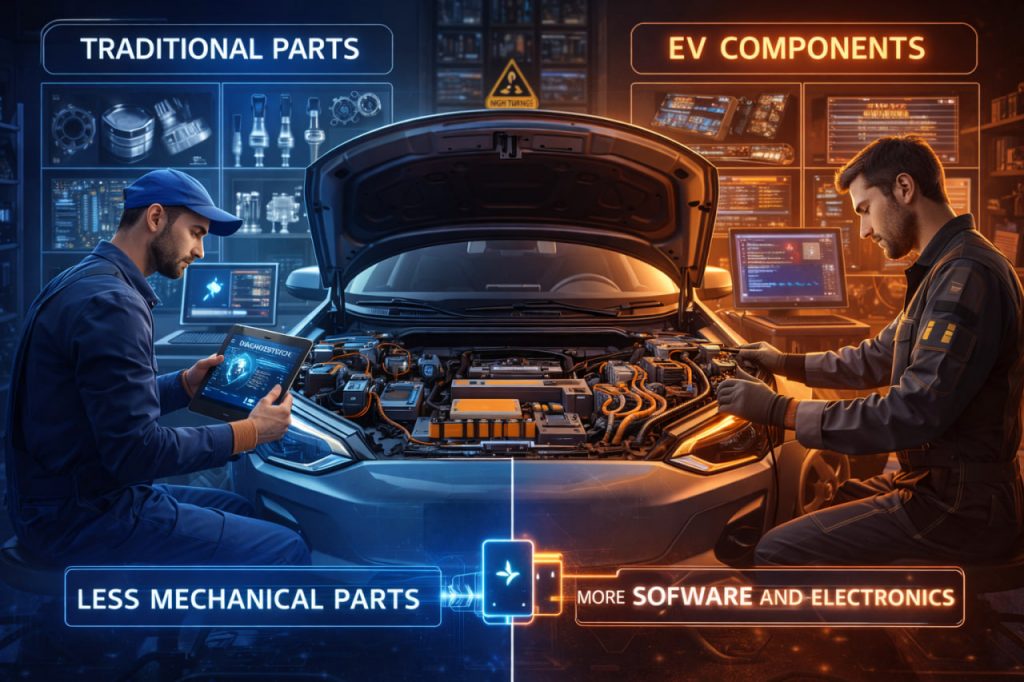
The transition to electric vehicles is not only transforming how cars are powered but also fundamentally reshaping the aftermarket industry — including spare parts, maintenance, and service models. Unlike internal combustion engine (ICE) vehicles, EVs have fewer moving components, different wear patterns, and a stronger reliance on software. This shift is forcing service providers, manufacturers, and suppliers to rethink traditional business models. As EV adoption accelerates, the entire ecosystem of automotive service is undergoing a structural transformation.
Fewer Mechanical Parts, Less Traditional Maintenance
One of the most significant differences between EVs and ICE vehicles is the reduction in mechanical complexity. Electric vehicles do not require:
- engine oil changes
- fuel system maintenance
- exhaust system repairs
- transmission servicing in the traditional sense
This leads to a decline in demand for many traditional spare parts and services.
According to automotive engineer Dr. Laura Mendes:
“Electric vehicles eliminate many of the high-frequency maintenance tasks that have sustained the service industry for decades.”
As a result, workshops that rely heavily on routine maintenance must adapt to new revenue streams.
New Critical Components: Batteries and Electronics
While EVs reduce mechanical complexity, they introduce new critical components:
- battery packs
- battery management systems (BMS)
- power electronics
- electric motors
The battery, in particular, becomes the most important and expensive component. Diagnostics, repair, and replacement require specialized skills and equipment.
This shift is creating demand for high-voltage specialists, technicians trained to safely handle EV systems.
Rise of Software-Driven Maintenance
Modern EVs rely heavily on software systems to manage performance, battery health, and user experience. Many issues that would traditionally require mechanical repair can now be resolved through:
- over-the-air (OTA) updates
- remote diagnostics
- predictive maintenance
According to automotive software expert Michael Turner:
“In EVs, maintenance is increasingly becoming a software problem rather than a mechanical one.”
This reduces service center visits while increasing the importance of digital infrastructure.
Predictive Maintenance and Data Analytics
EVs generate large amounts of operational data. Manufacturers use this data to implement predictive maintenance, identifying potential issues before they become critical.
For example:
- battery degradation trends
- thermal management anomalies
- component performance deviations
This approach improves reliability and reduces unexpected breakdowns.
Changes in the Spare Parts Market
The EV transition is reshaping the automotive parts supply chain:
- declining demand for engine-related parts
- growing demand for electronic components
- increased importance of battery recycling and refurbishment
Suppliers must adapt by shifting production toward EV-specific components. At the same time, new players are entering the market, particularly in battery technology and electronics.
Independent Workshops vs Authorized Service Centers
EVs pose challenges for independent repair shops. Access to proprietary software, diagnostic tools, and high-voltage systems can be restricted by manufacturers.
This creates a shift toward:
- authorized service networks
- specialized EV repair centers
However, independent workshops that invest in training and equipment can still remain competitive.
Workforce Transformation
The rise of EVs is changing the skills required in the automotive workforce. Traditional mechanics must transition toward roles that involve:
- electrical engineering knowledge
- software diagnostics
- data analysis
According to workforce development expert Dr. Kevin Liu:
“The future automotive technician will be as much a software specialist as a mechanic.”
Training and education programs are evolving to meet these new demands.
Environmental Impact and Circular Economy
EVs are also influencing sustainability in the service sector. The focus is shifting toward:
- battery recycling
- second-life battery applications
- reduced waste from fewer consumables
This supports the development of a circular economy, where components are reused and recycled rather than discarded.
Challenges in the Transition
Despite the opportunities, the transition presents challenges:
- high cost of diagnostic equipment
- need for specialized training
- regulatory uncertainty
- battery repair complexity
Service providers must invest significantly to remain relevant in the EV era.
The Future of EV Service and Parts Market
Looking ahead, the service industry will become more digital, specialized, and data-driven. Key trends include:
- remote diagnostics as a standard
- subscription-based maintenance services
- integration with smart infrastructure
- AI-assisted diagnostics
The traditional service model based on frequent mechanical repairs will gradually be replaced by a more predictive and technology-driven approach.
Conclusion
The rise of electric vehicles is fundamentally transforming the automotive parts and service market. While demand for traditional mechanical components is declining, new opportunities are emerging in batteries, electronics, and software-driven maintenance. This shift requires adaptation across the entire ecosystem—from technicians and workshops to suppliers and manufacturers. As EV adoption continues to grow, the aftermarket industry will evolve into a more advanced, efficient, and technologically focused sector.