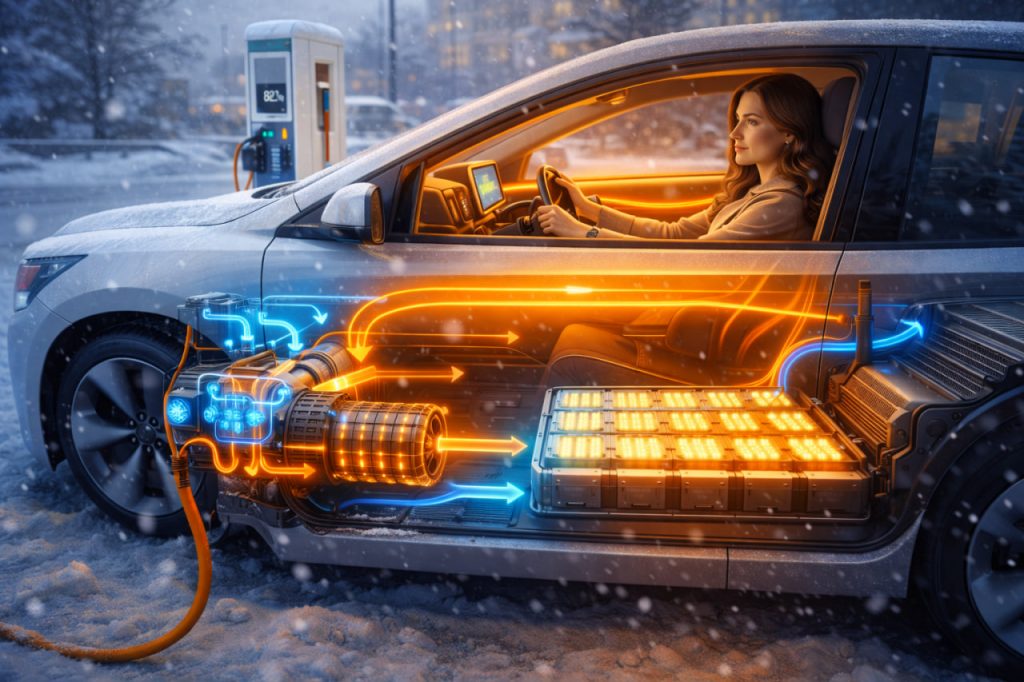
Thermal management is one of the least visible yet most important systems in a modern electric vehicle, and heat pumps have become a key innovation in making EVs more efficient year-round. Unlike traditional cabin heaters that simply consume electricity to generate heat, heat pumps move existing thermal energy from one place to another. This difference may sound subtle, but in real-world driving it can significantly reduce energy consumption, especially in cold weather. Understanding why heat pumps matter helps explain why some EVs maintain better winter range than others.
Why Heating Is a Major Energy Drain in EVs
In a combustion car, cabin heat is essentially free because it comes from engine waste heat. Electric vehicles do not have this luxury. Without an engine producing excess heat, EVs must actively generate warmth for the cabin and for battery conditioning. Early electric cars relied on resistive heaters, which convert electricity directly into heat. While simple and reliable, this method is inefficient, particularly in winter, where cabin heating alone can reduce range by 20–40%. This challenge made climate control one of the biggest hidden energy costs in electric driving.
What a Heat Pump Actually Is
A heat pump is a system that transfers heat instead of creating it. It uses a refrigerant, a compressor, valves, and heat exchangers to absorb heat from the outside air—or from vehicle components—and move it into the cabin or battery system. Even cold air contains usable thermal energy, and heat pumps are designed to extract it efficiently.
“A heat pump doesn’t generate heat; it relocates it, which is why it can deliver two to three units of heat for every unit of electrical energy used,” — Dr. Martin Keller, automotive thermal systems engineer.
How Heat Pumps Work Inside an Electric Car
In an EV, the heat pump integrates with the HVAC system, battery cooling loop, power electronics, and sometimes even the electric motor. During cold weather, the system pulls ambient heat from outside air and channels it into the cabin and battery. During warm weather, the same system operates like an air conditioner, removing heat from the cabin and components. Advanced designs dynamically switch modes depending on temperature, driving load, and charging state, ensuring optimal efficiency at all times.
Battery Heating and Charging Efficiency
Beyond passenger comfort, heat pumps play a critical role in battery thermal conditioning. Lithium-ion batteries operate best within a narrow temperature range. In cold conditions, charging a cold battery is inefficient and can accelerate degradation. A heat pump can warm the battery using far less energy than resistive heating, improving charging speed, regenerative braking availability, and overall efficiency.
“Thermal efficiency directly affects battery health and performance, not just cabin comfort,” — Dr. Elena Rossi, electric powertrain specialist.
Real-World Energy Savings and Range Benefits
In practical terms, EVs equipped with heat pumps often consume 10–30% less energy for heating compared to those using resistive heaters. This difference is most noticeable in city driving and winter commuting, where heating demands are constant. Drivers may see tens of kilometers of additional range on a single charge simply because less battery energy is diverted to climate control. Over a full winter season, these savings add up to lower charging frequency and reduced electricity costs.
Cold Climate Performance and Driver Experience
Heat pumps significantly improve the winter driving experience. Cabin warm-up is faster, range estimates are more stable, and regenerative braking remains available sooner after startup. Without a heat pump, EVs often prioritize battery heating over cabin comfort, leading to slower warm-up and higher energy draw. Vehicles with heat pumps can balance both needs more efficiently, making them better suited for colder regions.
Limitations and Trade-Offs
Despite their advantages, heat pumps are more complex than resistive heaters. They add cost, require sophisticated control software, and may lose efficiency in extremely low temperatures. Some EVs still supplement heat pumps with resistive heaters for very cold conditions. However, ongoing improvements in refrigerants and system design continue to expand the effective operating range of automotive heat pumps.
Why Heat Pumps Are Becoming Standard
As EV technology matures, manufacturers are increasingly prioritizing system-level efficiency rather than raw battery size. Heat pumps allow automakers to deliver better real-world range without adding heavier, more expensive batteries. This makes vehicles more affordable, more efficient, and more sustainable over their lifetime.
“The heat pump is one of the most cost-effective ways to increase usable range without increasing battery capacity,” — James Whitaker, EV systems analyst.
Conclusion
Heat pumps are a quiet but powerful technology inside modern electric cars. By moving heat instead of generating it, they dramatically reduce energy consumption for heating, protect battery health, and preserve driving range—especially in cold weather. While often invisible to drivers, heat pumps play a crucial role in making electric vehicles practical, efficient, and comfortable across all seasons.


Ohhh, let’s see how it work at -40?? Like, does it even just die?? 🤔