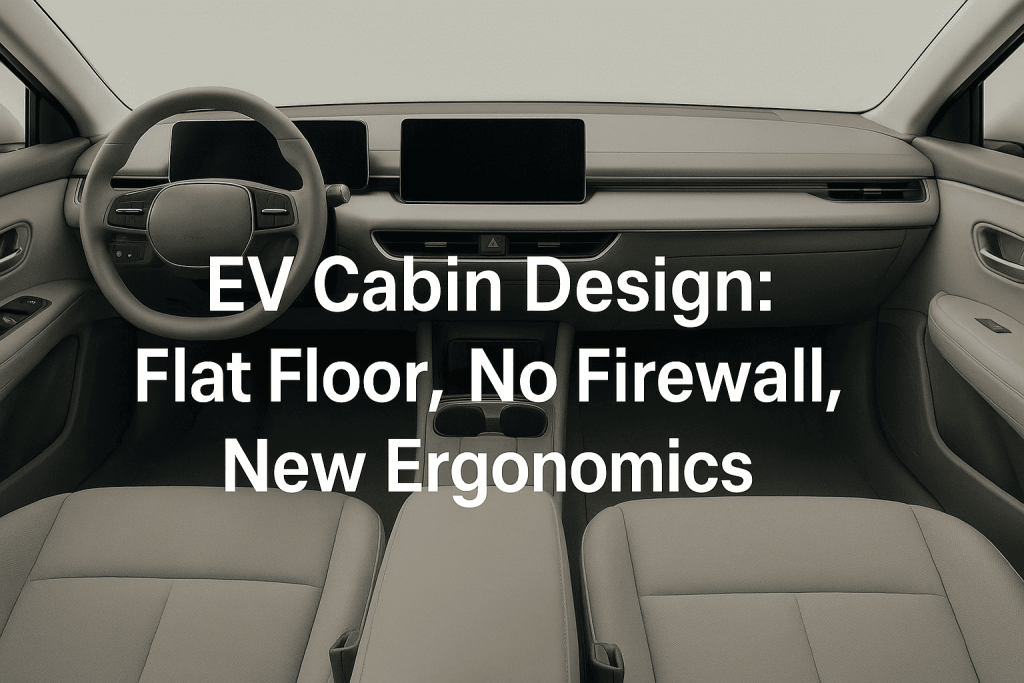
From ICE constraints to EV freedom: Electric skateboard platforms erase two sacred cows of combustion-era interiors—the central transmission tunnel and the bulky engine-side firewall. What’s left is a flatter floor, a shallower “toe board,” and far more flexible packaging. The ripple effects touch everything from seating geometry and storage to crash safety, HVAC routing, and UX. ⚙️⚡
Flat floors change posture and space: A true flat floor lets designers drop the H-point slightly without stealing knee room, while keeping hip-to-heel angles comfortable for long drives. Rear passengers benefit most: no “middle-seat hump,” better foot placement, and easier cross-leg movement. Families notice it when fitting three child seats across or when kids climb into the middle unimpeded.
Goodbye hump, hello modular consoles: With no prop shaft to bridge, the center console becomes optional, not structural. Brands can float thin consoles, create open “bag wells,” or provide removable organizers. Ride-hailing or commercial variants can run full-width benches or slide-out work surfaces. For premium trims, designers can keep a tall console purely for identity and storage—without compromising leg freedom.
Ingress/egress made easier: A flat floor and reduced sill intrusions simplify stepping in and out, especially in tight parking spaces. In accessibility-focused designs, wheelchair transfers and swivel-seat concepts become more feasible because feet aren’t fighting a tunnel and the seat base can sit lower while maintaining view height.
Second row gets first-class treatment: Without a tunnel, the rear footwell grows and the floor can be contoured for equal comfort at all three seating positions. Designers can align seat rails to allow fore–aft sliding second rows, reclining backs, or fold-flat tricks that were awkward around a driveshaft hump. Road-trip comfort jumps noticeably. 🧳
Firewall reimagined, not removed: In EVs the “firewall” evolves into a thin, multi-layer partition optimized for acoustics, thermal isolation, and crash load paths rather than heat shielding a hot ICE. With fewer heat sources up front, dash bulk can shrink, opening knee room and allowing lower, slimmer IP (instrument panel) designs—great for sight lines and airbag packaging.
Better visibility, lighter-feeling cabins: Pushing the dash forward and down improves forward vision and makes cabins feel airier. Pair a low cowl with thin battery-era HVAC ducts and you enable minimalist layouts without stealing storage. It also helps with motion sickness mitigation in robotaxi concepts by boosting eye-to-horizon visibility.
HVAC, heat pumps, and quiet packaging: EV HVAC modules and heat pumps are more compact and can be split across front and underfloor zones. Shorter duct runs and seat-integrated outlets heat and cool occupants faster with less energy. No tunnel means easier underfloor routing for ducts and harnesses, improving serviceability and reducing whistling or boom resonances.
Storage everywhere: frunks, sub-trunks, and pass-throughs: Without a front engine and internal tunnel, designers unlock frunks, deep rear wells, and long pass-throughs for skis or boards. The center “open bay” ahead of the console becomes a natural handbag or laptop garage with inductive charging pads, cable cubbies, and bag hooks.
Safety: new load paths, same protection mandate: While the ICE firewall shrinks, crash energy still needs to bypass the cabin. EVs use front crash boxes, cast nodes, and upper load paths that route forces around occupants. Under the floor, the battery enclosure, sills, and crossmembers create a strong safety cage. In side impacts, a flat floor allows straighter, stiffer crossmembers; in frontal impacts, the absence of an engine block reduces toe-pan intrusion risk.
NVH: quieter by default—then tuned: Losing a powertrain tunnel removes a noise chimney. Electric motors shift the soundscape toward high-frequency inverter/motor harmonics and road/tire roar. Designers can fill the underfloor with acoustic foam, use laminated glass, and tune motor mounts and seals for a serene cabin. The result: conversation-level quiet at speed, a boon for voice UX and conference calls. 🤫
Thermal comfort and battery realities: The battery’s underfloor location raises the foot plane slightly. Smart contouring and localized floor heating (or seat heaters) keep toes warm without wasting energy. In hot climates, a flat, insulated floor cuts radiant heat and reduces the blast required from vents.
Seating freedom—within airbag physics: With no tunnel, designers can float slimmer seat bases and add under-seat drawers. But airbags, belt anchor geometry, and crumple zones still constrain extreme experimentation. Structural seatbacks, pretensioners, and far-side airbags must coordinate with lower consoles that no longer act as “brace points.”
UX: fewer mechanical controls, smarter surfaces: EV packaging invites cleaner dashboards and larger displays, but touch-only isn’t a panacea. The best cabins keep a few tactile controls for eyes-off tasks (drive mode, wipers, temp set-point) while offloading the rest to contextual UI. Freed space allows better phone docks, camera status bars, and HUDs without crowding.
Materials and sustainability: With flatter floors and simpler structures, designers can use large-area carpets from recycled fibers, plant-based foams, and modular trim panels that are easier to remove and refurbish. Remanufacturable consoles and swappable décor strips let fleets refresh cabins without landfill waste. 🌱
Structural battery packs and the “virtual tunnel” myth: Some EVs still show a gentle floor crown or a low spine. That’s not a driveshaft—often it’s a stiffening rib or a cooling manifold over the pack, or packaging for exhaust-like aero tunnels under the car. The ergonomic impact is minor versus the ICE hump, yet it can improve torsional rigidity and crash performance.
PHEVs and legacy platforms—edge cases: Hybrids on adapted ICE platforms may keep partial tunnels for exhaust, fuel lines, or rigidity, limiting the EV-style gains. Purpose-built EV platforms unlock the full flat-floor promise, especially in long-wheelbase SUVs and vans where second and third rows benefit most.
Cargo modes and “work cabins”: Commercial EVs leverage the open floor for rolling offices: swivel chairs, fold-down desks, and lockable tool bays between seats. Without the hump, floor rails can host modular fixtures, from bike mounts to pet barriers, expanding use cases without custom fabrication.
Child seats and family ergonomics: A level second-row floor simplifies ISOFIX access and lets caregivers kneel squarely when buckling kids. Strollers slide into the center bay, and bottle/diaper storage fits under floating consoles. The small daily wins add up to genuine quality-of-life upgrades for parents.
Future directions: lounge layouts and autonomy: As assisted driving grows, seating may swivel or recline further while maintaining belt effectiveness via seat-integrated restraints. Flat floors and thin dash structures are prerequisites for these “living room” modes, with deployable tables and mixed-reality displays that don’t clash with knees and feet.
Design identity without the mechanical centerpiece: ICE cabins often used the tunnel as a spine for brand character. EVs must find new anchors—light signatures, material contrasts, floating architecture, and smart storage theatrics. The upside: cleaner sightlines and calmer forms that age well.
Cost and manufacturing simplicity: Eliminating the tunnel removes stampings, brackets, and trim parts. Fewer unique carpets and fewer console variants cut cost and complexity. Savings can be reinvested into better seats, audio, or ADAS sensors that directly uplift perceived quality.
Ergonomic cautions—don’t go too low: A flat floor tempts an ultra-low seat base, but excessive knee bend or insufficient thigh support fatigues taller occupants. The best EV cabins pair the flat floor with carefully sculpted cushions, adjustable tilt, and thoughtful foot clearance beneath front seats for rear passengers.
Charging-era habits influence interiors: With frequent short stops instead of rare long ones, cabins need smarter quick-access zones for snacks, cables, and cards. Open bays, magnetized lids, and wipe-clean surfaces matter more than ever, especially for high-usage fleet vehicles.
Conclusion: Removing the tunnel and rethinking the firewall doesn’t just free space—it rewires the ergonomics and identity of the EV cabin. Flat floors unlock equal-comfort seating, flexible storage, cleaner sightlines, and easier access, while modern safety structures and HVAC layouts preserve protection and comfort. Done right, this design freedom yields quieter, more human-centric interiors that feel bigger, work smarter, and adapt to the many lives an EV must serve. 🚀

no tunnel, more space – hell yeah! 😎