Electric vehicles are more than transport—they’re rolling energy assets. Vehicle-to-Home (V2H) and Vehicle-to-Building (V2B) turn a parked EV into a smart, bidirectional battery that can power your house or office, shave peak electricity costs, and keep critical loads running during outages. Think of it as mobility that pays rent to your meter.
V2H vs V2B: What’s the difference?
V2H serves a single residence: your EV discharges through a bidirectional charger or an onboard inverter to supply household circuits, typically during evening peaks or blackouts. V2B scales the same idea to commercial buildings—offices, stores, or campuses—where aggregated vehicles can offset demand charges, participate in demand response, and stabilize the site’s power profile.
The hardware stack you actually need
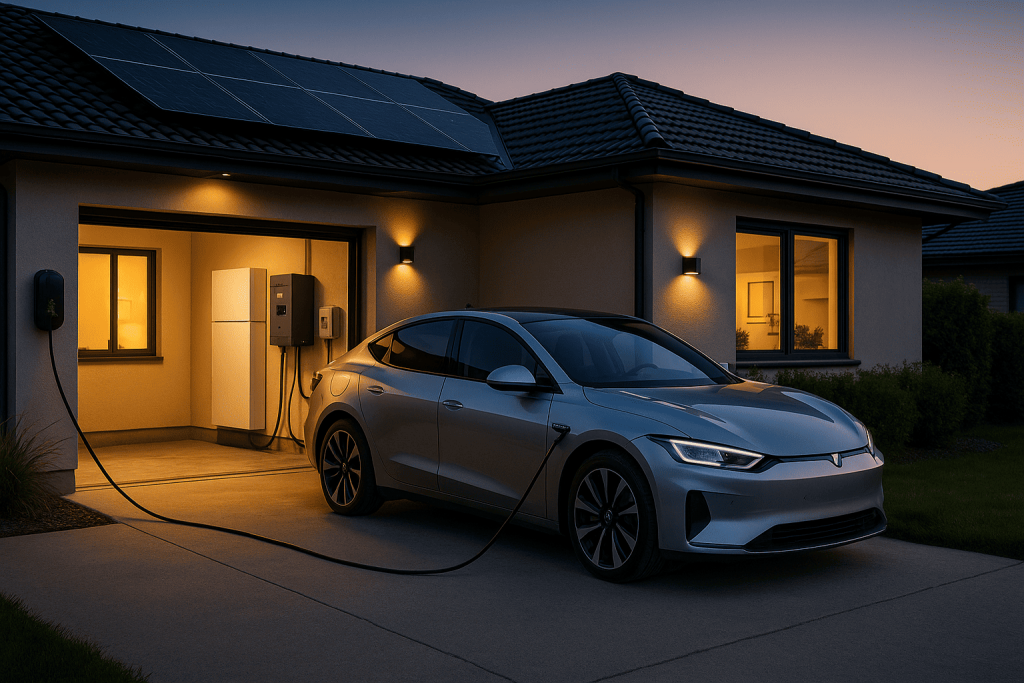
At minimum, you need a V2X-capable EV, a certified bidirectional charger (AC or DC), site protection gear (islanding/transfer switch), and a smart energy controller. DC systems (CHAdeMO today, CCS ISO 15118-20 rolling out) push higher power and efficiency; AC systems rely on the car’s inverter and can be simpler to install. In both cases, anti-islanding protection is mandatory so you don’t backfeed the grid during outages.
How the money math works (and why it’s about timing)
Electricity is cheap when the grid is flush with wind/solar and expensive when everyone cooks dinner. V2H/V2B exploits that spread: charge at off-peak (or from rooftop PV), then discharge during peak windows. Homes save via time-of-use arbitrage and backup value; businesses save even more by cutting demand charges—often 20–50% of a commercial bill—by shaving the month’s worst 15-minute peaks.
Smart charging is the secret sauce
Bidirectional is only half the story; the “smart” part decides when to flow energy. Algorithms look at your calendar, weather, PV forecast, and tariff schedule, then enforce guardrails like minimum state-of-charge (SOC) before your morning commute. For offices, controllers track occupancy and HVAC loads, discharging cars exactly when building demand spikes.
Backup power: your EV as a quiet generator
With a transfer switch, V2H keeps critical circuits alive—fridge, lighting, internet, gas boiler pumps—during outages. A 60–80 kWh EV can cover essential loads for one to three days, depending on usage. Unlike fuel generators, it’s silent, instantly available, and emissions-free. For V2B, fleets can sustain emergency lighting, IT racks, access control, and cash registers through short grid disturbances.
Battery health: will V2X wear out my pack?
Shallow, temperature-managed cycling used for peak shaving is gentler than road use. Modern control keeps discharge windows narrow (e.g., 30–70% SOC), limits depth-of-discharge, and preconditions cells. Empirically, well-managed V2X adds relatively few equivalent full cycles per year. Look for warranties that explicitly allow V2X within defined limits to protect resale value and peace of mind.
Home integration: circuit-level or whole-home?
Two approaches exist. Critical-load subpanels back up only essential circuits—cheaper and more efficient. Whole-home systems provide seamless coverage but require larger transfer switches and careful load management to avoid tripping during high-demand events (ovens, EV+EV). Circuit-level monitoring helps you see which appliances dominate and lets automation shed non-essentials during discharge.
Office playbook: policies, parking, and payroll
For V2B, define employee participation (opt-in), compensation (kWh credits, parking perks), minimum SOC guarantees, and parking allocation near bidirectional chargers. Staggered departure times increase available flexibility. Facilities teams coordinate with finance to capture demand-charge savings and with IT for metering data. Clear communication—“we’ll never leave you under X%”—drives adoption.
Solar synergy: charge from your own roof
Pairing rooftop PV with V2H/V2B turns midday surplus into evening resilience. Instead of exporting at low midday tariffs, you store energy in cars and deploy it at high-value times. Add a small stationary battery if you want overnight autonomy without depending on vehicle presence.
Interoperability and standards in plain English
Today’s practical V2H uses CHAdeMO in several models; CCS with ISO 15118-20 (true bidirectional) is arriving across more brands. “Plug & Charge” simplifies authentication; open charge-point protocols (OCPP) keep your hardware vendor-agnostic. If you’re buying now, ensure your charger and car are certified for the same V2X standard and your installer knows local interconnection rules.
Safety and compliance checklist
Use certified electricians. Install grid-isolation (transfer) switches. Verify earthing/grounding and fault-current ratings. Ensure anti-islanding and rapid disconnection. Label backed-up circuits. Keep firmware updated. For offices, coordinate with your DSO/utility and follow interconnection procedures to avoid export penalties.
Who benefits most, right now
Homes with time-of-use tariffs, frequent short outages, or rooftop PV. Small businesses facing stiff demand charges (restaurants, retail, clinics). Fleets that park predictably (delivery vans, service vehicles, pool cars). Early adopters with compatible EVs and a willingness to set sensible SOC rules see outsized value.
Practical starter plan for a home
Pick a V2H-capable car and certified bidirectional charger. Add a critical-load subpanel (fridge, lights, internet, boiler). Set SOC floor (e.g., 40%) and schedule off-peak charging. Enable discharge only during peak tariff or outages. Review monthly savings and tweak limits—comfort first, savings second.
Practical starter plan for an office
Audit peak intervals and identify the two worst 15-minute windows. Install a small bank of bidirectional chargers in priority spots. Offer employees credits to plug in by 9:00 with a 60–80% departure guarantee. Configure the controller to discharge only during peak alerts. Track demand-charge reductions and expand bays as ROI proves out.
Limitations to respect
You need a compatible EV and charger, an updated electrical panel, and clear tariffs. If your grid export is restricted, focus on behind-the-meter self-consumption. Vacation periods reduce available vehicle capacity—plan critical loads accordingly or complement with a small stationary battery.
Future outlook: from V2H/V2B to V2X everywhere
As more EVs ship with CCS bidirectional support and utilities formalize flexibility markets, cars will routinely arbitrage prices, support neighborhoods, and back up homes. Expect tighter solar integration, automated enrollment, and simple dashboards showing savings, avoided CO₂, and guaranteed morning SOC.
Conclusion
V2H and V2B transform your EV from a cost center into a smart energy partner—cutting bills, boosting resilience, and smoothing the grid. With the right hardware, safe installation, and sensible SOC rules, you get quiet backup power at home and measurable savings at work. It’s Smart Charging made tangible: energy efficiency you can feel every evening when the lights stay on and the meter spins a little slower.