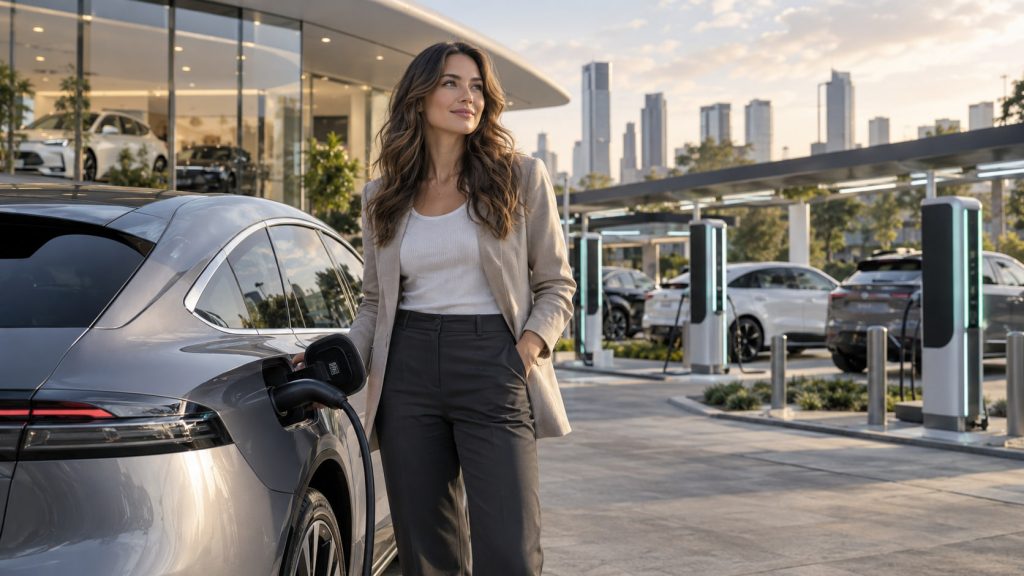
A decade ago, electric cars were still treated as an experiment by much of the automotive industry. In 2015, buyers had only a small selection of serious battery-electric vehicles, public charging remained limited, long-distance travel required careful planning, and most global manufacturers continued to build their strategies around gasoline and diesel engines.
Today, the picture is dramatically different.
Electric vehicles have evolved from niche products into one of the central forces reshaping the global car industry. Battery costs have fallen, driving ranges have increased, charging speeds have improved, dedicated EV platforms have become common, and China has emerged as an extraordinarily powerful center of electric-car development and production.
At the same time, the transition has proved more complicated than early enthusiasts expected. Infrastructure remains inconsistent, battery-electric cars are not ideal for every buyer, manufacturers are struggling with enormous investment requirements, and the market has become brutally competitive.
The biggest change of the past decade is not simply that electric cars have become better. The entire automotive industry has started reorganizing itself around electricity, batteries, software, and computing power.
Electric Cars Were Still a Niche in 2015
The electric-car market of 2015 looked almost primitive compared with today’s industry.
A handful of recognizable models defined the segment. The Nissan Leaf demonstrated that a relatively affordable battery-powered hatchback could work as everyday transportation. Tesla’s Model S showed that an EV could also be fast, luxurious, technologically advanced, and desirable.
BMW offered the unusual i3, while several other manufacturers sold electric vehicles in limited numbers or primarily to satisfy regulatory requirements.
Global electric-car sales were measured in hundreds of thousands rather than tens of millions.
According to historical data from the International Energy Agency, roughly half a million electric cars were sold worldwide in 2015. By 2024, annual electric-car sales had exceeded 17 million, representing more than one-fifth of new cars sold globally.
That change is extraordinary.
In less than a decade, EVs moved from approximately one percent of global new-car sales to more than 20 percent.
The growth has not been evenly distributed. China leads by a large margin, Europe has built a substantial EV market, and adoption in the United States has grown more gradually.
Nevertheless, electric propulsion is no longer a fringe technology.
Driving Range Has Changed Completely
Range anxiety was probably the most famous criticism of early electric cars.
The original Nissan Leaf offered roughly 100 miles or less of real-world driving under many conditions. Several other affordable EVs operated in a similar range.
That was sufficient for commuting, but long journeys demanded planning.
Modern electric cars are fundamentally different.
A typical mainstream EV may now provide somewhere around 250 to 350 miles of rated range depending on the testing standard, while several premium models can go significantly farther.
The improvement comes from multiple factors:
- Larger battery packs
- Higher energy density
- More efficient motors
- Better aerodynamics
- Improved thermal management
- More sophisticated software
- Lower electrical losses
Range is no longer automatically the biggest weakness of an electric vehicle.
For many drivers, modern battery capacity comfortably exceeds normal daily requirements.
The debate has consequently shifted.
Instead of asking whether an EV can travel far enough, buyers increasingly ask how quickly it can recover range when the battery is low.
Charging Speed Has Become Almost as Important as Battery Size
Early electric cars often relied on relatively slow charging.
Today, premium 800-volt electrical architectures can accept extremely high charging power under appropriate conditions.
Some modern EVs can add hundreds of kilometres of usable range during a short motorway stop.
Vehicles from companies such as Hyundai, Kia, Porsche, Audi, Lucid, Tesla, and numerous Chinese manufacturers demonstrate how dramatically charging technology has progressed.
Battery preconditioning has also become more common.
Before reaching a fast charger, the car can automatically bring the battery toward the optimum temperature for rapid charging.
This sounds like a minor software feature, but it can significantly improve charging performance in cold weather.
The important specification is no longer simply peak charging power. What matters is the entire charging curve.
A vehicle that briefly reaches an impressive maximum but rapidly reduces power may charge more slowly overall than one capable of maintaining high power for longer.
Consumers have therefore become more sophisticated about EV specifications.
Charging Networks Have Expanded Enormously
Charging infrastructure has also transformed.
Ten years ago, electric-car owners in many countries depended primarily on home charging and a relatively small collection of public chargers.
Long-distance EV journeys could require considerable research.
Today, major motorway corridors in many developed markets have extensive fast-charging networks.
Charging stations have become more powerful, navigation systems can route automatically through them, and modern vehicles can estimate arrival battery percentage before reaching the charger.
Tesla played an important role in demonstrating the value of a tightly integrated charging network.
Its Supercharger system made long-distance electric driving significantly easier because the vehicle, navigation software, payment system, and chargers were designed to operate together.
Other charging operators have since expanded rapidly.
Infrastructure is still far from perfect. Broken chargers, queues, incompatible payment systems, and insufficient facilities remain problems in some regions.
But the comparison with 2015 is dramatic.
Battery Prices Have Collapsed
Perhaps no development has influenced the EV industry more than falling battery costs.
Lithium-ion batteries were extremely expensive when modern mass-market electric cars first appeared.
BloombergNEF has tracked battery-pack prices for years and reported that average lithium-ion pack prices fell to approximately $115 per kilowatt-hour in 2024.
In the middle of the previous decade, average prices were several times higher.
This reduction has been made possible by:
- Larger manufacturing volumes
- Better cell chemistry
- Improved factory efficiency
- More competitive supply chains
- Pack simplification
- Technological improvements
Lower battery prices are critical because the battery remains one of the most expensive parts of an electric vehicle.
Every reduction in cost gives manufacturers greater freedom.
They can lower vehicle prices, install larger batteries, improve profit margins, or invest in better charging and thermal systems.
The industry has not yet achieved complete price parity in every segment, but the gap has narrowed dramatically.
Battery Chemistry Has Diversified
A decade ago, the industry seemed focused primarily on maximizing energy density.
Today, manufacturers use different battery chemistries for different purposes.
Nickel-rich lithium-ion cells remain important for vehicles requiring maximum range and performance.
However, lithium iron phosphate batteries have become increasingly influential.
LFP cells generally offer lower energy density than many nickel-based alternatives, but they provide several advantages:
- Lower material costs
- Long cycle life
- Good thermal stability
- Reduced dependence on nickel and cobalt
Chinese battery companies were especially important in bringing LFP technology back into the mainstream.
It is now common in more affordable electric vehicles.
The industry is also investing heavily in sodium-ion batteries, solid-state designs, silicon-rich anodes, improved lithium chemistries, and other technologies.
The battery race is no longer about discovering one perfect chemistry. It is about matching different batteries to different vehicles and missions.
China Has Become the Center of the EV Industry
Perhaps the biggest geopolitical change of the past decade has been the rise of China’s electric-car industry.
Ten years ago, many Western consumers knew very little about Chinese automakers.
Today, companies such as BYD, Geely, SAIC, XPeng, Nio, Li Auto, and numerous others compete in one of the world’s most advanced and aggressive automotive markets.
China has also developed enormous strength in batteries.
CATL and BYD have become two of the industry’s most important battery manufacturers, while Chinese companies occupy major positions throughout the supply chain.
Chinese EV development cycles can also be remarkably fast.
New models frequently arrive with sophisticated infotainment systems, advanced driver-assistance technology, powerful charging systems, and aggressive pricing.
This has placed enormous pressure on established manufacturers.
The global automotive competition of the 2020s is increasingly defined not only by Detroit, Stuttgart, Munich, Nagoya, and Seoul, but also by Shenzhen, Shanghai, Hangzhou, and other Chinese technology centers.
The Electric Car Has Become a Software Product
The traditional automobile was primarily a mechanical machine with electronics added to it.
Modern electric vehicles are moving toward the opposite philosophy: sophisticated computing platforms wrapped in a mechanical product.
Software can now control:
- Power delivery
- Battery temperature
- Charging
- Navigation
- Driver assistance
- Suspension
- Climate systems
- Infotainment
- Energy recovery
- Vehicle personalization
Over-the-air updates have become particularly important.
A manufacturer can modify certain characteristics after the vehicle leaves the factory.
Tesla popularized this concept in the automotive world, and many competitors have followed.
However, software-defined vehicles also create new problems.
A poorly designed infotainment system can make an otherwise excellent car frustrating to use. Software bugs can affect functions that once depended on simple physical controls.
Cybersecurity has also become increasingly important.
Cars are becoming connected computers, and computers require continuous security management.
EV Performance Has Redefined Expectations
Ten years ago, extraordinary acceleration was associated mainly with supercars.
Electric motors changed that relationship.
Instant torque and powerful multi-motor drivetrains made extremely rapid acceleration relatively easy to achieve.
Family sedans and SUVs can now produce performance that would once have required an exotic sports car.
Vehicles capable of accelerating from zero to 60 mph in around three seconds are no longer extraordinary within the premium EV segment.
This has created an unusual situation.
Performance itself is becoming easier to obtain, so manufacturers must find new ways to differentiate their cars.
Chassis tuning, efficiency, braking feel, steering, comfort, software quality, charging performance, and design increasingly matter.
Electric propulsion has made straight-line speed abundant. Making an EV genuinely enjoyable and distinctive is the harder engineering challenge.
Dedicated EV Platforms Have Replaced Early Conversions
Many early electric cars were based on platforms originally designed for combustion engines.
This created compromises.
Battery packs had to fit around structures intended for fuel tanks, exhaust systems, transmissions, and engines.
Modern EV platforms are usually designed around the battery from the beginning.
A large, flat pack can sit beneath the passenger compartment.
This approach can provide:
- Longer wheelbases
- More interior space
- Lower centers of gravity
- Flat floors
- Better structural integration
- Improved crash protection
Some EVs also offer front luggage compartments because there is no large combustion engine occupying the traditional engine bay.
Vehicle proportions have therefore begun changing.
Cabins can move forward, wheelbases can grow, and designers have more freedom to reorganize interior space.
Regenerative Braking Has Become Sophisticated
Regenerative braking was already present in early EVs, but modern systems are much more refined.
Electric motors can operate as generators when the vehicle slows, converting kinetic energy back into electrical energy and storing it in the battery.
Many cars now offer selectable regeneration levels.
Some provide strong one-pedal driving, allowing the driver to complete most normal deceleration without touching the conventional brake pedal.
Others automatically adjust regeneration according to traffic, navigation information, or road conditions.
The technology improves efficiency and reduces wear on conventional friction brakes.
However, manufacturers have learned that brake-pedal calibration matters enormously.
Poor integration between regenerative and mechanical braking can make a vehicle feel unnatural.
Good modern EVs make the transition nearly invisible.
Heat Pumps and Thermal Management Became Serious Engineering Priorities
Early electric cars exposed one of the weaknesses of battery propulsion: heating the cabin can consume substantial energy.
Combustion vehicles have abundant waste heat from the engine.
Electric motors are much more efficient, meaning far less waste heat is available.
Heat pumps have therefore become increasingly common.
They can heat the cabin more efficiently than simple resistance heaters under many conditions.
Sophisticated thermal systems can also move heat between the motor, electronics, cabin, and battery.
This improves range, fast-charging performance, battery durability, and comfort.
Thermal management has evolved from a background engineering detail into a major competitive advantage.
EV Manufacturing Has Become a Cost War
Early electric cars often carried premium prices because batteries were expensive and production volumes were low.
Today, competition has become much more aggressive.
Manufacturers are attempting to reduce:
- Cell costs
- Wiring complexity
- Component counts
- Factory time
- Electronics costs
Gigacasting is one example.
Instead of assembling certain body sections from many stamped components, manufacturers can use very large castings to reduce part count.
Cell-to-pack and structural battery concepts attempt to remove unnecessary packaging around individual cells.
Automakers are also developing highly integrated electric drive units combining motors, inverters, gear reduction, and other components.
The goal is no longer merely to manufacture an electric car.
The goal is to manufacture one profitably at enormous scale.
Established Automakers Have Had to Reinvent Themselves
The EV transition created an extraordinary strategic challenge for traditional manufacturers.
Companies built around more than a century of combustion-engine expertise suddenly had to invest billions in:
- Battery factories
- Electric platforms
- Software
- Power electronics
- Charging partnerships
- New supply chains
At the same time, they still had to build profitable gasoline and hybrid vehicles.
This explains why the transition has not been smooth.
Some manufacturers initially announced extremely aggressive electrification schedules and later revised them as consumer demand developed differently between regions.
Hybrids have consequently regained importance in several markets.
Rather than moving directly from combustion engines to battery-electric vehicles, the industry increasingly recognizes that multiple drivetrain technologies may coexist for years.
Experts Now See Electrification as a Structural Change
International Energy Agency Executive Director Fatih Birol has repeatedly argued that the rapid expansion of electric-car sales represents a fundamental transformation of the global automotive and energy industries rather than a temporary trend.
IEA analysis shows that electric cars are already reducing projected oil demand growth, while continued adoption will increasingly influence fuel markets and energy policy.
This is an important point.
The significance of EVs extends far beyond car manufacturing.
They affect:
- Oil consumption
- Electricity demand
- Battery materials
- Power grids
- Industrial policy
- International trade
Few automotive technologies have implications across so many industries simultaneously.
The EV Industry Still Has Serious Problems
A decade of progress has not solved everything.
Affordable electric cars remain unavailable in some markets.
Public charging quality varies considerably.
Apartment residents may struggle to charge at home.
Insurance and collision repair can be expensive for certain EV models.
Cold-weather range remains lower than ideal.
Large battery packs increase vehicle mass.
Battery mineral extraction creates environmental and social challenges.
Depreciation has also become a concern for some owners because aggressive new-car price cuts and rapid technological improvement can affect used values.
These problems matter.
The EV industry has matured enough that it can no longer dismiss every criticism as resistance to change.
The next phase of electrification will depend less on proving that EVs work and more on making them affordable, convenient, repairable, efficient, and profitable.
Conclusion
The electric-car industry of today barely resembles the market of 2015.
Global sales have moved from hundreds of thousands to many millions per year. Driving ranges have increased dramatically, fast charging has become genuinely useful, battery prices have fallen, and dedicated electric platforms have transformed vehicle packaging.
China has emerged as a dominant force, battery chemistry has diversified, software has become central to vehicle development, and electric performance has changed what consumers expect from ordinary cars.
Perhaps most importantly, electrification is no longer a side project within the automotive industry.
It is now one of the industry’s defining technologies.
The next decade may bring solid-state batteries, cheaper compact EVs, faster charging, better vehicle-to-grid integration, increased battery recycling, more capable driver-assistance systems, and continued competition between battery-electric, hybrid, and other powertrain strategies.
The first decade of modern EV growth proved that electric cars could become mainstream. The next decade will determine which companies can make them cheaper, smarter, more sustainable, and genuinely better than the vehicles they are replacing.