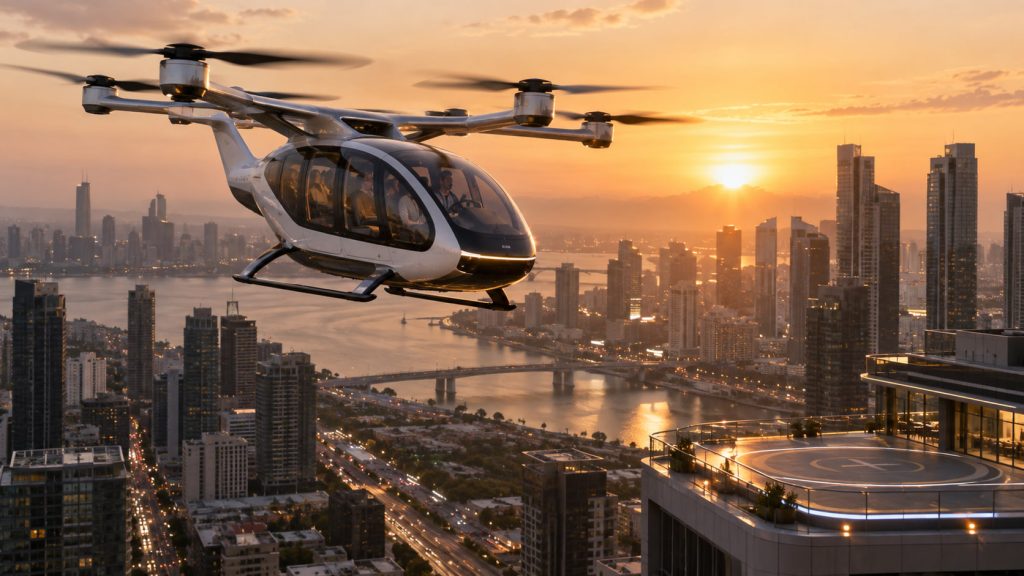
For decades, the idea of avoiding traffic by flying directly across a city belonged mostly to science fiction. Helicopters already made that possible for wealthy passengers and emergency services, but they remained too noisy, expensive, maintenance-intensive, and operationally complex to become a normal part of everyday transportation.
Electric air taxis are designed to change that equation.
Usually described as electric vertical takeoff and landing aircraft, or eVTOLs, these machines combine elements of helicopters, airplanes, electric vehicles, drones, and modern flight-control systems. Most are intended to rise vertically from compact landing areas, transition into efficient forward flight, and carry a small number of passengers over congested cities or between nearby destinations.
The industry has attracted automotive companies, airlines, aerospace manufacturers, technology investors, and transportation authorities. Developers including Joby Aviation, Archer Aviation, and others are working toward passenger service, while regulators in the United States, Europe, and the Middle East are creating rules for an aircraft category that barely existed commercially a decade ago.
Yet air taxis are not simply “flying cars.” Their success will depend on aviation certification, battery performance, noise, weather, infrastructure, economics, and public acceptance.
The technology is becoming increasingly real, but turning experimental eVTOL aircraft into routine transportation is a much larger challenge than making one fly.
What Is an Air Taxi?
An air taxi is a small aircraft designed to transport passengers over relatively short distances on demand or on scheduled routes.
The new generation of air taxis differs from conventional helicopter services because many proposed aircraft use electric propulsion and multiple electric motors rather than a large turbine engine driving a main rotor.
Typical eVTOL concepts include:
- Multiple electric motors
- Several propellers or rotors
- Vertical takeoff and landing
- Battery-electric propulsion
- Digital flight-control systems
- Lightweight composite structures
- Distributed propulsion
- Capacity for a pilot and several passengers
Some designs use rotors that change orientation between vertical and forward flight. Others use separate systems for lift and cruise.
The objective is to combine the compact landing capability of a helicopter with the quieter propulsion, lower mechanical complexity, and potentially lower operating cost associated with electric power.
Why Air Taxis Are Being Developed
The basic transportation problem is easy to understand.
Major urban areas often have enormous investments in roads and public transportation, yet journeys of only a few dozen miles can still take more than an hour during heavy congestion.
An aircraft does not have to follow the same road network.
A trip between an airport and a business district, for example, might require a long drive but a relatively short direct flight.
This has made airport transfers one of the most frequently discussed early applications for eVTOL aircraft. Other possible uses include:
- City-to-city transportation
- Regional commuting
- Medical transport
- Business travel
- Tourist routes
- Cargo delivery
- Connections between transportation hubs
Air taxis are therefore part of a broader concept commonly called Advanced Air Mobility.
The FAA describes Advanced Air Mobility as including passenger transportation, cargo operations, and other uses involving new powered-lift aircraft. The agency has already established regulations covering how these aircraft can be integrated into the national airspace system.
How an Electric Air Taxi Works
The fundamental advantage of electric propulsion is that relatively compact electric motors can be installed in several locations around an aircraft.
A conventional helicopter typically relies on a mechanically complex drivetrain connecting its engine to large rotors. An eVTOL can distribute thrust among numerous electrically driven propellers.
That configuration offers several potential benefits.
If properly designed, distributed propulsion can provide redundancy because the aircraft does not necessarily depend on one propulsion unit. Digital controls can continuously coordinate motor output, aircraft attitude, and transition between vertical and forward flight.
During takeoff, the propulsion system generates enough vertical thrust to lift the aircraft.
Once sufficient altitude is reached, some eVTOL designs transition into forward flight. Wings then produce much of the lift, potentially reducing the amount of power required compared with remaining in helicopter-style hover.
Hovering is extremely energy intensive.
For battery-powered aircraft, efficient forward flight is essential because every unnecessary minute spent hovering consumes valuable energy and reduces practical range.
Batteries Are One of the Biggest Engineering Constraints
Electric cars can tolerate heavy batteries because the wheels support the vehicle.
Aircraft cannot.
Every additional kilogram must be lifted into the air, which creates one of the fundamental challenges facing electric aviation.
Battery packs must simultaneously provide:
- High energy density
- High power output
- Low weight
- Fast charging
- Long cycle life
- Thermal stability
- Strong safety performance
During vertical takeoff, an eVTOL may demand very high power. During cruise, power requirements can fall considerably.
That creates a demanding operating cycle in which batteries repeatedly experience high loads.
Air taxis also need sufficient reserves for contingencies. Aviation operators cannot simply plan to land with the battery almost completely depleted.
Weather changes, unexpected routing, traffic, aborted landings, or unavailable landing sites can all require additional energy.
This is why early electric air taxis are generally being designed for relatively short routes rather than long-distance flights.
Why Air Taxis Could Be Quieter Than Helicopters
Noise may determine whether air taxis are accepted in cities.
Helicopters create distinctive low-frequency rotor noise that can be heard over large areas. If hundreds of aircraft eventually operate above urban neighborhoods, simply replacing helicopters with equally noisy machines would create serious opposition.
Electric motors themselves are comparatively quiet, but propellers and rotors still move large quantities of air.
Manufacturers therefore focus heavily on rotor size, blade shape, rotational speed, aircraft configuration, and flight paths.
Multiple smaller rotors can distribute propulsion differently from a conventional helicopter, while electric motors allow more precise control over rotor speed.
However, “quieter than a helicopter” does not mean silent.
A neighborhood experiencing dozens of flights per hour may respond differently from one experiencing an occasional demonstration flight.
The relevant question is not only how loud one eVTOL is, but how an entire transportation network will sound when operating repeatedly throughout the day.
Safety Standards Will Be Extremely Demanding
Air taxis may look closer to large drones than conventional airliners, but passenger-carrying aircraft must satisfy aviation safety requirements.
In the United States, the FAA classifies many eVTOL designs as powered-lift aircraft, a category combining characteristics of airplanes and rotorcraft.
The FAA issued a final rule in 2024 covering powered-lift pilot qualifications, training, and operations. The agency described powered-lift as the first new category of civil aircraft introduced since helicopters in the 1940s.
Certification examines much more than whether an aircraft can complete a successful flight.
Regulators need evidence covering areas such as:
- Structural strength
- Flight controls
- Propulsion reliability
- Battery safety
- Electrical systems
- Software
- Emergency procedures
- Crashworthiness
- Manufacturing quality
- Continued airworthiness
As of September 2026, the FAA states that it has issued experimental airworthiness certificates to multiple eVTOL manufacturers for testing, but has not yet certified an eVTOL for commercial use in the United States.
That distinction is crucial. A prototype completing thousands of successful test miles is not the same as an aircraft receiving approval to carry paying passengers routinely.
Europe Is Building Its Own Regulatory Framework
Europe is developing a detailed framework for vertical-takeoff aircraft as well.
The European Union Aviation Safety Agency has established requirements for small VTOL-capable aircraft and commercial operations involving these vehicles.
For operations over congested areas, EASA’s framework calls for an enhanced certification standard for qualifying VTOL-capable aircraft, reflecting the higher consequences associated with operating over populated environments.
This illustrates one of the central realities of the air-taxi industry.
Manufacturers are not developing consumer electronics that can be released and improved through software updates after launch. They are building passenger aircraft that must meet aviation-grade safety requirements before widespread commercial operation.
Joby Aviation and the Push Toward Commercial Service
Joby Aviation is one of the most prominent eVTOL developers.
Its aircraft is designed for a pilot and four passengers and uses six electric propulsion units.
In March 2026, Joby announced that its first FAA-conforming aircraft intended for Type Inspection Authorization testing had begun flying. The company said this aircraft would support testing intended to demonstrate compliance with certification requirements, with FAA pilots expected to participate in formal testing.
In its August 2026 shareholder update, Joby continued to state that it was targeting its first passenger operations during 2026 while also preparing demonstration and pilot-program activities in several U.S. markets.
These targets remain dependent on regulatory approvals and the specific authorization under which operations take place.
Joby has also pursued Dubai as an early international market, working with local authorities on a route toward passenger service.
Archer and the Midnight Air Taxi
Archer Aviation is developing an aircraft called Midnight.
The design is intended for short passenger journeys and uses electric propulsion with vertical takeoff capability.
In 2026, Archer reported further progress through the FAA certification process. The company said it had completed Phase 3 of its certification program and was advancing formal compliance testing under Phase 4.
Archer is also pursuing operations in the United Arab Emirates.
In May 2026, the company announced that the UAE General Civil Aviation Authority had moved Midnight into a Restricted Type Certificate pathway intended to support limited initial commercial operations.
The Middle East has become particularly important to the emerging air-taxi industry because cities such as Dubai and Abu Dhabi combine high passenger demand, substantial infrastructure investment, and government interest in advanced transportation.
Vertiports Could Become the Air-Taxi Equivalent of Charging Stations
An eVTOL cannot create useful transportation simply by landing wherever there is empty pavement.
Air taxis need dedicated infrastructure.
These sites are often called vertiports.
A practical vertiport may require:
- Landing and takeoff areas
- Passenger waiting facilities
- High-power charging
- Emergency equipment
- Secure access
- Weather monitoring
- Communications systems
- Maintenance support
- Connections to ground transportation
Location will be critical.
A vertiport that requires a 30-minute drive after landing could eliminate much of the time advantage created by the flight.
The strongest locations may therefore be airports, railway stations, business districts, major hotels, transportation hubs, and other places where passengers already begin or end journeys.
This resembles the early development of electric-vehicle charging.
A technically excellent vehicle provides limited value if the infrastructure surrounding it is inconvenient.
Weather Will Still Matter
Air taxis cannot make weather disappear.
Wind, thunderstorms, heavy rain, icing, visibility, and temperature can all affect flight operations.
Urban areas create additional aerodynamic challenges because tall buildings can generate turbulent air and unpredictable gusts.
NASA has studied control technologies intended to improve ride quality and stability for advanced air mobility aircraft in such environments. The agency has noted that sudden urban gusts can create complex aircraft motions, making active flight-control systems important for passenger comfort and stability.
This is a useful expert perspective because it highlights a problem often missing from futuristic renderings.
An air taxi must work reliably in the real atmosphere above a real city, not just during perfect demonstration conditions.
Will Air Taxis Be Autonomous?
Many people imagine air taxis operating without pilots.
That may eventually happen, but the first significant passenger operations are expected to rely heavily on trained pilots.
There are several reasons.
Certification becomes more complicated when an aircraft must replace human judgment with automated systems. Regulators must consider failure modes, communications, navigation, cybersecurity, and how an autonomous aircraft responds to unexpected conditions.
Starting with pilots also gives passengers a familiar safety model.
Over time, increasing automation could reduce workload and potentially allow remote supervision or autonomous operation.
Removing the pilot could also change the economics because one seat would become available for a paying passenger and labor costs could decline.
But achieving that stage requires much more than demonstrating autonomous flight.
What Will an Air-Taxi Ride Cost?
Early air-taxi services are unlikely to compete directly with ordinary buses or economy cars.
Aircraft are expensive assets. Operators must pay for pilots, insurance, maintenance, charging infrastructure, landing facilities, certification, and fleet management.
The first services may therefore compete more closely with:
- Premium ride-hailing
- Chauffeur services
- Airport limousines
- Helicopter transfers
- Business aviation
Costs could decline if manufacturers successfully produce aircraft at scale and operators achieve high daily utilization.
Electric propulsion may help because electric motors can contain fewer moving parts than turbine drivetrains, potentially reducing some maintenance requirements.
However, batteries also degrade and may represent a significant lifecycle cost.
The long-term economics will depend on how many passengers each aircraft carries, how frequently it flies, how rapidly it can recharge, and how much infrastructure costs.
Air Taxis Will Not Replace Cars
Despite dramatic concept videos, eVTOL aircraft are unlikely to replace ordinary road transportation.
A car can leave directly from a home, carry luggage, operate in poor weather, travel flexible routes, and remain parked until needed.
An air taxi will typically require passengers to travel to a vertiport, complete boarding procedures, fly to another vertiport, and then continue by ground transportation.
That means the two systems are more likely to complement each other.
Autonomous shuttles, taxis, trains, electric cars, and eVTOL aircraft could eventually operate as parts of one connected transportation network.
The most valuable air-taxi routes will probably be journeys where road congestion is severe and the time saved in the air is large enough to justify the extra cost and complexity.
Conclusion
Air taxis have moved beyond the stage of purely speculative concept vehicles. Real eVTOL prototypes are flying, regulators have created powered-lift frameworks, certification programs are advancing, and cities are preparing infrastructure for initial operations.
At the same time, the industry has not yet reached mature mass transportation.
In the United States, no eVTOL aircraft had received FAA certification for commercial passenger use as of September 2026. Companies including Joby and Archer continue to advance testing, certification, manufacturing, and early operational programs, while regulators in Europe and the Middle East develop their own frameworks.
The technology still needs to prove that it can deliver aviation-level safety, acceptable noise, dependable battery performance, reliable all-weather operations, practical infrastructure, and competitive economics.
If those challenges can be solved, the air taxi may become something more important than a futuristic vehicle: a new transportation layer connecting airports, city centers, regional hubs, and road networks from above.