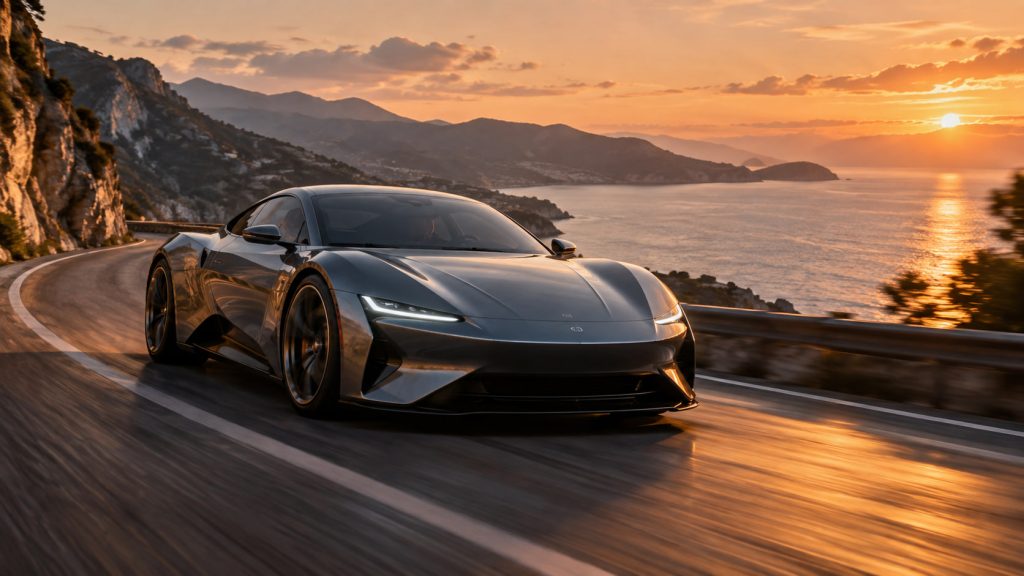
For more than a century, the character of a sports car was closely tied to its engine. Drivers learned to recognize the sound of a high-revving naturally aspirated motor, the surge of a turbocharger, the timing of a perfect gear change, and the mechanical feedback that separated an ordinary car from something genuinely exciting.
Electric performance cars have changed those rules.
Modern sports electric cars can deliver enormous power almost instantly, control torque independently at different wheels, accelerate with a violence that would have seemed unrealistic only a decade ago, and repeat that performance with remarkable precision. Cars such as the Rimac Nevera R, Porsche Taycan Turbo GT, Lucid Air Sapphire, Pininfarina Battista, Hyundai IONIQ 5 N, and Xiaomi SU7 Ultra demonstrate that electrification is no longer limited to efficiency-focused transportation.
Yet acceleration alone does not create a great sports car.
The most interesting development in electric performance is therefore not the race toward ever larger horsepower figures. It is the effort to make heavy, battery-powered machines feel agile, communicative, durable on a circuit, and emotionally engaging.
The electric sports car is entering a new phase: manufacturers are learning that speed is easy to advertise, but driver involvement is much harder to engineer.
Why Electric Motors Are So Effective in Performance Cars
An internal-combustion engine produces its strongest performance within a particular range of engine speeds. Gearboxes keep the engine operating within that useful range, while turbochargers, transmissions, differentials, and launch-control systems help transfer power to the road.
Electric motors behave differently.
They can provide strong torque almost immediately from very low speeds, and their output can be controlled extremely quickly by power electronics. That gives high-performance EVs an enormous advantage when accelerating from a standstill.
A sophisticated electric sports car can also use several motors. Instead of sending power from one engine through a complicated mechanical drivetrain, manufacturers can place motors on different axles or even control individual wheels.
That creates opportunities for extremely precise torque vectoring.
During a corner, software can continuously adjust how much power reaches different wheels, helping the car rotate, reducing unwanted wheelspin, and improving stability.
In a modern performance EV, software is becoming almost as important to handling as springs, dampers, tires, and suspension geometry.
Rimac Nevera R Shows the Extreme End of Electric Performance
The Rimac Nevera helped establish the electric hypercar as a serious performance category. The later Nevera R moves the concept even further toward track-focused driving.
Rimac specifies four electric motors and 2,107 horsepower, combined with an advanced all-wheel torque-vectoring system. In 2025 and 2026, the company continued setting acceleration records with the model, eventually reporting a 0–60 mph time of 1.66 seconds and a maximum recorded speed of 431.45 km/h, or 268.2 mph.
Those figures are extraordinary, but the Nevera R is important for another reason.
Rimac did not simply add more power. The company revised the chassis, battery, brakes, aerodynamics, tires, and downforce characteristics to make the car more responsive in corners.
That reflects the central challenge facing electric hypercars. Once acceleration reaches the point where available tire grip becomes the limiting factor, additional power creates diminishing returns.
A car capable of reaching 60 mph in well under two seconds no longer needs dramatically more launch performance. Engineers instead have to improve braking, thermal management, cornering balance, repeatability, and driver confidence.
Porsche Taycan Turbo GT Proves That Lap Times Matter
Porsche approaches electric performance from a different direction.
The Taycan Turbo GT is a four-door car rather than a low-volume hypercar, yet it has been engineered with serious circuit use in mind. The Weissach Package removes the rear seats, reduces weight, adds aerodynamic modifications, and prioritizes track performance.
Current Taycan Turbo GT specifications list up to 1,019 horsepower with launch-control overboost, while the Weissach-equipped version can accelerate from 0 to 60 mph in approximately 2.1 seconds.
More revealing than the acceleration figure is its circuit performance.
A pre-production Taycan Turbo GT with Weissach Package completed the Nürburgring Nordschleife in 7 minutes 7.55 seconds, while Porsche also recorded a 1 minute 27.87 second lap at Laguna Seca.
Porsche development driver Lars Kern has emphasized that the car’s performance comes from the overall package rather than one headline number. Discussing the car at Laguna Seca, he highlighted acceleration, braking, traction, cornering grip, controllability, and balance as the characteristics that made the difference.
That is an important expert observation.
A genuinely fast electric sports car must manage acceleration, braking, tires, battery temperature, chassis balance, and power delivery as one interconnected system.
Lucid Air Sapphire Combines Supercar Performance With Long Range
The Lucid Air Sapphire demonstrates another possibility: extreme electric performance without abandoning the practicality of a large luxury sedan.
Its three-motor powertrain uses one motor at the front and two at the rear, producing a combined 1,234 horsepower. Lucid quotes a 0–60 mph time of 1.89 seconds, a 205 mph top speed, and an EPA-estimated range of up to 427 miles.
The two rear motors allow sophisticated control of rear-wheel torque. Instead of relying only on a conventional mechanical limited-slip differential, the system can alter torque delivery electronically.
This illustrates a major advantage of multi-motor EV architecture.
Electric power can be used not merely to propel the car but to influence its behavior through corners. Under the right conditions, the control system can effectively help rotate the vehicle by changing the amount of torque delivered to each side.
For manufacturers, this creates an entirely new area of chassis development.
Hyundai IONIQ 5 N Focuses on Driver Entertainment
The Hyundai IONIQ 5 N may be one of the most revealing performance EVs because it attacks the emotional problem directly.
It is not a traditional two-seat sports coupe. Instead, it takes a relatively practical electric platform and adds specialized hardware and software intended to make driving more involving.
The 2026 model produces up to 601 horsepower normally and up to 641 horsepower temporarily with N Grin Boost. Hyundai quotes approximately 3.25 seconds from 0 to 60 mph when the appropriate performance functions are activated. It uses an 84 kWh battery and an approximately 800-volt electrical architecture, with Hyundai quoting an 18-minute 10-to-80-percent charging time under suitable high-power DC conditions.
More unusual are N e-Shift and N Active Sound+.
An electric motor does not require a conventional multi-speed gearbox for normal operation, yet Hyundai intentionally created simulated gear changes. The system modifies torque delivery to reproduce the sensation of changing gears.
From a purely engineering-efficiency perspective, that seems unnecessary.
From a driver’s perspective, it addresses something important.
Traditional performance cars give drivers events to respond to: engine speed rises, a shift approaches, the gearbox changes ratio, and acceleration changes.
A powerful EV with a single-speed transmission can otherwise feel almost too seamless.
Hyundai’s solution shows that the future of sports EVs may involve deliberately adding interaction rather than eliminating every mechanical sensation.
Electric Performance Cars Are Heavy
The greatest physical disadvantage of today’s electric sports cars remains battery mass.
A large lithium-ion battery contains substantial energy, but its energy density is far below that of liquid fuel.
An internal-combustion car becomes lighter as it burns gasoline. An electric vehicle carries nearly the same battery mass whether its state of charge is high or low.
Engineers attempt to compensate by positioning the battery low in the chassis.
This can create a low center of gravity, reducing body roll and giving the car impressive stability. But a low center of gravity does not eliminate mass.
Weight affects:
- Braking distances
- Tire temperatures
- Tire wear
- Suspension loads
- Direction changes
- Energy consumption
- Track endurance
A two-ton performance EV can generate tremendous cornering force, but tires and brakes still have to control that mass.
This is why lightweight construction remains important even in extremely powerful electric vehicles.
Carbon fiber, aluminum, forged wheels, lighter seats, reduced interior equipment, and optimized battery structures are becoming increasingly important in serious performance models.
Battery Temperature Can Matter More Than Battery Capacity
A large battery alone does not guarantee consistent track performance.
Rapid acceleration produces heat in the battery, motors, inverters, cables, and cooling system.
Repeated hard acceleration and regenerative braking can raise temperatures quickly.
When components become too hot, the car may have to reduce available power to protect itself.
This phenomenon is particularly important on racetracks, where a car can spend lap after lap alternating between maximum acceleration and heavy braking.
Performance EVs therefore require sophisticated thermal management.
Cooling systems may regulate:
- Battery cells
- Electric motors
- Inverters
- Power electronics
- Charging systems
Manufacturers increasingly offer battery preconditioning modes specifically for performance driving.
The objective is to bring the battery into an ideal temperature window before maximum power is demanded.
For an electric sports car, thermal endurance can be more meaningful than a spectacular acceleration run performed once.
Regenerative Braking Changes the Driving Experience
Electric performance cars can slow down using their motors as generators.
Instead of converting all kinetic energy into heat at the brake discs, regenerative braking sends some of that energy back into the battery.
This offers obvious efficiency advantages, but it also creates opportunities for performance tuning.
Engineers can change the amount of regenerative braking according to driving mode, battery condition, corner entry, and driver preference.
However, conventional friction brakes remain essential.
At very high speeds, during repeated track use, or when the battery cannot accept sufficient regenerative power, physical brakes must dissipate enormous amounts of energy.
That is why extreme EVs still use large high-performance brake systems, often including carbon-ceramic components.
The ideal system blends regenerative and friction braking without making the brake pedal feel inconsistent.
Performance EVs Are Becoming More Aerodynamically Aggressive
Range-focused electric cars often prioritize low aerodynamic drag.
Sports EVs have a more complicated requirement.
They still need efficiency, but high-speed cornering requires aerodynamic stability and downforce.
Adding a large wing can increase grip but also increase drag and energy consumption.
Engineers therefore use:
- Active aerodynamic elements
- Diffusers
- Adjustable spoilers
- Venturi tunnels
- Controlled cooling openings
- Carefully managed underbody airflow
The Rimac Nevera R, Taycan Turbo GT Weissach, and other track-focused EVs demonstrate how performance design is moving beyond simple drag reduction.
The fastest electric cars increasingly need aerodynamic solutions resembling those found on conventional supercars.
China Is Becoming a Major Electric Performance Player
The rise of Chinese EV manufacturers is also changing the performance market.
Xiaomi’s SU7 Ultra demonstrates how quickly the boundaries are moving. Xiaomi describes the car as using a three-motor system with up to 1,548 PS and quotes 0–100 km/h in 1.98 seconds, along with a designed maximum speed of 350 km/h.
Its significance goes beyond the specification sheet.
Chinese manufacturers increasingly combine powerful electric drivetrains with advanced electronics, battery technology, sophisticated chassis controls, and aggressive pricing.
Traditional European and American sports-car manufacturers are therefore facing competitors that did not exist in the premium performance market a generation ago.
Electric Hypercars Have Created a New Performance Ceiling
At the most expensive end of the market, the Pininfarina Battista illustrates how electric power has transformed hypercar specifications.
The Battista uses four motors and a 120 kWh battery. Automobili Pininfarina lists 1,900 horsepower, a 0–100 km/h time of 1.86 seconds, a 350 km/h top speed, and a claimed range of 476 km.
Performance of this level was once associated with purpose-built racing machinery.
Now it can be delivered by a road-legal luxury car with an electric drivetrain.
The challenge is no longer proving that electric cars can be fast.
That question has been answered decisively.
What Electric Sports Cars Still Need to Improve
Despite spectacular progress, several weaknesses remain.
Weight is the most obvious. Battery technology must improve if manufacturers want electric sports cars that combine high energy capacity with the agility of lighter combustion vehicles.
Charging is another limitation.
Fast charging has improved dramatically, but restoring energy still takes much longer than filling a fuel tank. That matters particularly during repeated track sessions or long-distance performance driving.
Driver engagement also remains controversial.
Some enthusiasts prefer the immediate torque and smoothness of an electric motor. Others miss engine sound, manual transmissions, and mechanical vibration.
Manufacturers are experimenting with different answers rather than assuming one philosophy will satisfy everyone.
Future sports EVs may use simulated gearshifts, artificial sound, sophisticated torque-vectoring modes, active aerodynamics, steer-by-wire tuning, or radically lighter batteries.
The Future of the Electric Sports Car
The next major breakthrough may not be another vehicle with dramatically more horsepower.
Two thousand horsepower already exists.
What matters now is using electrical technology more intelligently.
Future electric sports cars are likely to focus increasingly on:
- Lower mass
- Higher battery energy density
- Faster charging
- Better cooling
- Greater track endurance
- More precise torque vectoring
- Improved brake feel
- Stronger driver feedback
- More efficient aerodynamics
- Better integration of software and chassis hardware
Solid-state and other advanced battery technologies could eventually reduce some of the compromises, although mass production, cost, durability, and manufacturing scale remain important hurdles.
The most successful electric sports cars will probably not attempt to imitate combustion cars in every detail.
They will instead develop characteristics that are uniquely electric.
Conclusion
Sports electric cars have already destroyed the idea that battery-powered vehicles must be slow or purely practical.
The Rimac Nevera R demonstrates the astonishing acceleration possible with four independently controlled motors. The Porsche Taycan Turbo GT shows that an EV can be engineered around serious lap-time performance. The Lucid Air Sapphire combines supercar acceleration with long-distance capability, while the Hyundai IONIQ 5 N demonstrates that software can be used to create more driver interaction rather than simply making the car faster. Meanwhile, vehicles such as the Pininfarina Battista and Xiaomi SU7 Ultra illustrate how broad and competitive the electric performance market has become.
But enormous horsepower figures are only the beginning.
The defining question for the next generation of sports electric cars is no longer whether an EV can outperform a combustion car in a straight line. It is whether manufacturers can make electric performance lighter, more repeatable, more communicative, and more enjoyable when the road begins to turn.