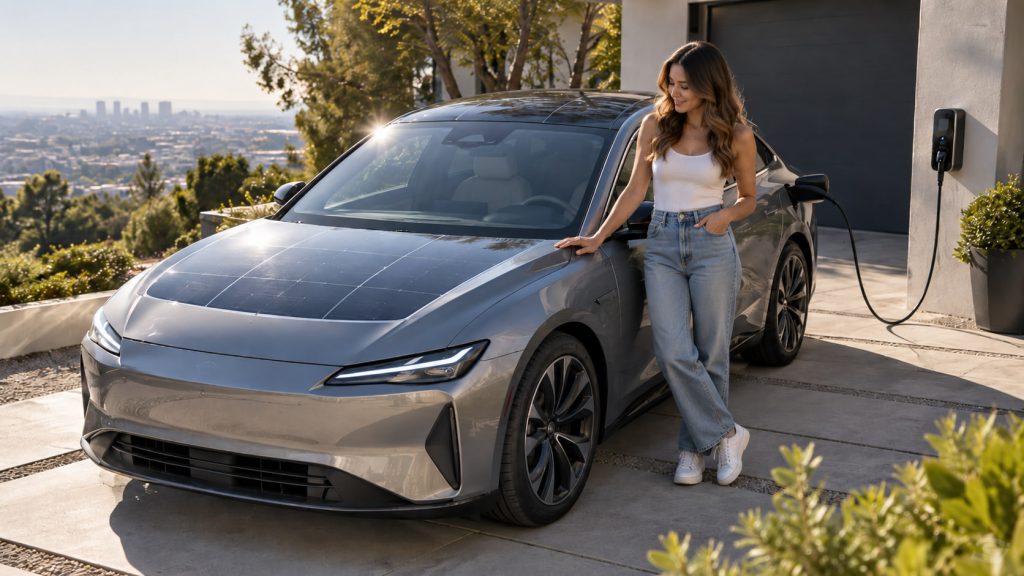
The idea sounds almost perfect: park an electric car in the sun, let solar panels recharge the battery, and drive away using energy collected directly from the sky. No charging station, no cable, no electricity bill. For an industry built around batteries and charging infrastructure, a solar electric car appears to offer the ultimate form of independence.
Reality is more complicated.
Solar panels on electric cars are technically useful, and vehicle-integrated photovoltaics are a serious area of research. Solar energy can extend driving range, reduce auxiliary power consumption, maintain a battery while a vehicle is parked, and reduce dependence on external charging. But the limited surface area of a passenger car means that even excellent solar cells cannot collect enough energy to replace conventional charging under most conditions.
Solar panels on an EV are neither a miracle solution nor automatically a marketing gimmick. Their value depends heavily on vehicle efficiency, available panel area, climate, parking conditions, and how the car is used.
Understanding the numbers reveals where solar-powered electric cars genuinely make sense — and where impressive advertising can get ahead of physics.
Why Solar Panels on Electric Cars Are So Appealing
Electric vehicles already convert electricity into motion far more efficiently than conventional combustion vehicles convert fuel into motion. Adding photovoltaic cells appears to complete the concept by allowing a car to generate some of its own electricity.
Vehicle-integrated photovoltaics, often abbreviated as VIPV, place solar cells into components such as:
- The roof
- Hood
- Rear deck
- Body panels
- Glass surfaces
- Cargo-box roofs
- Trailer surfaces
Electricity generated by the panels can be routed through power electronics into the traction battery or used for auxiliary systems.
In principle, an EV covered in photovoltaic cells produces electricity whenever sufficient sunlight reaches it. It can generate energy while parked and, depending on the system, while driving.
That offers something conventional EV charging cannot: continuous passive energy collection without requiring the driver to do anything.
But passive does not mean unlimited.
The Biggest Problem Is Simply the Size of the Car
A modern residential solar installation can use dozens of square meters of photovoltaic panels. A passenger car has only a small fraction of that usable area.
The roof might provide roughly 1.5 to 2 square meters. Adding the hood and other practical surfaces can increase the total, but windows, structural components, aerodynamic requirements, curvature, antennas, shading, styling, safety regulations, and manufacturing constraints limit how much of the body can realistically become an efficient solar array.
Modern commercial photovoltaic modules can exceed 20 percent efficiency under standardized laboratory conditions. Even with highly efficient cells, a few square meters of panels typically produce only hundreds of watts at peak output.
Suppose an exceptionally well-designed solar EV has approximately 700 watts of useful peak solar capacity.
That does not mean it generates 700 watts continuously.
Peak output requires strong sunlight and favorable conditions. Clouds, shadows, high panel temperatures, dirt, poor solar angles, buildings, trees, seasons, latitude, and parking orientation all reduce real production.
Over a sunny day, such a system might generate a few kilowatt-hours of electricity. That can certainly move an efficient EV, but it is very different from filling a 60 or 80 kWh battery.
How Much Extra Driving Range Can Solar Really Provide?
Range depends on both solar generation and vehicle efficiency.
A typical mainstream electric vehicle might consume approximately 15 to 20 kWh per 100 kilometers under favorable conditions. Larger SUVs and pickups can use considerably more.
Now imagine that vehicle-integrated solar panels produce 2 kWh during a particular day.
At 16 kWh per 100 kilometers, that energy represents roughly:
12.5 kilometers of theoretical driving energy.
If the system produces 3 kWh, the same efficient vehicle could theoretically gain nearly 19 kilometers.
For someone who drives only 10 kilometers per day and leaves the vehicle outside in a sunny climate, solar energy could cover a surprisingly large percentage of annual mileage.
For someone commuting 100 kilometers every day in a large electric SUV, it would be a modest contribution.
This is why claims such as “solar-powered driving” require context.
A small amount of solar electricity becomes much more valuable when the vehicle itself requires very little energy to move.
Efficiency Changes Everything
Solar integration makes the strongest case when engineers design the entire vehicle around extremely low energy consumption.
Aerodynamics are particularly important.
At highway speeds, aerodynamic drag represents one of the largest demands on an EV’s battery. A streamlined, lightweight vehicle with narrow tires and a small frontal area may travel considerably farther on each kilowatt-hour than a conventional crossover.
This produces an important relationship:
A limited solar array cannot easily become much larger, but designers can make every collected kilowatt-hour take the vehicle farther.
Some dedicated solar-electric vehicle concepts therefore look dramatically different from normal cars. Their unusual proportions are not simply futuristic styling. Long aerodynamic tails, smooth underbodies, reduced frontal area, low weight, and optimized rolling resistance all help stretch limited solar energy.
A highly efficient vehicle might turn one day’s solar production into meaningful additional range.
Put the same solar array on a heavy electric pickup, and the benefit will be much smaller.
Solar Does Not Replace Plug-In Charging
This is the most important misconception.
Even a sophisticated passenger-car solar system generally cannot collect energy at anything close to the rate available from conventional EV charging.
A household Level 2 charger can commonly supply several kilowatts continuously. Public DC fast chargers may provide well over 100 kW, with the most capable vehicles accepting much more for limited periods.
An integrated solar roof operates on an entirely different scale.
If a solar-covered EV generates 500 watts at a given moment while a charger provides 11 kW, the plug is delivering more than twenty times as much power.
A fast charger delivering 150 kW would be supplying roughly 300 times more power than that 500-watt solar output.
Solar panels should therefore be viewed primarily as a range extender and supplementary energy source, not as a direct substitute for ordinary EV charging.
That does not make them pointless. It simply defines their correct role.
Why Parking Conditions Matter So Much
Solar-electric vehicle marketing often describes what the system can produce under favorable sunlight.
Real cars, however, are not laboratory installations.
They spend time:
- In garages
- Under carports
- Beneath trees
- Between tall buildings
- In underground parking
- Covered in snow
- Driving through cloudy weather
- Parked at unfavorable angles to the sun
A rooftop solar array can be intentionally positioned for solar exposure. A vehicle cannot.
A car may face north in the morning, sit beside an office tower during the afternoon, and return to a garage at night. Even when sunlight reaches the vehicle, curved panels receive radiation at different angles.
Partial shading creates another challenge because shadows across individual photovoltaic sections can significantly affect production unless the electrical architecture manages them effectively.
Vehicle solar therefore requires specialized power electronics and careful panel segmentation.
Heat Creates an Interesting Trade-Off
Parking in direct sunlight maximizes photovoltaic production, but it also heats the cabin.
Solar cells themselves generally become less efficient as their temperature rises. At the same time, passengers returning to a very hot vehicle may demand substantial air-conditioning power.
Part of the solar energy collected while parked can therefore be offset by the additional cooling required because the vehicle has been sitting in the sun.
This does not eliminate the benefit. Solar electricity can also be used to ventilate or precondition the cabin.
But it demonstrates why calculating real-world solar range is more complicated than multiplying panel wattage by hours of daylight.
Solar Panels Can Power More Than the Traction Motor
Extra driving range receives most of the attention, but auxiliary loads may be one of the strongest applications for vehicle solar.
Solar electricity can potentially support:
- Cabin ventilation
- Air conditioning
- Low-voltage electrical systems
- Telematics
- Sensors
- Refrigeration equipment
- Battery maintenance
- Electronics used while parked
For conventional vehicles, solar auxiliary power can reduce the amount of fuel used to operate certain electrical equipment. For battery-electric vehicles, it can reduce energy drawn from the traction battery.
This becomes particularly attractive when a vehicle spends long periods outdoors and has substantial daytime electrical loads.
Commercial Vehicles May Benefit More Than Passenger Cars
The U.S. Department of Energy has examined opportunities and barriers surrounding vehicle-integrated photovoltaics. In feedback collected from industry stakeholders, some of the most promising applications identified included medium- and heavy-duty utility vehicles, refrigerated transport, recreational vehicles, buses, and local delivery fleets.
There is a logical reason.
Large commercial vehicles can provide enormous relatively flat surfaces.
A tractor-trailer roof offers considerably more photovoltaic area than a passenger-car roof. A delivery truck may operate outside throughout the day. A refrigerated trailer can also consume electricity even when propulsion is not the primary concern.
Large fleets add another advantage: small efficiency gains are multiplied across many vehicles.
Consider hundreds or thousands of delivery vans. If each vehicle obtains even a modest daily contribution from solar power, the total annual energy savings can become economically meaningful.
The strongest business case for automotive solar may eventually be found above vans, trucks, buses, trailers, and recreational vehicles rather than on ordinary passenger cars.
Why Solar Roofs Can Still Make Sense on Normal EVs
For an average passenger EV, integrated photovoltaics can still provide practical advantages.
One is reducing what is sometimes called vampire drain — the energy consumed by electronics while the vehicle is parked. Solar production can help offset standby loads.
Another is slowly recovering useful range during long parking periods.
Imagine leaving an EV at an airport parking lot for ten sunny days. A solar-equipped vehicle could potentially return with more energy than it would otherwise have had, depending on weather, system output, and standby consumption.
Solar can also be valuable in areas with limited charging infrastructure.
It may not completely recharge the vehicle, but several extra kilometers per day could become significant if a driver is temporarily far from a charger.
In such situations, the question is not whether solar replaces the grid. It is whether free passive range is worth the additional cost and complexity.
Solar Range Can Accumulate Over a Year
A daily contribution can look small while still becoming meaningful over twelve months.
Suppose an efficient solar EV obtains an average equivalent of only 8 kilometers of usable solar driving range per day over an entire year.
That becomes approximately:
2,900 kilometers per year.
At 15 kilometers per day, the annual contribution becomes almost:
5,500 kilometers.
Actual production will vary enormously according to geography and parking habits, but accumulated solar mileage helps explain why manufacturers continue exploring the technology.
Someone with a short daily commute in a sunny region could potentially perform a meaningful portion of annual driving using energy collected directly by the vehicle.
Someone living in a cloudy northern climate and parking indoors would see a completely different result.
Why Solar Integration Is Expensive
Ordinary photovoltaic modules benefit from enormous manufacturing scale and relatively simple installation on stationary surfaces.
Cars create much harder engineering requirements.
Automotive solar panels may need to be:
- Lightweight
- Thin
- Aerodynamically integrated
- Resistant to vibration
- Resistant to impacts
- Weatherproof
- Durable for years
- Compatible with curved surfaces
- Electrically safe after collisions
- Easy enough to repair
- Attractive enough for consumers
They must coexist with paint, glass, roof structures, crash protection, wiring, antennas, sensors, and manufacturing processes.
Specialized photovoltaic materials, encapsulation, controllers, maximum-power-point tracking hardware, wiring, manufacturing integration, testing, and repair procedures all add cost.
The energy itself may be free, but the equipment collecting it is not.
Repairability Is an Underrated Issue
A traditional steel hood can be repaired or replaced relatively easily. A hood containing an integrated photovoltaic array, electrical connections, protective layers, and specialized electronics may be considerably more expensive.
The same issue applies to roofs and body panels.
Minor collision damage that would normally be cosmetic could potentially affect electricity generation.
Insurance companies must understand repair procedures, technicians need training, replacement components must remain available, and damaged photovoltaic materials have to be handled correctly.
End-of-life recycling also becomes more complicated when photovoltaic components are permanently integrated into vehicle body structures.
These issues matter because a technology that saves a relatively modest quantity of electricity should not create disproportionately high repair costs.
Is It Better to Put the Solar Panels on Your House?
For many EV owners, this is the most important comparison.
If the objective is simply to drive using solar electricity, stationary photovoltaic panels are usually much easier to optimize.
A house, garage, or solar carport can provide:
- Much greater surface area
- Better orientation toward the sun
- Less shading variability
- Easier maintenance
- Standardized components
- Lower integration complexity
A home solar installation can generate electricity during the day, send it into the home’s electrical system or battery storage, and ultimately help charge the EV.
The vehicle does not need to remain directly under sunlight.
This means that solar-powered driving does not require solar panels on the car itself.
For many households, putting more photovoltaic capacity on a stationary roof and plugging in the vehicle will be technically and economically superior.
Vehicle solar becomes valuable when mobility, passive generation, limited access to charging, or continuous outdoor operation provides benefits that stationary solar cannot deliver.
When Solar Panels on an EV Are Mostly Marketing
Solar integration moves toward gimmick territory when manufacturers imply that a conventional electric vehicle effectively becomes independent from charging simply because the roof contains photovoltaic cells.
Physics does not support that claim for ordinary passenger vehicles.
Warning signs include:
- Advertising only peak solar range
- Using ideal sunlight figures without discussing annual averages
- Ignoring cloudy weather
- Ignoring indoor parking
- Failing to state panel output
- Avoiding discussion of added cost
- Suggesting a normal EV will rarely need charging regardless of usage
A small solar roof may produce useful electricity, but a feature should be judged according to energy generated over years, not how futuristic it looks in advertising.
When Solar Panels Are a Genuine Engineering Advantage
Solar integration becomes much more convincing when several conditions align:
The vehicle is extremely efficient.
It spends substantial time outdoors.
The climate provides good solar resources.
The owner drives relatively short distances.
The photovoltaic area is large.
The price premium is reasonable.
The panels have useful durability and repairability.
Or the vehicle has meaningful auxiliary electrical loads that solar power can offset.
Under those conditions, vehicle-integrated photovoltaics can reduce external charging demand and provide measurable operating benefits.
The technology becomes particularly compelling for specialized fleets and vehicles whose large surface areas would otherwise serve no productive purpose.
The Future Could Improve the Equation
Today’s limitations are not permanent.
Higher-efficiency photovoltaic cells could produce more electricity from the same surface area. Tandem solar-cell architectures may increase conversion efficiency beyond conventional single-junction technologies. Lightweight flexible modules could cover more complex vehicle shapes.
Better power electronics could minimize losses from partial shading.
More efficient EVs will also make each solar kilowatt-hour more valuable.
If a future vehicle requires only 8 or 10 kWh to travel 100 kilometers instead of 18 or 20 kWh, the same solar array could provide approximately twice as much driving distance.
That may be the most important path forward.
Solar cells cannot make a passenger car much larger, but automotive engineers can make the vehicle much less energy-hungry.
Ideal Solution or Marketing Gimmick?
The answer is somewhere between the two extremes.
Solar panels on electric cars are based on completely legitimate technology. They generate real electricity, can provide real additional range, and can reduce external energy consumption. Vehicle-integrated photovoltaics may become particularly valuable for highly efficient cars, commercial vehicles, buses, vans, trailers, recreational vehicles, and specialized fleets.
But the phrase “solar-powered car” can create unrealistic expectations.
A typical passenger vehicle simply does not offer enough photovoltaic surface area to generate the enormous amount of energy available from conventional charging infrastructure.
For most EVs, solar is a supplement to charging, not an alternative to charging.
And that distinction determines whether the technology is brilliant engineering or clever marketing.
Conclusion
Solar panels on electric cars solve a real problem, but only on a limited scale. They can collect energy whenever favorable sunlight is available, extend range, reduce auxiliary battery consumption, and potentially lower charging needs over thousands of kilometers of annual driving.
Their effectiveness depends strongly on sunlight, parking behavior, vehicle efficiency, photovoltaic area, system cost, and local climate.
For conventional passenger EVs, installing solar panels on a home or carport and using that electricity to charge the car will often provide substantially greater energy production and flexibility.
For ultra-efficient vehicles and large commercial platforms, however, integrated solar can be far more compelling.
The winning solar EV will not be the car with the most impressive solar-panel advertisement. It will be the vehicle that combines genuinely efficient photovoltaics with exceptionally low energy consumption, sensible cost, durability, and enough real-world sunlight to make every collected kilowatt-hour count.