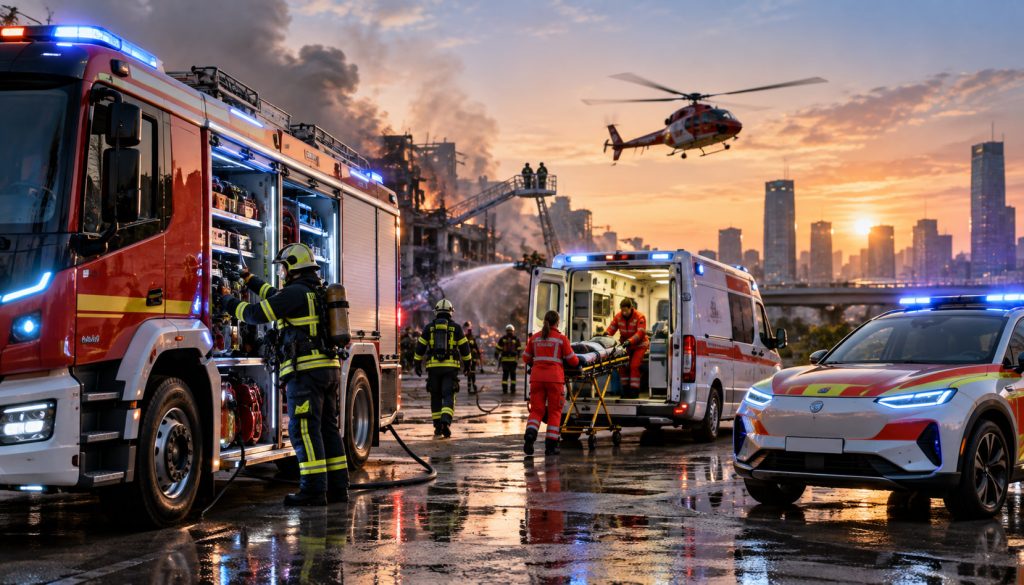
Electric vehicles are rapidly moving beyond private cars and delivery vans. The next frontier is far more demanding: emergency services. Fire departments, ambulance fleets, police units, civil protection agencies, and disaster-response teams are beginning to test and deploy electric vehicles in roles where reliability is not simply convenient but potentially lifesaving.
At first glance, the idea seems contradictory. Emergency vehicles must operate in extreme weather, carry heavy equipment, remain ready around the clock, and respond without delay. A failed battery, long charging stop, or limited range could have serious consequences.
Yet electric drivetrains also offer characteristics that emergency services value: instant torque, quiet operation, lower local emissions, reduced mechanical complexity, and the ability to supply electrical power directly to onboard equipment.
The real question is not whether electric vehicles can enter emergency fleets, but which emergency roles they can perform reliably today and where conventional powertrains are still necessary.
Why Emergency Services Are Interested in Electric Vehicles
Emergency organizations operate large fleets that often spend significant time idling, accelerating aggressively, and performing short urban journeys.
These conditions can be inefficient for conventional combustion engines.
Ambulances may wait outside hospitals with climate-control systems running. Fire engines can remain stationary for long periods while pumps, lights, radios, ventilation equipment, and computers operate. Police vehicles may spend entire shifts alternating between low-speed patrol, idling, and rapid acceleration.
Electric vehicles behave differently.
An electric motor does not need to idle in the traditional sense. When the vehicle is stationary, energy is consumed only by systems that actually require electricity.
This can reduce:
- Fuel use
- Local exhaust emissions
- Noise
- Mechanical wear
- Maintenance requirements
For urban emergency fleets with predictable routes and centralized bases, these advantages can become significant.
Electric Fire Trucks Are Already Becoming Real
Fire engines represent one of the most demanding applications imaginable for an electric drivetrain.
A modern fire truck may weigh many tonnes and carry:
- Water
- Hoses
- Ladders
- Rescue tools
- Breathing equipment
- Medical equipment
- Hydraulic systems
- Communication hardware
It may need to accelerate rapidly, climb steep roads, and then operate equipment continuously at the scene of an incident.
Manufacturers have responded with purpose-built electric fire trucks rather than simply converting conventional diesel vehicles.
One of the best-known examples is the Rosenbauer RTX, an electric fire and rescue vehicle developed around a battery-electric drivetrain with a combustion-powered range-extender system for extended operation.
This type of architecture makes sense for emergency work.
The truck can perform normal urban duties primarily on electric power, while the backup generator provides additional security during long incidents or when charging is unavailable.
For fire services, redundancy may matter more than achieving a completely zero-emission drivetrain.
Instant Torque Can Be a Major Advantage
Electric motors produce strong torque immediately from low speed.
This characteristic is useful in emergency vehicles, which frequently need rapid acceleration from traffic lights, junctions, and station exits.
Heavy emergency vehicles can therefore feel surprisingly responsive despite their mass.
The advantage is even greater when engineers design the entire chassis specifically around electric propulsion rather than converting an existing diesel platform.
Battery packs can be mounted low in the chassis, helping lower the center of gravity.
This can improve stability for tall vehicles carrying heavy equipment.
Electric drivetrains can also allow more flexible packaging because designers do not need to accommodate a traditional engine, transmission, exhaust system, and fuel tank in the same way.
That may create additional space for equipment or allow a lower cabin floor.
A Lower Cabin Can Improve Firefighter Safety
Firefighters may enter and exit a vehicle many times during a shift.
Traditional fire trucks can have relatively high steps because of the engine and chassis structure.
Purpose-built electric fire trucks can place components differently, allowing a lower entrance.
This may seem like a small detail, but repeated climbing in and out while wearing heavy protective equipment creates physical strain.
A lower cabin can reduce that burden and may reduce the risk of falls or injuries.
Emergency vehicle design is therefore not just about range and horsepower.
Electrification can influence ergonomics, accessibility, and crew safety.
Quiet Operation Has Unexpected Benefits
Emergency vehicles are naturally associated with sirens and loud engines.
However, there are situations where quieter operation is useful.
At night, an electric ambulance or response vehicle can arrive in a residential area without a diesel engine continuing to run loudly outside homes.
At an incident scene, reduced engine noise can improve communication between responders.
Firefighters, police officers, paramedics, and command teams may hear radio instructions and each other more clearly.
Quiet operation can also be valuable in search-and-rescue situations.
For example, when teams are searching for trapped victims after a structural collapse, minimizing unnecessary mechanical noise may help rescuers detect faint sounds.
The vehicle can still operate lights, communications equipment, and other systems from its battery without continuously running an engine.
Electric Ambulances May Be One of the Best Applications
Ambulances are particularly suitable for electrification in dense cities.
Many emergency medical vehicles travel relatively short distances between:
- Ambulance stations
- Emergency calls
- Hospitals
- Charging bases
Their routes are often predictable compared with long-distance freight vehicles.
Electric ambulances can also improve the environment around patients and medical staff.
A quieter drivetrain reduces vibration and noise inside the patient compartment.
This can make communication easier between paramedics and patients.
It may also create a calmer working environment when medical staff are trying to monitor vital signs or communicate with a hospital.
Removing exhaust emissions at hospitals is another advantage.
Ambulances frequently gather near emergency departments, where conventional diesel vehicles can contribute to local air pollution.
Replacing some of these vehicles with electric models could improve air quality around healthcare facilities.
Battery Capacity Is Not the Same as Usable Emergency Range
Range figures require special caution when discussing emergency vehicles.
An ordinary passenger EV may travel efficiently at a steady speed under mild conditions.
An emergency vehicle faces completely different demands.
Energy may be consumed by:
- Emergency lighting
- Radios
- Medical equipment
- Heating
- Air conditioning
- Pumps
- Hydraulic rescue tools
- Computers
- Ventilation systems
- Refrigeration equipment
Cold weather can further reduce available range because batteries perform less efficiently and cabin heating requires additional energy.
Hot weather can create similar problems because intensive air conditioning may be necessary.
A fire truck may also remain at an incident scene for several hours.
Therefore, fleet planners cannot simply look at a manufacturer’s driving-range figure.
Emergency vehicle energy planning must include the entire mission, not only the kilometres driven.
Charging Infrastructure Becomes Mission-Critical
For a private EV owner, a broken charger is inconvenient.
For an emergency service, it can affect operational readiness.
Charging infrastructure must therefore be designed with redundancy.
An emergency station may require:
- Multiple charging points
- Backup chargers
- Battery storage
- Emergency generators
- Independent electrical feeds
- Smart energy management
- Rapid charging capability
Fleet software can monitor vehicle state of charge and ensure that the most urgently needed vehicles receive priority.
A vehicle returning from a call may automatically begin charging immediately.
If another emergency occurs, dispatch software can assign the vehicle with the most appropriate battery level.
This turns charging into a fleet-management problem rather than simply a hardware problem.
Power Outages Are a Serious Challenge
Emergency services are most important precisely when normal infrastructure is failing.
Storms, floods, earthquakes, wildfires, and other disasters can damage electrical networks.
That creates an obvious concern for electric emergency fleets.
If the local grid fails, how will the vehicles recharge?
This is why full electrification requires resilient infrastructure.
Emergency stations may need their own microgrids combining:
- Solar generation
- Battery storage
- Grid connections
- Backup generators
Vehicle-to-building technology may eventually add another layer.
Large vehicle batteries could potentially supply power to communication systems, lighting, medical equipment, or temporary command posts during outages.
In this scenario, the emergency vehicle becomes not only transportation but also a mobile energy source.
Remote Disaster Response Remains Difficult
Urban ambulances and fire engines may be good candidates for electrification.
Remote disaster response is much more challenging.
Rescue teams may operate hundreds of kilometres from normal infrastructure.
They may need to cross damaged roads, flooded regions, forests, mountains, or areas without reliable electricity.
Fuel remains relatively easy to transport and store.
Electricity can be more difficult to deliver quickly at high power.
For this reason, heavy rescue trucks, mobile command centers, off-road vehicles, and long-distance disaster-response fleets may continue using diesel, hybrid, or range-extended systems for longer.
Emergency fleets are unlikely to become fully electric all at once. A mixed-fleet strategy is more realistic.
Battery Fires Require Different Training
Electric vehicles introduce new safety challenges for responders.
Lithium-ion batteries store large amounts of energy and operate at high voltage.
When severely damaged, battery cells can enter thermal runaway, a process in which heat triggers additional chemical reactions and can spread to neighboring cells.
A damaged battery may also reignite after the visible fire appears to have been extinguished.
The National Fire Protection Association has repeatedly emphasized the importance of specialized training for incidents involving electric and hybrid vehicles.
Responders must understand:
- High-voltage cables
- Battery locations
- Vehicle shutdown procedures
- Thermal runaway
- Fire suppression techniques
- Post-fire monitoring
- Damaged battery handling
This is especially relevant because emergency agencies will increasingly face electric vehicles not only within their own fleets but also at accident scenes.
Electrification changes the risks responders must manage even if their own emergency vehicles remain conventional.
Water Remains an Important Tool for EV Battery Fires
Public discussion sometimes creates the impression that water cannot be used on electric vehicle battery fires.
In reality, large quantities of water can be used to cool lithium-ion batteries and limit thermal propagation when responders follow appropriate procedures.
The challenge is that battery packs are often protected inside the vehicle structure.
Cooling the cells directly can therefore be difficult.
Firefighters may need prolonged cooling and thermal monitoring.
Vehicles involved in severe battery incidents may also require isolation after the fire because damaged cells can reignite later.
This creates additional operational requirements for towing companies, storage yards, and fire departments.
Electric Police and Rapid-Response Vehicles Are Easier to Deploy
Not every emergency vehicle needs to carry several tonnes of water or medical equipment.
Police cars, command vehicles, inspection vehicles, and rapid-response cars can often use platforms closely related to normal passenger EVs.
These applications are therefore easier to electrify.
Performance is rarely a problem.
Many modern electric cars offer extremely rapid acceleration.
The larger questions are:
- Range during long shifts
- Charging availability
- Cabin heating and cooling
- Equipment power consumption
- Vehicle durability
- Repair costs
For urban patrol work, an EV may spend much of its shift at moderate speeds.
Regenerative braking can recover energy during repeated slowing and stopping, making city operation relatively efficient.
Maintenance Costs Could Fall
Electric drivetrains have fewer moving mechanical components than traditional combustion powertrains.
There is no engine oil to replace and no conventional multi-speed transmission in most EVs.
There are also no spark plugs, exhaust systems, or many of the other components associated with internal-combustion engines.
Regenerative braking can reduce wear on friction brakes.
For large public fleets, these savings can accumulate.
However, emergency vehicles place unusual loads on components.
Suspension, tires, brakes, electrical systems, and body equipment still require regular maintenance.
Battery repairs can also be expensive if a pack is damaged.
Therefore, the economic case depends on the specific vehicle and duty cycle.
Cold Weather Is a Major Test
Emergency vehicles must work when conditions are at their worst.
Cold weather represents one of the toughest challenges for electric fleets.
Low temperatures can reduce battery performance and increase energy consumption.
Cabin heating can be especially demanding.
Emergency vehicles may need to remain warm for crews or patients even while parked for long periods.
Battery thermal management becomes critical.
Preconditioning can help by warming the battery and cabin while the vehicle is still connected to external power.
This preserves more battery energy for the actual mission.
Fleet operators in cold regions will need realistic winter testing rather than relying on laboratory range figures.
Heat Can Be Just as Important
Extreme heat creates a different set of challenges.
Air conditioning must keep crews, patients, electronic equipment, and sometimes medical supplies within safe temperatures.
Battery packs also require thermal management.
Wildfire operations can expose vehicles to unusually high ambient temperatures and prolonged stationary operation.
Emergency EVs must therefore be engineered for thermal resilience far beyond the requirements of many ordinary passenger vehicles.
Emergency Services Could Become Mobile Power Networks
One of the most interesting future possibilities involves bidirectional charging.
An electric emergency truck with a large battery contains a substantial amount of stored energy.
If designed appropriately, that energy could supply:
- Temporary lighting
- Communication equipment
- Medical devices
- Pumps
- Command centers
- Shelters
- Portable charging stations
During a blackout, several emergency vehicles could potentially function as a temporary distributed power network.
This capability could become particularly valuable after storms, earthquakes, or other disasters.
Instead of transporting separate generators to every location, some energy could come directly from vehicle batteries.
The Best Solution Will Depend on the Mission
There is no single answer to the question of whether emergency services should switch to electric vehicles.
A city-center ambulance has completely different requirements from a mountain rescue truck.
A police patrol car has different demands from a heavy fire engine.
A disaster-response organization must evaluate:
- Typical daily distance
- Maximum mission duration
- Weather
- Payload
- Charging availability
- Backup requirements
- Electricity reliability
- Terrain
- Equipment power demand
- Emergency operating scenarios
The correct drivetrain may be battery-electric in one case, hybrid in another, and conventional combustion in a third.
Emergency fleet electrification should be driven by operational requirements, not by ideology or marketing.
Conclusion
Electric vehicles have a genuine future in emergency services.
Electric ambulances, police cars, rapid-response vehicles, and urban fire engines can benefit from instant torque, reduced local emissions, quieter operation, lower mechanical complexity, and the ability to power onboard equipment without continuously running an engine.
Purpose-built electric fire trucks also demonstrate that electrification can improve vehicle packaging, stability, and crew ergonomics.
However, emergency vehicles operate under conditions that ordinary cars rarely experience.
Charging infrastructure must be extremely reliable. Batteries must support not only driving but also medical equipment, pumps, communications systems, heating, cooling, and long periods at incident scenes.
Remote disasters, extreme weather, power outages, and prolonged operations remain serious challenges.
That is why the transition will probably happen gradually.
Urban fleets with predictable missions are likely to electrify first. Long-range rescue and disaster-response vehicles may continue relying on hybrids, range extenders, or combustion engines for additional resilience.
The most successful emergency fleets of the future will not necessarily be completely electric. They will use electrification where it improves readiness, safety, efficiency, and resilience without compromising the ability to respond when lives are at risk.