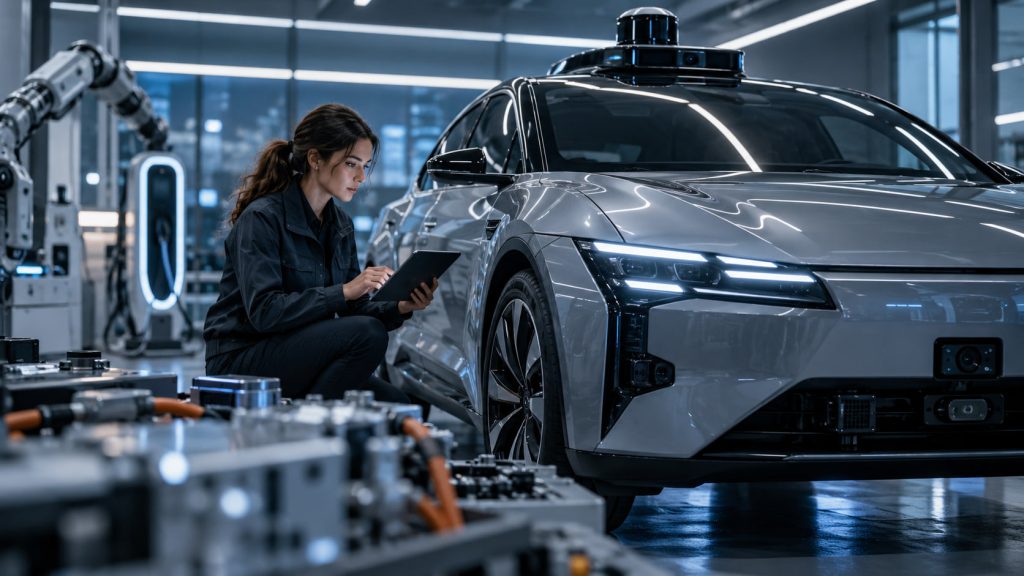
Electric vehicles are often described as batteries on wheels, but that description is becoming outdated. The newest generation of EVs increasingly resembles a distributed computer system built around a high-voltage battery, electric motors, cameras, radar, connectivity, and powerful processors.
Artificial intelligence is becoming the technology that connects many of these components.
AI can help an electric car recognize other road users, predict how much energy a journey will require, protect the battery, choose an efficient charging strategy, monitor the driver, diagnose technical problems, and personalize the cabin. In advanced vehicles, machine-learning systems are already processing enormous quantities of sensor and operational data continuously.
The real transformation is not simply that electric cars are receiving more AI features. It is that AI is gradually becoming part of the vehicle’s underlying operating architecture.
That evolution could change how EVs are designed, driven, maintained, and even how long their batteries remain useful.
Why Electric Cars Are Particularly Well Suited to AI
Artificial intelligence can be installed in combustion-engine vehicles as well, but EVs provide an unusually favorable environment.
Modern electric cars are highly electronic from the beginning. Their propulsion, charging, thermal management, regenerative braking, battery protection, and many auxiliary functions are already controlled by software.
An EV continuously generates information about:
- Battery voltage
- Cell temperature
- Charging power
- Motor output
- Energy consumption
- Vehicle speed
- Regenerative braking
- Ambient temperature
- Navigation
- Driving behavior
- Camera and radar observations
- Component health
Traditional software can control these systems using predetermined rules.
AI adds another capability: it can recognize complicated relationships in data that would be difficult to describe with a simple set of fixed instructions.
For example, energy consumption depends on far more than distance. Temperature, wind, speed, traffic, road gradient, cabin heating, driving style, battery condition, and tire behavior can all influence the final result.
Machine-learning systems can combine these variables to improve predictions.
AI Is Improving EV Range Prediction
One of the first problems every electric-car driver encounters is range estimation.
A simple range calculator could divide usable battery capacity by average energy consumption. In the real world, that calculation is often insufficient.
Driving 100 miles on a mild day at moderate speed can require dramatically less energy than covering the same distance in freezing temperatures at highway speed.
Modern EVs can use machine learning to analyze previous journeys and current conditions.
Inputs may include:
- Recent energy consumption
- Outside temperature
- Battery temperature
- Elevation changes
- Traffic conditions
- Vehicle speed
- Heating and air-conditioning use
- Driver behavior
- Historical consumption on similar roads
The system can then continuously revise the predicted remaining range.
Better range prediction does not increase the physical capacity of the battery, but it makes more of that capacity practically usable because the driver can trust the estimate.
This is especially important during long-distance travel, where inaccurate predictions can force unnecessary charging stops or create the risk of reaching a charger with too little energy remaining.
Intelligent Route Planning Goes Beyond Navigation
Traditional navigation answers one primary question: what is the fastest route?
Electric-car navigation has a more complicated job.
It may need to determine where the vehicle should charge, how long it should remain connected, what battery level should be maintained, and whether an alternative charger would produce a faster overall journey.
AI-assisted route planning can evaluate:
- Remaining state of charge
- Expected consumption
- Charger locations
- Charging power
- Predicted arrival battery percentage
- Weather
- Traffic
- Elevation
- Battery temperature
- Expected charging speed
Some systems can also prepare the battery before the vehicle reaches a fast charger.
Lithium-ion batteries generally accept high charging power most effectively within an appropriate temperature range. When the navigation system knows that the driver is approaching a rapid-charging station, the vehicle can begin heating or cooling the battery in advance.
That reduces charging time without requiring the driver to manage battery temperature manually.
AI Is Becoming Part of Battery Management
The battery is the most expensive and technically sensitive component in most electric vehicles.
Every battery pack contains a battery-management system, or BMS, responsible for monitoring and protecting the cells.
Traditional battery-management algorithms rely heavily on physical models and carefully calibrated control strategies. Increasingly, manufacturers and researchers are supplementing these techniques with machine learning.
An AI-supported BMS can help estimate:
- State of charge
- State of health
- Battery temperature
- Available power
- Cell imbalance
- Remaining useful life
- Degradation patterns
State of charge sounds simple, but a battery does not contain a mechanical fuel gauge. The vehicle must infer how much usable energy remains from electrical measurements and models.
State of health is even more complicated.
Battery capacity changes gradually with age, charging habits, temperature exposure, high-power use, and other conditions.
Machine learning can compare large quantities of historical battery data and identify degradation patterns that conventional models may miss.
More accurate battery estimation could allow manufacturers to protect cells without keeping unnecessarily large safety margins, potentially improving usable capacity and battery life simultaneously.
Thermal Management Can Become Predictive
Temperature has a major influence on electric vehicles.
A battery that is too cold may charge slowly and deliver less power. Excessive heat can accelerate degradation or require performance limitations.
Electric cars therefore contain sophisticated cooling and heating systems.
Traditional thermal management reacts to measured temperature. Predictive control can go further.
Imagine that the vehicle knows:
- The driver has selected a mountain route.
- A long uphill section is approaching.
- Ambient temperature is high.
- Battery power demand will probably increase substantially.
An intelligent thermal-management system could begin cooling the battery before temperatures rise significantly.
The same principle applies before rapid charging or extreme winter driving.
Predictive control may reduce temperature extremes, improve charging performance, and decrease the amount of energy used by pumps, fans, compressors, and heaters.
Regenerative Braking Can Become More Adaptive
Regenerative braking converts some of the vehicle’s kinetic energy back into electrical energy.
Basic systems provide fixed levels of regeneration. More advanced systems can adjust automatically.
AI can potentially incorporate:
- Traffic ahead
- Road gradient
- Navigation information
- Distance to intersections
- Vehicle speed
- Driver habits
- Battery state of charge
If the car detects slower traffic approaching, for example, it can begin reducing speed earlier using regenerative braking rather than waiting until stronger friction braking becomes necessary.
Predictive regeneration can make driving smoother while increasing energy recovery.
The benefit on a single stop may be small. Across thousands of braking events, however, the energy savings can become meaningful.
Advanced Driver Assistance Depends Heavily on AI
The most visible application of artificial intelligence in modern cars is advanced driver assistance.
Cameras, radar, ultrasonic sensors, and other technologies generate enormous volumes of data.
AI systems process this information to identify:
- Vehicles
- Pedestrians
- Cyclists
- Lane markings
- Traffic lights
- Road boundaries
- Obstacles
- Signs
- Free spaces
Computer vision based on deep neural networks has become particularly important.
Rather than programming a system with rules describing every possible appearance of a pedestrian, engineers can train neural networks using enormous collections of examples.
The network learns statistical patterns that help it recognize similar objects in previously unseen situations.
AI may also contribute to trajectory prediction.
Recognizing a cyclist is only the first step. An advanced system may attempt to estimate where that cyclist is likely to move during the next several seconds.
Autonomous Driving Requires More Than One AI Model
Marketing sometimes creates the impression that autonomous driving is simply a matter of installing a sufficiently intelligent neural network.
In reality, automated driving is a system-level engineering problem.
It involves perception, localization, mapping, prediction, planning, control, redundancy, and safety monitoring.
Professor Amnon Shashua, co-founder and chief executive of Mobileye and a computer-vision researcher, has repeatedly emphasized that autonomous-driving technology requires a structured combination of perception, decision-making, mapping, and formal safety mechanisms rather than relying on a single source of intelligence.
This is an important point.
A vehicle cannot treat an AI prediction as unquestionably correct when a mistake could create a physical accident.
Automotive systems therefore use validation, redundancy, confidence measurements, fallback behavior, and conventional control software around machine-learning components.
Driver Monitoring Is Another Growing AI Application
An increasingly common cabin feature is the driver-monitoring system.
A camera positioned inside the vehicle can observe the driver’s face and head position.
Machine-learning algorithms may estimate whether the driver is:
- Looking at the road
- Becoming distracted
- Becoming drowsy
- Using a phone
- Closing their eyes for an unusual period
- Failing to respond to warnings
This becomes particularly important as driver-assistance systems become more capable.
Partial automation can create a dangerous behavioral problem: drivers may begin trusting the system more than its technical limitations justify.
Driver monitoring helps determine whether the person remains prepared to take control.
AI Is Changing the Car’s Voice Assistant
Traditional automotive voice systems were notoriously limited.
Drivers often had to memorize specific commands and speak them in a particular format.
Modern language models allow much more natural interaction.
Instead of saying a rigid command, a driver might say:
“The cabin feels too warm.”
The assistant could understand that the likely intention is to reduce the temperature.
Future systems may combine access to vehicle data with conversational intelligence.
A driver could ask:
“Why is my energy consumption higher today?”
The car might consider temperature, driving speed, cabin heating, elevation, and battery conditions before providing an explanation.
Or the driver could ask:
“Can I reach home without charging?”
The assistant could combine navigation and energy information rather than simply providing a generic answer.
The major challenge is reliability. A conversational system controlling real vehicle functions requires much stricter boundaries than an ordinary chatbot.
Predictive Maintenance Could Reduce Unexpected Failures
Electric vehicles contain fewer traditional mechanical components than combustion cars, but they are not maintenance-free.
They still contain:
- Cooling pumps
- Bearings
- Suspension components
- Brakes
- Air-conditioning systems
- Power electronics
- Charging equipment
- Low-voltage electrical systems
Sensors continuously collect operational information.
Machine learning can search this data for abnormal patterns.
A gradually changing vibration signature could indicate bearing wear. Unexpected temperature behavior could suggest a cooling problem. Charging irregularities might indicate deterioration in a connector or electronic module.
Predictive maintenance attempts to identify these patterns before a component actually fails.
Instead of waiting for a fault code after something breaks, the vehicle may eventually estimate that a component is becoming increasingly likely to fail.
Fleet operators could benefit particularly strongly because even small improvements in vehicle availability can have substantial economic value.
Electric Cars Can Learn Through Fleet Data
Connected vehicles create an enormous distributed source of engineering information.
When thousands or millions of vehicles are operating in different climates and road conditions, manufacturers can analyze anonymized or appropriately managed fleet data to identify patterns.
This information can help engineers understand:
- Battery degradation
- Charging behavior
- Component failures
- Energy consumption
- Driver-assistance performance
- Thermal-management efficiency
Software improvements can then be distributed through over-the-air updates.
This creates a development cycle that was largely impossible in traditional automobiles.
The car leaves the factory, collects experience during real operation, contributes data to engineering analysis, and later receives improved software.
That does not mean every vehicle literally trains its own AI system while driving. Training is often performed centrally using carefully selected data, while the updated model is later deployed to the vehicle.
AI Is Moving from the Cloud Into the Vehicle
Some AI calculations can be performed remotely in data centers, but safety-critical driving functions must work locally.
A car cannot depend on a continuous internet connection to recognize a pedestrian or apply emergency braking.
Modern vehicles therefore use increasingly powerful onboard processors capable of running neural networks in real time.
This approach is known as edge AI.
It offers several advantages:
- Lower latency
- Operation without connectivity
- Reduced dependence on cloud infrastructure
- Better privacy for some data
- Immediate response to sensor input
Cloud computing remains useful for model training, large-scale analytics, software updates, mapping, and noncritical services.
The future EV will therefore use a hybrid architecture: critical intelligence inside the vehicle, massive training and fleet analysis in the cloud.
AI Can Also Improve Charging Infrastructure
Artificial intelligence does not stop at the vehicle.
Charging networks can use machine learning to forecast demand and predict when individual stations will become busy.
Fleet operators can schedule charging when electricity is cheaper or when renewable generation is abundant.
At large charging depots, intelligent control systems can decide which vehicle receives power first.
The objective may be to ensure that every vehicle reaches its required state of charge without exceeding the electrical capacity of the site.
AI can also help identify failing chargers by examining abnormal power delivery, connection failures, temperature, and repeated interrupted sessions.
Privacy and Cybersecurity Become More Important
More intelligence usually requires more data.
Modern EVs may process information about driving patterns, location, charging behavior, cameras, voice commands, and cabin activity.
That makes data protection increasingly important.
Manufacturers must decide:
- Which data remains in the vehicle
- Which information is uploaded
- How long it is stored
- Whether it can identify individuals
- Who can access it
- How it is protected
Cybersecurity presents another challenge.
A software-defined vehicle contains numerous electronic systems connected through internal networks and external communication interfaces.
AI can improve cybersecurity by detecting unusual behavior, but highly connected vehicles also create additional potential attack surfaces.
An intelligent vehicle must therefore become more capable without becoming unnecessarily exposed.
AI Does Not Replace Automotive Engineering
The rapid growth of artificial intelligence sometimes encourages exaggerated predictions.
AI cannot ignore basic vehicle physics.
Battery capacity, tire grip, braking distance, cooling performance, electrical limits, and crash structures remain governed by physical engineering.
A neural network cannot create additional battery energy merely by making a better prediction.
Similarly, advanced driver assistance does not eliminate the need for brakes, steering systems, mechanical redundancy, and rigorous validation.
The most successful automotive applications use AI where it offers a genuine advantage while retaining deterministic engineering where predictable behavior is essential.
Conclusion
Artificial intelligence is becoming deeply integrated into electric vehicles because EVs are already highly computerized machines.
AI can improve range prediction, route planning, charging, battery management, thermal control, regenerative braking, driver assistance, predictive maintenance, voice interaction, and fleet optimization.
Its greatest contribution may not be one spectacular feature.
Instead, AI allows dozens of vehicle systems to become predictive rather than merely reactive.
A future electric car may know that the battery should be warmed before charging, that a particular route will consume more energy than usual, that a component is beginning to wear, or that the driver is becoming distracted—all before the situation develops into a noticeable problem.
At the same time, greater intelligence introduces new responsibilities. Automotive AI must remain reliable, secure, explainable where necessary, and carefully separated from functions where unpredictable behavior could become dangerous.
Electric cars are already changing from mechanical products into software-defined platforms. Artificial intelligence is becoming one of the technologies that determines how intelligently those platforms understand the road, manage energy, protect their batteries, communicate with drivers, and improve throughout their operating life.