Choosing an electric car becomes a very different exercise when one of your regular passengers has four legs. Range, acceleration, and charging speed still matter, but dog owners also need to think about cargo-floor height, climate control, rear-seat space, washable materials, ventilation, access through the tailgate, and whether a secure crate or harness can be installed properly.
Electric vehicles can be particularly well suited to pet owners. Their quiet drivetrains create a calmer cabin, stationary climate systems can operate without an idling combustion engine, and many EV platforms provide exceptionally spacious interiors because there is no conventional engine or transmission tunnel.
However, the best electric car for a dog is not simply the EV with the biggest trunk. It is the vehicle that allows the animal to travel securely, comfortably, and at an appropriate temperature while still meeting the owner’s everyday needs.
The following models stand out for different kinds of dog owners, from families with small pets to people transporting large breeds, crates, outdoor equipment, and several passengers.
What Makes an Electric Car Good for Dogs?
Cargo volume is an obvious starting point, but published capacity figures tell only part of the story.
A useful dog-friendly EV should ideally offer:
- A large and relatively square cargo area
- A low or manageable loading height
- Good ventilation in the rear
- Foldable rear seats
- Easy-clean interior surfaces
- Space for a properly secured carrier or crate
- Climate control that can operate while parked
- Wide doors or a large tailgate opening
- Storage for leads, water, towels, food, and other equipment
- Smooth ride quality
The dog’s size matters as much as the vehicle’s dimensions. A small terrier traveling in a secured carrier has completely different requirements from a German Shepherd using a large automotive crate.
Owners should also consider age and mobility. An athletic young dog may have little difficulty entering an SUV, while an older animal with arthritis may benefit significantly from a low cargo floor, ramp, or step.
Tesla Model Y: Best All-Round EV for Many Dog Owners
The Tesla Model Y remains one of the easiest EVs to recommend for households that regularly travel with dogs.
Tesla currently advertises up to 74 cubic feet of cargo space, providing enough flexibility for pet equipment, luggage, and everyday family use. The hatchback body also makes the rear area more practical than a conventional sedan trunk.
Its most distinctive pet-oriented feature is Pet Mode. Tesla states that the system can maintain a comfortable cabin temperature while the vehicle is parked. The feature is designed specifically for situations in which an owner briefly leaves a pet in the car.
Tesla even sells an official second-row pet liner for the Model Y. It uses water-resistant protective material and includes door protection against dirt, hair, paws, and other inevitable consequences of carrying an animal regularly.
The Model Y works particularly well for:
- Medium-sized dogs
- Families that use the rear seat for their pet
- Owners who frequently take road trips
- People who want dedicated parked climate control
- Households that need substantial storage without moving to a full-size SUV
Pet Mode should not be treated as permission to leave an animal unattended for extended periods. Equipment can fail, environmental conditions can change, and local laws governing unattended animals vary.
Pet climate features are an additional layer of protection, not a replacement for responsible supervision.
Kia EV9: Best Electric SUV for Large Dogs and Families
For households that need considerably more interior space, the Kia EV9 is one of the strongest options.
The three-row electric SUV offers up to 81.7 cubic feet of cargo room behind the front seats, 43.5 cubic feet behind the second row, and 20.2 cubic feet with all three rows available, according to Kia’s current U.S. specifications.
That makes the EV9 especially useful when a dog must coexist with children, adults, luggage, and vacation equipment.
Its second- and third-row seats can also be folded to produce a large storage area. Kia describes configurations in which both rear rows can fold flat, giving owners considerable flexibility when carrying large equipment.
For a large dog, that can mean room for an appropriately sized crate without sacrificing every other part of the vehicle.
The EV9 is particularly attractive for:
- Large and giant breeds
- Two-dog households
- Families that need three rows
- Owners using substantial travel crates
- Long-distance trips involving people and pets
Its size is also its disadvantage. A large SUV can have a higher cargo floor than a lower crossover, which matters for older or injured dogs. Owners of less mobile animals may want to add a secure pet ramp.
Rivian R1S: Best for Dogs and Outdoor Adventures
The Rivian R1S is one of the most practical premium EVs for people who combine dog ownership with camping, hiking, outdoor sports, or lengthy road trips.
Rivian lists seating for seven and substantial cargo flexibility. Current specifications show 17.6 cubic feet behind the third row, 48.6 cubic feet with the third row folded, and up to 90.7 cubic feet with the second row folded as well.
There is also an 11.1-cubic-foot front trunk, which can be particularly useful for separating clean passenger space from muddy boots, towels, dog equipment, or other gear.
Rivian says the R1S rear seats can fold individually, while interior materials are designed for durability and easier cleaning.
That combination matters for pet owners. A dog-friendly vehicle has to survive claws, sand, dirt, wet coats, shedding, and occasional accidents without becoming difficult to maintain.
Separate storage is underrated for pet travel. Keeping food, leads, wet equipment, cleaning supplies, and luggage away from the dog’s secure travel space can make long journeys substantially easier.
The R1S is best suited to owners who need considerable room and genuinely use the vehicle for adventure travel.
Hyundai IONIQ 5: Best Spacious EV Without Full-Size SUV Bulk
Not every dog owner needs a three-row vehicle.
The Hyundai IONIQ 5 is an excellent example of how an EV platform can provide a surprisingly large interior within manageable exterior dimensions.
Hyundai lists approximately 520 liters of rear cargo capacity, expanding to around 1,580 liters with the second row folded in European specifications.
Its long 3,000-millimeter wheelbase contributes to a spacious passenger compartment, while the crossover format gives owners easier rear access than a traditional sedan.
The IONIQ 5 is particularly suitable for:
- Small and medium-sized dogs
- Owners who prefer a crossover to a large SUV
- Rear-seat pet harness arrangements
- Folded-seat cargo configurations
- Urban households that still take long trips
Hyundai also includes Utility Mode on certain versions and markets, allowing the high-voltage battery to supply vehicle electrical systems while stationary. Exact functions and availability can vary by region and model year, so owners should confirm the specification of the individual vehicle rather than assuming it operates like a dedicated pet mode.
Volvo EX90: Best Luxury EV for Dogs and Large Families
The Volvo EX90 combines three-row accommodation with one of the roomier interiors in the premium electric SUV segment.
For the seven-seat configuration, Volvo lists maximum cargo volume of approximately 13.6 cubic feet behind the third row, 37.3 cubic feet behind the second row, and 75.4 cubic feet with the rear rows folded, depending on the measurement method.
The vehicle also provides underfloor storage, individually folding rear seats, and a hands-free tailgate.
The ability to fold seats individually is useful for pet owners because passenger and dog spaces can be configured separately. One portion of the vehicle can accommodate a crate while another remains available for people or luggage.
Volvo also advises using appropriate cargo-separation equipment when the rear seats are folded, helping prevent objects in the luggage area from entering the passenger compartment during sudden movement.
For owners seeking a quieter, more luxurious long-distance environment for both passengers and pets, the EX90 deserves serious consideration.
Subaru Solterra: A Sensible Choice for Active Dog Owners
Subaru has long marketed heavily toward owners who use their vehicles outdoors, and the Solterra electric crossover fits naturally into that role.
One notable advantage is the availability of factory pet-oriented accessories. Subaru offers a padded cargo liner for the 2026 Solterra specifically designed to create a more comfortable resting surface while protecting the cargo floor and seatbacks from pet hair and wear.
That may sound minor compared with range or charging performance, but dedicated pet accessories are useful indicators of how easily a vehicle can be adapted to regular animal transport.
The Solterra is most appealing for:
- One medium-sized dog
- Outdoor-oriented owners
- Drivers who value all-wheel-drive capability
- Households wanting a conventional crossover footprint
- Owners who want factory pet-protection accessories
As always, a padded liner improves comfort and cleanliness but does not function as a crash restraint.
Why a Secure Dog Restraint Matters More Than Cargo Space
It is tempting to focus entirely on comfort, but the most important question is how the dog will be secured.
The American Veterinary Medical Association advises owners to consider crash-tested harnesses that connect appropriately with vehicle seat belts. For animals traveling in carriers or crates, the AVMA recommends choosing equipment appropriate to the pet and securing it properly within the vehicle.
This is important for two reasons.
First, an unrestrained dog can be seriously injured during a collision or emergency stop.
Second, an animal moving freely through the cabin can become a danger to human occupants or distract the driver.
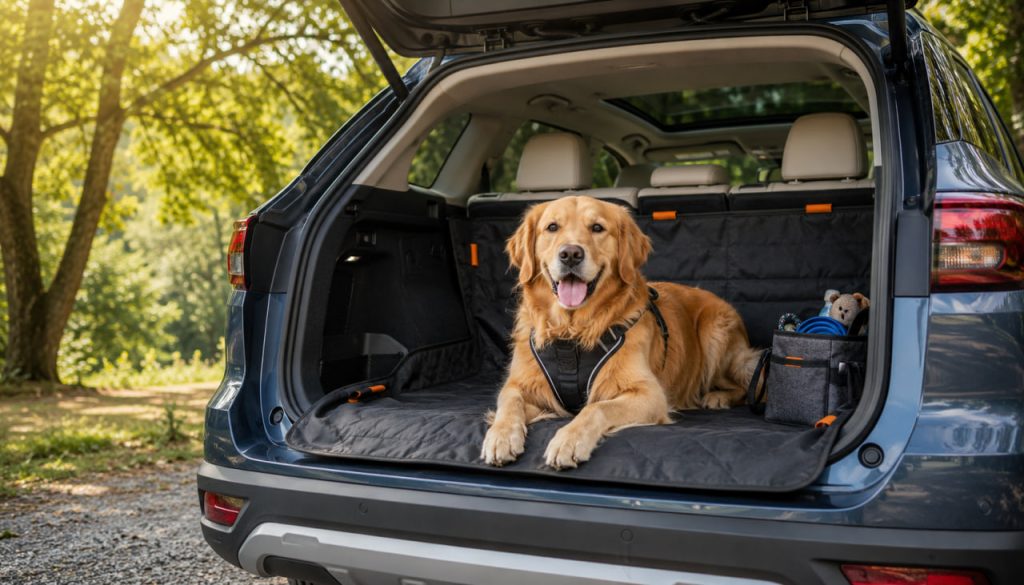
A large cargo area is not automatically a safe dog compartment. Space must be combined with appropriate restraint.
The ideal setup depends on the dog’s size and the vehicle. Small pets may be best suited to secure carriers, while larger dogs may travel in crash-tested harness systems or appropriately secured automotive crates.
Owners should follow the restraint manufacturer’s installation instructions and check that the product is actually compatible with their vehicle.
Do Not Let a Dog Ride Loose in the Front Seat
The front passenger seat is usually a poor location for a dog.
Airbags are designed for human occupants, not animals, and their deployment can injure a pet. A dog near the driver can also interfere with steering, controls, or visibility.
The rear passenger area or a properly configured cargo compartment generally provides more suitable options for secure transportation.
Allowing a dog to put its head far outside an open window is also risky. Road debris can injure the eyes and face, and an improperly restrained animal may attempt to jump from the vehicle.
Climate Control Is Especially Important in an EV
Electric vehicles have a major practical advantage when stationary: cabin climate systems do not require a combustion engine to idle.
That makes it technically easier to maintain heating or air conditioning during short stops.
But temperature management should still be treated carefully.
Dogs can overheat rapidly, and the cabin of a parked vehicle can become dangerous even when outdoor conditions do not initially feel extreme.
Owners should:
- Never assume shade will remain in the same place
- Verify that climate control is actually operating
- Avoid prolonged unattended periods
- Keep adequate battery charge
- Ensure the pet has access to appropriate water
- Understand the vehicle’s climate-control limitations
- Follow local animal-welfare laws
Tesla’s dedicated Pet Mode is particularly convenient because pet use is an explicitly supported scenario. In vehicles without an equivalent feature, owners should not assume that ordinary climate settings will remain active indefinitely.
Consider Loading Height for Older Dogs
One factor specifications rarely capture is how easily the dog can enter the vehicle.
Large electric SUVs often have relatively high floors because their battery packs sit beneath the passenger compartment.
Repeated jumping can be difficult for:
- Senior dogs
- Heavy breeds
- Dogs with joint problems
- Animals recovering from surgery
- Dogs with spinal conditions
A lower crossover such as the IONIQ 5 may therefore be more practical than a larger SUV for some owners even if the SUV offers substantially more total cargo capacity.
For a high vehicle, a properly designed ramp can provide an easier solution.
The important point is to evaluate the vehicle from the dog’s perspective rather than relying solely on published volume.
Measure the Dog Crate Before Buying the Car
If you use a crate, bring its exact measurements into the buying process.
Cargo-volume figures do not tell you:
- Tailgate opening width
- Tailgate opening height
- Distance between wheel arches
- Roof curvature
- Cargo-floor length
- Rear-seat angle
- Location of tie-down points
A vehicle with a large published cargo figure can still fail to accommodate a particular crate.
Before ordering an EV, measure the crate’s height, width, and depth and compare those dimensions with the actual vehicle.
Better still, physically test the crate at a dealership where possible.
Which Electric Car Is Best for Your Dog?
There is no single winner for every pet owner.
Tesla Model Y is arguably the strongest all-round choice thanks to its useful cargo space and dedicated Pet Mode.
Kia EV9 is better for large dogs, multiple pets, or families that need enormous flexibility and three rows.
Rivian R1S is particularly compelling for outdoor lifestyles because it combines generous cargo capacity, seven-seat versatility, and additional front storage.
Hyundai IONIQ 5 offers an excellent balance between interior room and manageable exterior size.
Volvo EX90 is a strong premium solution for families needing a spacious, flexible three-row EV.
Subaru Solterra provides a more conventional crossover alternative with useful factory pet accessories.
Conclusion
Electric cars can be excellent vehicles for dog owners. Quiet operation, spacious EV-specific platforms, flexible interiors, powerful stationary climate systems, and large hatchback cargo areas can make pet travel more comfortable than in many traditional cars.
But choosing the right model requires more than finding the largest trunk.
Consider the dog’s size, age, mobility, preferred restraint system, crate dimensions, ventilation requirements, loading height, and the number of human passengers who must share the vehicle.
Most importantly, follow expert safety guidance. The American Veterinary Medical Association recommends appropriate vehicle restraints, including suitable crash-tested harnesses and securely positioned carriers or crates.
The best electric car for a dog is ultimately the one that provides enough space for the animal to travel comfortably while allowing it to be restrained securely on every journey.