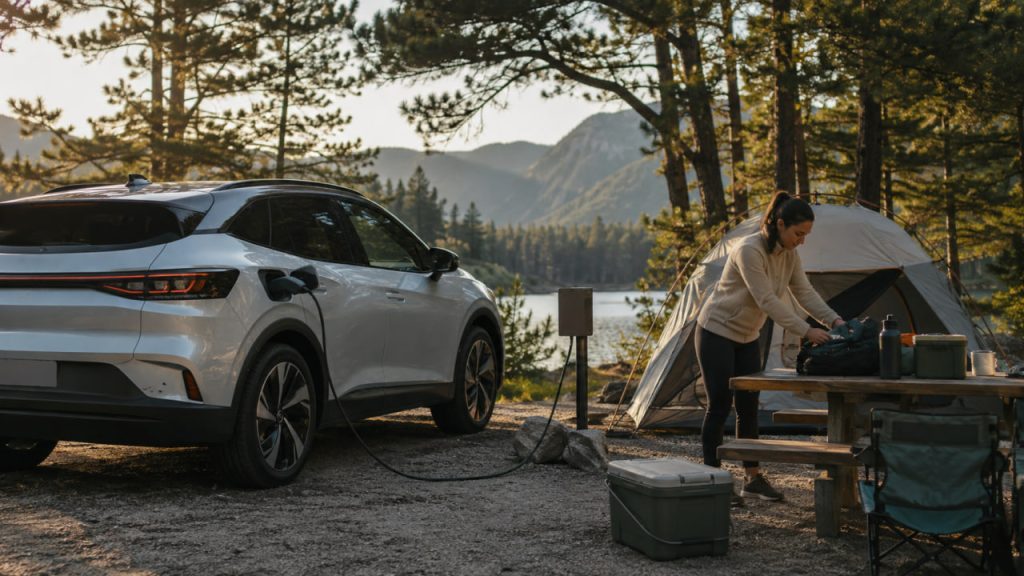
Traveling by electric car and sleeping in a tent combines two experiences that once seemed almost incompatible: modern electric mobility and traditional camping. In reality, they can work remarkably well together. An EV can carry camping equipment, provide quiet transportation through natural areas, recharge devices, and, in some models, supply power for accessories or maintain cabin climate while parked.
The difficult part is charging.
Traditional road trips can usually rely on fuel stations appearing regularly along major routes. Electric-car camping requires more deliberate planning because campsites vary enormously. Some have dedicated EV chargers, some provide electrical hookups intended primarily for recreational vehicles, and others have no electricity at all.
The U.S. Department of Energy maintains a public charging-station locator covering the United States and Canada, while the National Park Service provides its own map for chargers in and around national parks. These tools make remote EV travel increasingly practical, but availability is still far from universal.
The safest strategy is to treat campground electricity as a bonus unless the site explicitly confirms that EV charging is permitted. Your primary charging plan should be built around verified EV charging stations.
Why Electric Cars Can Be Excellent Camping Vehicles
Electric vehicles have several characteristics that suit camping surprisingly well.
The drivetrain is quiet, meaning early departures and late arrivals create less engine noise. Large battery packs can support onboard electronics, and many modern EVs offer substantial cargo space because their platforms do not require conventional engines, transmissions, or exhaust systems.
Depending on the model, an electric vehicle may also provide:
- USB charging for phones and cameras
- Low-voltage power outlets
- Climate control while parked
- External power outlets
- Vehicle-to-load power
- Large underfloor storage
- Front-trunk storage
- Flat or nearly flat rear seating areas
These features are particularly useful when camping with a tent because the vehicle can function as a secure equipment locker and limited electrical hub while the tent remains the primary sleeping space.
Some EVs go considerably further. Tesla, for example, provides Camp Mode on compatible vehicles. The manufacturer states that Camp Mode can maintain cabin temperature while the vehicle is parked and continue powering USB and low-voltage outlets.
Other manufacturers offer vehicle-to-load systems capable of powering external appliances, although capabilities, output limits, and regional availability vary by model.
The First Rule: Plan Charging Before Choosing the Campsite
For a conventional camping trip, people often choose the destination first and worry about fuel later.
With an electric vehicle, reverse the process.
Start by examining the entire journey:
- Home to the destination.
- Charging opportunities along the route.
- Charging near the campground.
- Electricity available at the campground.
- Driving planned during the stay.
- The return journey.
The Department of Energy’s Alternative Fuels Data Center provides a station locator specifically designed to identify EV charging locations.
National parks require particular attention. Charging infrastructure can differ dramatically even between famous destinations.
Yosemite National Park, for example, currently lists charging at multiple locations including Yosemite Valley, Wawona, El Portal, and Tuolumne Meadows.
Yellowstone presents a very different situation. The National Park Service currently states that there are no public EV charging stations inside Yellowstone itself because of infrastructure and electrical-capacity limitations, although limited Level 2 charging exists at certain partner-operated lodges and charging is available outside some entrances.
Never assume that a major tourist destination automatically has abundant charging simply because millions of people visit it.
Arrive at the Campground With a Safety Margin
One of the easiest mistakes is arriving at a remote campground with a nearly empty battery because electricity is supposedly available there.
That creates unnecessary risk.
If the charger is occupied, broken, inaccessible, or incompatible with the vehicle, you may not have enough energy to reach an alternative.
A better strategy is to reach remote areas with a meaningful reserve.
There is no single correct percentage because terrain, weather, vehicle efficiency, charger spacing, and distance to the next station all matter. But the principle is universal: your arrival charge should be based on the distance to the next dependable charger, not merely on the distance remaining to the campsite.
Imagine that you reach camp with 25 percent remaining and the nearest dependable charger is 40 miles away. That may be perfectly comfortable in one vehicle.
If the next charger is 100 miles away through mountainous terrain, the same battery percentage may be far less reassuring.
Think in usable driving distance, not just percentage.
Can You Charge an EV From an RV Campsite Hookup?
Sometimes, but this is where campers need to be particularly careful.
Many developed campgrounds have electrical pedestals offering outlets intended for recreational vehicles. Depending on the site, these can include 20-, 30-, or 50-amp services.
Physically connecting an EV may appear straightforward with the correct portable charging equipment and adapter.
That does not mean charging is permitted or that the campground’s electrical infrastructure was designed for the sustained load.
Kampgrounds of America provides unusually clear guidance on this subject. KOA states that many existing campground electrical pedestals were originally designed for the non-continuous electrical loads associated with RV use and may not support the continuous demand produced by electric-vehicle charging. Only some KOA locations are specifically equipped for EV charging.
The National Park Service has issued similar warnings at individual campgrounds. Fort Pickens Campground has electrical service at certain sites but warns that its systems can be affected by electric-vehicle charging demands.
Therefore, the correct procedure is simple:
Ask the campground directly whether EV charging from the campsite electrical hookup is allowed.
Do not assume permission because an outlet is physically present.
Dedicated EV Chargers Are the Better Option
Whenever possible, use a purpose-built EV charging station.
The U.S. Department of Energy identifies Level 2 charging as a common 240-volt option capable of significantly faster charging than basic Level 1 equipment.
For camping, Level 2 charging can be ideal because vehicles often remain parked for many hours.
A highway trip may favor DC fast charging because every minute matters. At a campground, slower charging is less problematic. If the vehicle remains parked overnight, several hours of Level 2 charging may restore a substantial amount of range while the occupants sleep.
This creates one of the best EV camping routines:
Drive during the day, plug in at the destination, set up the tent, cook dinner, sleep, and leave the next morning with additional range.
It converts time that would otherwise be spent parked into charging time.
Understand Level 1 Charging
A conventional household-style outlet can also charge an EV, provided the outlet, circuit, charging equipment, and campground rules all support the arrangement.
This is generally called Level 1 charging in North America.
The Department of Energy explains that Level 1 charging uses standard lower-voltage electrical service and is considerably slower than Level 2 charging.
For a normal commuter this can feel restrictive. For camping, it can occasionally be useful because the vehicle may remain stationary for 10, 12, or even 24 hours.
Suppose a slow connection adds only a modest amount of range each hour. Over an entire evening and night, that can still become useful energy.
However, Level 1 should not be treated as guaranteed campsite charging. Permission and electrical suitability still have to be confirmed.
Never Improvisе Electrical Connections
Camping equipment often encourages improvisation. EV charging should not.
Avoid questionable extension cords, improvised adapters, damaged outlets, overloaded power strips, or electrical arrangements that were never intended for sustained high current.
Electric vehicles can draw substantial continuous power for hours.
If the connection overheats or protection systems detect a problem, charging may stop. More seriously, unsafe wiring can create fire and electrical hazards.
Use manufacturer-approved or appropriately rated charging equipment, inspect cables before use, protect connections from inappropriate exposure to moisture, and follow both vehicle and campground instructions.
A charging solution that works electrically is not necessarily a charging solution that is safe or permitted.
Call the Campground Before Booking
Website descriptions can be ambiguous.
A campground might advertise “electric sites,” but that may simply mean RV electrical hookups. It does not necessarily mean the operator permits electric-car charging.
Before reserving a site, ask specifically:
- Do you have dedicated EV chargers?
- Can overnight guests use them?
- Is charging included in the campsite fee?
- Is reservation required?
- May an EV charge from the site’s electrical pedestal?
- Which electrical connections are available?
- Are there time limits?
- Are chargers accessible overnight?
- Can a vehicle remain plugged in after charging?
- Are chargers shared with non-camping visitors?
These questions take a few minutes and can prevent a major travel problem.
Do Not Depend on a Single Charger
Remote travel works best with redundancy.
When planning each charging stop, identify at least one backup whenever practical.
Your primary station might be unavailable because of:
- Hardware failure
- Construction
- Network outage
- Parking restrictions
- Unexpected closure
- Other vehicles occupying the chargers
- Severe weather
A resilient route includes alternatives.
For example, you might select a DC fast charger 40 miles before the campground as the primary stop while identifying another station in a nearby town as a backup.
If both are operational, use the more convenient one. If the first fails, the trip does not collapse.
Charging Speed Matters Less When You Are Camping
One advantage of tent camping is that you are already planning to stay in one place for many hours.
This changes the economics of charging time.
On a normal long-distance drive, adding 200 miles of range in 25 minutes instead of two hours is extremely valuable.
At a campsite, the difference between three and eight hours may be practically irrelevant if you are sleeping overnight.
For this reason, destination charging can be more important than maximum charging speed for camping trips.
A vehicle with excellent DC fast charging is still useful on the highway, but a well-located overnight Level 2 charger may have more practical value at the destination.
Expect Range to Change in Mountainous Terrain
Camping routes frequently lead away from flat highways and into forests or mountains.
Climbing requires additional energy.
An EV may therefore consume significantly more power while ascending toward a mountain campground than it did on flat roads.
The encouraging part is that regenerative braking can recover some energy during the descent.
However, the energy used climbing cannot be completely recovered because no system is perfectly efficient.
Plan conservatively when driving:
- Long mountain climbs
- Unpaved roads
- High-speed highways
- Strong headwinds
- Heavy rain
- Snow
- Very hot or very cold conditions
Do not build a route around the vehicle reproducing its ideal efficiency under demanding conditions.
Cold Weather Deserves Special Planning
Temperature affects battery performance and cabin-energy consumption.
Winter camping creates two simultaneous demands: the battery may operate less efficiently in low temperatures, while passengers are more likely to use heating.
If you are sleeping in a tent rather than the car, this may reduce overnight vehicle consumption. But you will still need enough energy for morning travel and potentially for battery or cabin preconditioning.
A useful strategy is to complete important charging before reaching the coldest or most remote part of the route.
If a charger is available at camp, remaining connected can be advantageous because some vehicle energy needs may be supplied from external electricity rather than relying entirely on stored battery energy.
Hot Weather Has Different Challenges
Summer camping can reduce heating demand but increase air-conditioning use.
When the vehicle is parked in direct sunlight, the cabin can become extremely hot.
If you are using the car during the day for storage, protect temperature-sensitive equipment. Do not assume an EV’s climate system will automatically remain active indefinitely after parking unless the vehicle specifically supports that function and it has been intentionally activated.
Tesla’s Camp Mode is one verified example of a system designed to maintain cabin temperature while camping.
For other models, consult the current owner’s manual because behavior varies.
Vehicle-to-Load Can Transform a Campsite
Some modern electric cars can supply AC electricity externally from the traction battery.
This capability is commonly described as vehicle-to-load power.
When supported, it can potentially run modest camping equipment such as:
- Lighting
- Laptop chargers
- Camera batteries
- Small cooking equipment
- Portable refrigerators
- Air pumps
The exact output varies considerably by vehicle and market, so owners must follow manufacturer limits.
This capability should also be managed with the return journey in mind.
Every kilowatt-hour used at camp is energy no longer available for driving.
A few lights and phone chargers may consume relatively little. Heating, cooling, cooking appliances, and other high-power equipment can use considerably more.
The traction battery is a huge source of camping electricity, but it is also your fuel tank.
Calculate How Much Battery You Actually Need
A simple energy budget makes remote camping less stressful.
Suppose:
- Your campground is 60 miles from the nearest reliable charger.
- Your vehicle normally uses 30 kWh per 100 miles.
- You need to return 60 miles.
- You expect 20 miles of local driving.
That produces roughly 80 miles of required travel before you can depend on another charge.
At 30 kWh per 100 miles, the theoretical driving requirement is approximately 24 kWh.
You should then add a safety margin for terrain, weather, detours, cabin use, and unexpected circumstances.
The calculation does not need to be perfect. Its purpose is to stop you from treating the battery percentage as an abstract number.
Carry the Right Charging Equipment
For an EV camping trip, charging equipment deserves the same attention as the tent.
Depending on your vehicle and destination, useful equipment may include:
- The vehicle’s portable charging cable
- Manufacturer-approved adapters
- Charging-network applications or access methods
- Backup payment options
- A phone charging cable
- Offline charging-location information
Do not buy random adapters simply because they appear to connect one plug to another.
Confirm that every adapter is intended for your vehicle, charging equipment, electrical service, and intended current.
Download Maps Before Leaving Coverage
Remote campsites often have limited mobile reception.
That matters because drivers increasingly depend on connected navigation for charger availability, routing, and payment.
Before leaving reliable coverage:
- Save the campground location
- Save primary charging stations
- Save backup charging stations
- Download offline maps where supported
- Note important road junctions
- Check operating hours
- Record any access instructions
A charger ten miles away is not very useful if you cannot locate it without a data connection.
Expert Guidance: Use Charging Infrastructure Designed for the Load
The most important expert lesson comes directly from campground operators and energy authorities.
The U.S. Department of Energy describes dedicated EV charging equipment as the normal method for charging electric vehicles and distinguishes between Level 1, Level 2, and DC fast charging.
Meanwhile, KOA explicitly warns that many traditional RV electrical pedestals were designed around different load patterns and cannot necessarily accommodate the continuous electrical demand of EV charging.
Together, these sources support a clear rule:
Prefer dedicated EV charging infrastructure and use campground hookups for vehicle charging only when the campground explicitly allows it and the equipment is suitable.
A Practical EV Camping Strategy
For most drivers, the least stressful approach looks like this:
Leave home with a high state of charge.
Use DC fast charging on long highway sections where speed matters.
Make the final major charging stop before entering a remote area.
Arrive at the campsite with enough reserve to reach a known charger without relying on campsite electricity.
If the campground offers an approved EV charging option, charge overnight.
During the stay, monitor energy use from local driving, climate systems, and vehicle-powered camping equipment.
Recharge before the return journey rather than departing remote territory with the minimum possible battery.
This plan gives you redundancy even if campsite charging unexpectedly becomes unavailable.
What to Pack for an Electric-Car Tent Camping Trip
Traditional camping essentials remain unchanged, but an EV trip adds a few considerations.
A practical setup can include:
- Tent and groundsheet
- Appropriate sleeping bags
- Sleeping pads
- Water
- Food
- Cooking equipment
- Weather-resistant clothing
- First-aid supplies
- Flashlight or headlamp
- Vehicle charging equipment
- Approved adapters
- Power bank
- Offline maps
- Emergency contact information
- Tire repair or inflation equipment where appropriate
Avoid filling the vehicle with unnecessary heavy equipment. Added mass increases energy consumption, although the impact is generally much smaller than factors such as highway speed, aerodynamic drag, temperature, and steep terrain.
Conclusion
Tent camping with an electric car is no longer an experiment reserved for enthusiasts. Public charging networks now extend into many recreational areas, the National Park Service maps charging infrastructure in and around parks, and some campgrounds offer dedicated charging facilities.
But electric-car camping still rewards preparation.
Do not assume that an electrical campsite automatically permits EV charging. Operators such as KOA specifically warn that conventional campground pedestals may not be designed for the continuous loads created by electric vehicles.
Instead, build your journey around verified chargers, maintain a reasonable battery reserve, identify backup stations, account for terrain and weather, and confirm campsite charging rules before you arrive.
The ideal EV camping trip is not one where you reach the charger with almost nothing left. It is one where charging quietly fits into the journey while you spend your time enjoying the campsite rather than worrying about whether you can get home.