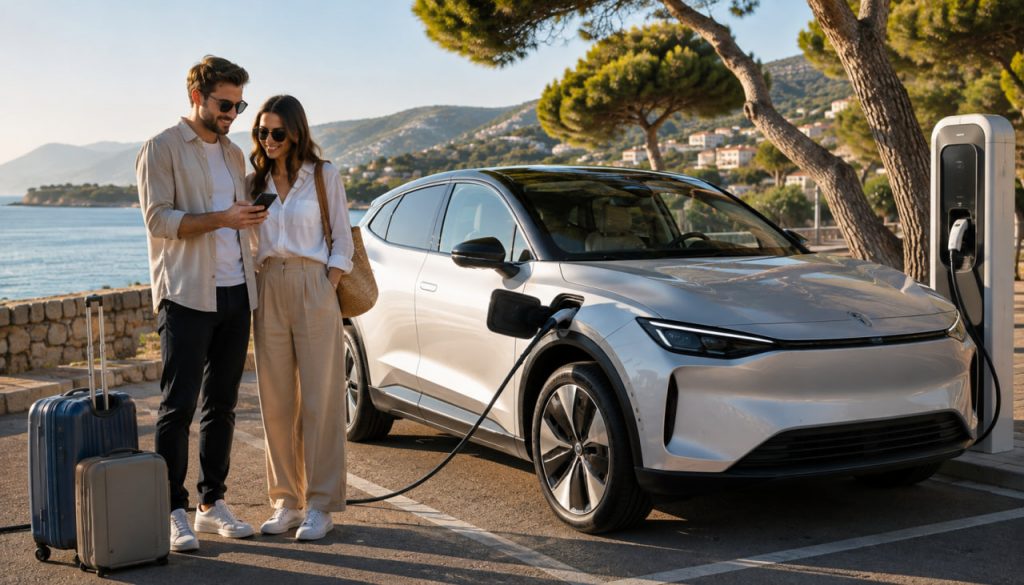
Renting an electric car on vacation can make a trip quieter, more comfortable, and potentially less expensive to operate. It also offers an easy way to experience electric driving without committing to buying an EV.
However, renting an electric vehicle requires more preparation than choosing a conventional rental car. Charging access, connector compatibility, real-world range, return requirements, and payment methods can all affect the experience.
A rental EV works best when the vehicle, destination, accommodation, and daily driving plan are compatible with one another.
Decide Whether an Electric Rental Car Suits Your Trip
An EV can be an excellent choice for urban vacations, short regional journeys, and trips where the hotel or rental property provides overnight charging.
It may be less convenient when the itinerary includes remote areas, long daily distances, unpredictable routes, or regions with limited fast-charging infrastructure.
Before making a reservation, consider:
- Expected daily mileage
- Distance between destinations
- Availability of chargers near the accommodation
- Highway charging coverage
- Weather and terrain
- Time available for charging
- The rental company’s return policy
A small electric hatchback may be ideal for city travel but unsuitable for a long family road trip with luggage. A larger EV may provide more range and space, although it will often consume more energy and may take longer to charge.
Choose the Vehicle by Range, Not Only by Price
Rental websites frequently advertise a vehicle category rather than guaranteeing a specific model. A booking may therefore show one EV followed by the words “or similar.”
This matters because vehicles within the same category can have significantly different battery capacities, charging speeds, connector types, luggage space, and real-world range.
Before confirming the reservation, check:
- The likely models included in the category
- Official driving range
- Realistic highway range
- Maximum direct-current charging rate
- Cargo capacity
- Number of seats
- Charging-port location
- Connector compatibility
Do not assume that every modern EV is suitable for long-distance travel. Some models are designed primarily for urban use and may charge slowly on highway journeys.
Understand That Advertised Range Is an Estimate
Official range figures are measured under standardized testing conditions. Real-world results depend on speed, weather, elevation, driving style, tire choice, passenger load, and climate-control use.
Cold temperatures can reduce available range because the battery and cabin require heating. Hot weather can also increase consumption when air conditioning is used heavily.
Highway driving usually consumes more energy than lower-speed urban travel because aerodynamic resistance rises substantially with speed.
A vehicle advertised with 300 miles of range should not automatically be treated as capable of covering 300 uninterrupted highway miles under all conditions.
Plan charging stops with a reserve rather than attempting to reach a station with almost no battery remaining.
Research Charging Before Booking
Charging infrastructure should be evaluated before the rental is paid for, not after the car is collected.
Search for chargers near:
- The airport or rental branch
- Your hotel or vacation property
- Main tourist destinations
- Planned highway routes
- The vehicle return location
The United States Department of Energy’s Alternative Fuels Data Center recommends charging fully before a long trip and planning charging stops along the route because public charging is not yet as universally available as conventional fuel stations.
Do not rely on a single charger in an isolated area. A station may be occupied, damaged, inaccessible, restricted to hotel guests, or incompatible with the rented vehicle.
Prepare at least one alternative charging location for important stops.
Choose Accommodation with Overnight Charging
A hotel with reliable charging can transform the rental experience. Instead of spending vacation time waiting at a public fast charger, the vehicle can recharge while the occupants sleep.
AAA advises EV road-trip drivers to consider hotels with charging because overnight charging offers a convenient way to replenish the battery without adding a separate stop to the journey.
Before reserving accommodation, confirm:
- Whether chargers are operational
- Whether they can be reserved
- Whether access is limited to guests
- Whether charging is included in the room price
- What connector is provided
- Whether parking or charging fees apply
- How many charging spaces are available
A hotel listing that merely says “EV charging available” may not guarantee access. A large hotel may have only one or two charging points.
Learn the Difference Between Slow and Fast Charging
Public charging is generally divided into alternating-current charging and direct-current fast charging.
Alternating-current charging is common at hotels, parking garages, workplaces, and shopping centers. It is suitable when the vehicle will remain parked for several hours or overnight.
Direct-current fast charging is designed for longer journeys. It can add a substantial amount of energy during a meal or rest stop, although charging speed depends on both the vehicle and the charger.
The Alternative Fuels Data Center notes that public charging commonly uses Level 2 or direct-current fast charging, with slower chargers typically placed where vehicles remain parked for longer periods.
A high-powered charger will not force a vehicle to charge faster than the vehicle itself can accept.
Check the Charging Connector
Connector standards vary by vehicle, country, and charging network.
In North America, rental EVs may use the Combined Charging System, the North American Charging Standard, or the older CHAdeMO connector. Some vehicles can use additional networks through approved adapters.
In much of Europe, Type 2 is widely used for alternating-current charging, while the Combined Charging System is common for direct-current fast charging.
The Alternative Fuels Data Center identifies CCS, CHAdeMO, and J3400 as connector formats used by direct-current fast-charging infrastructure in the United States.
At collection, ask the rental employee to show you:
- The charging port
- The compatible connector
- Any included cable
- Any approved adapter
- How to open and close the charging door
- How to release a locked charging cable
Never use an unapproved adapter merely because it physically appears to fit.
Install Charging Applications Before the Trip
Many charging networks require a mobile application, account, or payment authorization. Some support contactless bank-card payments, but availability varies.
Download the major local charging applications before collecting the car. Create accounts and add a valid payment method while you have reliable internet access.
Charging applications can help you check:
- Charger location
- Connector type
- Power output
- Current availability
- Pricing
- Access restrictions
- Recent user reports
Do not assume that the rental company’s payment card or charging account is included. Ask whether charging costs are billed directly to you, charged through the rental company, or added to the final invoice.
Inspect the Car Carefully at Collection
A normal rental inspection is especially important with an EV because charging accessories can be expensive to replace.
Photograph or record:
- Exterior damage
- Wheel and tire condition
- Windshield damage
- Interior condition
- Battery level
- Estimated range
- Charging cable
- Adapters
- Cargo cover
- Emergency equipment
Ensure that all supplied charging accessories are listed on the rental agreement.
Check the tire sidewalls and wheels carefully. Electric cars are often heavy and may use large, expensive wheels with low-profile tires.
Ask for a Charging Demonstration
Do not leave the rental facility until you understand how to charge the vehicle.
Ask the representative to demonstrate:
- How to locate nearby chargers
- How to start and stop charging
- How to unlock the connector
- How to set a charging limit
- How to precondition the battery
- How to monitor charging progress
- How to contact roadside assistance
The procedure is usually simple, but unfamiliar software can make it confusing during a late-night charging stop.
Learn the Basic Controls Before Driving
Most electric cars operate like automatic vehicles, but several characteristics may feel unfamiliar.
Electric motors deliver torque immediately, so accelerator response can be stronger than expected. Apply pressure smoothly until you understand the vehicle.
Many EVs also use regenerative braking. When the driver lifts off the accelerator, the vehicle may slow significantly while recovering energy.
Some models offer one-pedal driving, while others behave more like conventional automatic cars. Regenerative braking settings may be adjustable.
Before entering fast traffic, locate:
- Drive, Reverse, Neutral, and Park
- Hazard-warning lights
- Headlight controls
- Windshield demisting
- Parking brake
- Charging controls
- Driving-mode selection
Driver-assistance systems do not remove the driver’s responsibility to supervise the vehicle.
Use the Vehicle’s Navigation System for Long Trips
The built-in navigation system can be more useful than an ordinary map application because it may account for battery level, energy consumption, charger compatibility, and battery preparation.
Some EVs automatically warm or cool the battery before arriving at a fast charger. This process, known as battery preconditioning, can significantly improve charging performance.
For the system to work correctly, the charger may need to be entered as a destination through the vehicle’s own navigation interface.
Plan to arrive at a fast charger with a reasonable reserve. In many vehicles, charging is fastest when the battery is relatively low and slows as it approaches a high state of charge.
Do Not Automatically Charge to 100 Percent
Charging to full capacity is useful before a long journey, but it may be unnecessary during every stop.
Fast charging usually becomes slower as the battery fills. Continuing from 80 percent to 100 percent can sometimes take disproportionately long compared with charging from a low level to 80 percent.
For many road trips, it is quicker to make shorter charging stops and continue driving.
However, the correct target depends on:
- Distance to the next charger
- Weather
- Terrain
- Vehicle efficiency
- Charging availability
- Rental return requirements
Charge to 100 percent when the planned route genuinely requires it, particularly before traveling through areas with limited infrastructure.
Understand Charging Costs
Public charging prices may be based on energy consumed, time connected, charging duration, or a combination of fees.
Additional costs may include:
- Session fees
- Parking charges
- Idle fees after charging finishes
- Membership fees
- Foreign transaction fees
- Rental-company administration charges
Fast charging is often more expensive than overnight charging. Prices can also vary considerably between networks and locations.
Move the vehicle after charging is complete when required. Some operators impose idle fees to discourage drivers from occupying a charger unnecessarily.
Read the Rental Company’s Return Policy
Return-charge requirements differ between companies, countries, and rental products.
Some companies require the battery to be returned at approximately the same level recorded at collection. Others offer prepaid charging or allow the renter to return the car with a lower battery level in exchange for a fixed or variable fee.
Hertz states in its United States terms that it aims to provide an EV with approximately 80 percent charge and does not require a return level above 75 percent, although the exact financial treatment depends on the option selected in the rental agreement.
Enterprise documentation in some European locations states that returning an EV below its initial charge level may result in a recharge fee based on the missing energy plus an additional charge.
Always rely on the written agreement for your specific rental rather than assuming that another company’s policy applies.
Plan the Final Charging Stop in Advance
Returning an EV can be more complicated than returning a petrol car because a suitable charger may not be located directly beside the airport.
Identify the final charger before the last day of the trip. Check its distance from the rental branch and allow time for:
- Driving to the charger
- Waiting for an available connector
- Charging
- Reaching the rental return
- Airport security or check-in
Do not plan to charge immediately before an important flight without a backup option.
Take a photograph of the battery level and dashboard mileage at return. Retain charging receipts until the final rental invoice has been reviewed.
Check Driving Licence and Insurance Requirements
International renters should confirm that their driving licence is valid in the destination country. Some locations may require an international driving permit in addition to the original licence.
The European Union advises travelers renting in another EU country to verify driving-licence validity and ensure adequate insurance coverage.
Also confirm:
- Minimum driver age
- Young-driver fees
- Credit-card requirements
- Security deposit
- Additional-driver charges
- Insurance exclusions
- Roadside-assistance coverage
- Tire and windshield protection
- Cross-border permission
Credit-card rental insurance may have exclusions for expensive or premium electric vehicles. Review the terms rather than assuming complete coverage.
Confirm Whether Cross-Border Travel Is Allowed
Traveling between countries may require written permission from the rental company. Insurance, roadside assistance, registration documents, and charging-network access may differ after crossing a border.
Some rental agreements restrict certain countries, ferries, islands, mountain roads, or one-way international returns.
Even where cross-border travel is permitted, inform the company in advance and obtain confirmation in writing.
Consider Road Tolls, Parking Rules, and Low-Emission Zones
Electric cars may qualify for reduced tolls, discounted parking, or access to restricted areas, but these advantages are not automatic or universal.
Some benefits apply only to locally registered vehicles. Others require advance registration or a specific payment account.
Do not assume that an electric rental car can enter every restricted traffic zone without payment. Check local rules concerning:
- Congestion charges
- Low-emission zones
- Toll roads
- Residential parking
- Charging-only parking spaces
- Time limits at public chargers
Traffic regulations differ between countries, and the EU notes that there is no single set of road-safety rules applying identically across all member states.
Prepare for Weather and Mountain Driving
Temperature and elevation can change energy consumption significantly.
Cold weather reduces range and may slow charging until the battery reaches a suitable temperature. Cabin heating also consumes energy.
Mountain climbing increases consumption, although some energy may be recovered through regenerative braking during descent. Never assume that the energy recovered downhill will fully compensate for the climb.
Strong headwinds, rain, snow, roof boxes, and heavy luggage can also reduce range.
Increase the planned reserve when conditions are difficult.
Know What to Do If the Battery Becomes Critically Low
Respond to low-battery warnings immediately. Reduce speed safely, avoid unnecessary acceleration, and navigate to the nearest compatible charger.
Do not continue toward a distant preferred station when a slower but reachable charger is available nearby.
If the vehicle stops:
- Move away from traffic if possible
- Activate the hazard-warning lights
- Contact the rental company’s roadside service
- State that the vehicle is electric
- Follow the manufacturer’s transport instructions
- Do not attempt to access the high-voltage system
The rental agreement may make the renter responsible for towing or recovery costs if the battery was allowed to become completely depleted.
Expert Advice on Renting an EV
AAA recommends researching charging infrastructure before an electric-car rental trip, checking the cables or adapters required, and confirming charging availability in the destination area.
This advice reflects the most important principle of vacation EV rental: charging should be part of the travel plan rather than an emergency decision made after the battery is nearly empty.
A few minutes of preparation before booking can prevent long detours, unexpected fees, and missed travel connections.
When an Electric Rental Car Is the Best Choice
An EV is particularly suitable when:
- Daily journeys are predictable
- The hotel offers reliable charging
- Public charging is widely available
- Most travel takes place in cities or developed corridors
- The driver wants a quiet and refined experience
- There is enough time for planned charging stops
It can also be an excellent way to test electric-car ownership under realistic conditions.
When a Hybrid or Conventional Car May Be More Practical
A different powertrain may be preferable when:
- The route passes through remote regions
- Charging coverage is poor
- Daily distances are exceptionally high
- The itinerary changes frequently
- Accommodation has no charging
- The driver cannot install the necessary charging applications
- Strict schedules leave no margin for charging delays
Choosing a petrol car or hybrid in these circumstances is not a failure to embrace electric mobility. It is simply selecting the most appropriate vehicle for the trip.
Vacation EV Rental Checklist
Before booking, confirm:
- Likely vehicle model
- Realistic range
- Fast-charging capability
- Charging connector
- Local charging coverage
- Hotel charging
- Rental return requirements
- Insurance and deposit
- Cross-border permission
- Roadside-assistance terms
At collection, check:
- Battery level
- Existing damage
- Charging cable and adapters
- Tire condition
- Navigation system
- Charging procedure
- Emergency contact details
Before return, check:
- Required battery percentage
- Location of the final charger
- Time needed for charging
- Return-branch opening hours
- Final mileage and battery photographs
Conclusion
Renting an electric car on vacation can provide a smooth, quiet, and enjoyable driving experience, but it requires more planning than a conventional rental.
The most important steps are choosing a vehicle with suitable real-world range, confirming charging availability, understanding the connector and payment system, and reading the return-charge conditions carefully.
The success of an EV rental depends less on achieving the maximum advertised range and more on having convenient charging at the places where the vehicle will already be parked.
When the route and infrastructure are suitable, an electric rental car can be one of the most comfortable and rewarding ways to explore a destination.