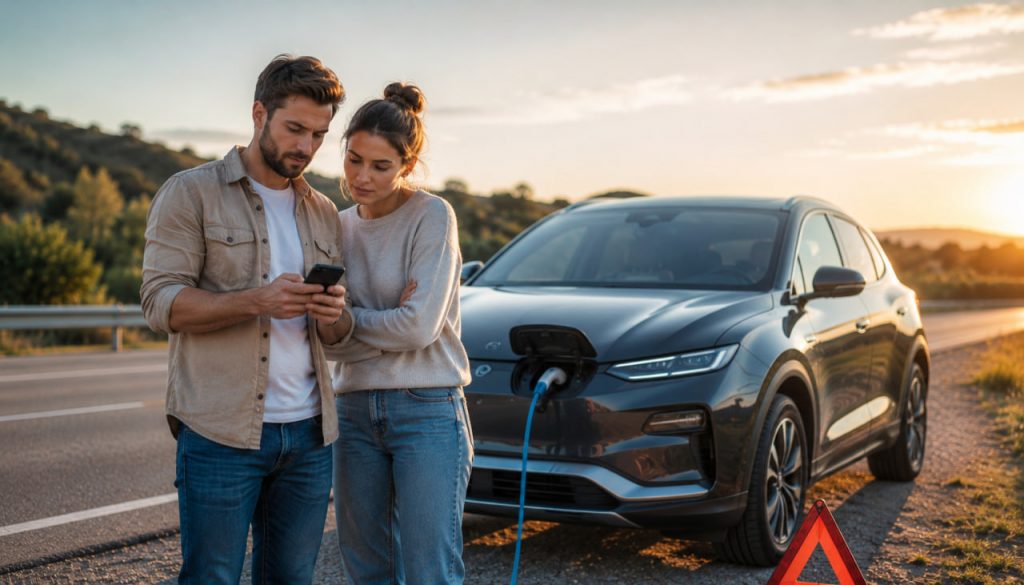
Running out of battery in an electric vehicle can be stressful, especially when it happens far from a charging station or on a busy road. However, a depleted traction battery is usually a roadside-assistance problem rather than a mechanical disaster.
Modern electric cars provide repeated warnings before their usable energy is exhausted. They may suggest nearby charging stations, reduce available power, limit climate control, or activate an energy-saving mode. If the vehicle eventually stops, the safest response is to secure the car, protect its occupants, and arrange appropriate assistance.
Do not attempt to repair, open, or directly energize the high-voltage battery yourself.
Take Low-Battery Warnings Seriously
An electric vehicle normally warns the driver well before it becomes unable to continue. The displayed remaining range may decline faster than expected because it is an estimate rather than a guarantee.
Actual energy consumption is affected by:
- Driving speed
- Outside temperature
- Cabin heating or air conditioning
- Wind and elevation changes
- Rain, snow, and road conditions
- Vehicle load
- Tire pressure
- Driving style
As soon as the car displays a critical battery warning, stop treating the original destination as the priority. Search for the closest compatible charger and check whether it is operational, accessible, and suitable for your vehicle.
Reaching a slower nearby charger is safer than gambling on a distant high-power station.
Reduce Energy Consumption While the Car Is Still Moving
When the battery is critically low but the vehicle remains driveable, small efficiency improvements may provide enough additional range to reach a safe location.
Reduce your speed smoothly and avoid rapid acceleration. Highway speed has a major effect on energy consumption because aerodynamic resistance rises sharply as speed increases.
Use an economical driving mode where available and keep your speed steady. Avoid unnecessary overtaking, hard braking, and repeated acceleration.
Cabin heating can consume substantial energy in cold weather, particularly in vehicles without an efficient heat pump. Reduce the temperature gradually rather than switching off essential heating immediately. Maintain enough warmth to preserve visibility and occupant safety.
You can also:
- Disable unnecessary seat or steering-wheel heating
- Reduce air-conditioning intensity
- Turn off rear-window heating when it is no longer needed
- Remove unnecessary electrical loads
- Use regenerative braking smoothly
- Follow the vehicle’s navigation recommendation
Do not switch off headlights, demisting equipment, or other safety-critical systems merely to save energy.
Leave the Highway Before the Vehicle Stops
If possible, exit a motorway or high-speed road while the car still has power. A parking area, service station, charging site, or well-lit public location is considerably safer than a traffic lane or narrow shoulder.
When the vehicle begins restricting propulsion power, move toward a safe stopping place immediately. Do not continue in the hope that the range display will remain accurate.
Activate the hazard warning lights and park as far away from moving traffic as safely possible. Apply the parking brake and place the vehicle in Park.
If the car stops in an active traffic lane and cannot be moved, contact emergency services and follow local road-safety instructions.
Protect the Driver and Passengers
Occupant safety comes before recovering the vehicle.
On a high-speed road, remain aware that standing close to traffic can be extremely dangerous. Whether occupants should remain inside or leave the vehicle depends on the road layout, local guidance, traffic conditions, weather, and the presence of a safe protected area.
When it is safe and legally appropriate to leave:
- Exit through the side away from traffic
- Move behind a barrier where one is available
- Keep children and animals under close control
- Wear a reflective vest if carried
- Avoid standing directly in front of or behind the car
Place a warning triangle only where local law recommends it and where doing so will not expose you to traffic.
Share your precise location with the assistance provider. Useful details include the road name, direction of travel, nearby junction, mile marker, coordinates, and visible landmarks.
Contact the Manufacturer or Roadside-Assistance Provider
Use the vehicle’s assistance button, manufacturer application, insurance service, roadside membership, or local recovery company.
Tell the operator that the vehicle is fully electric and has exhausted its traction battery. Provide:
- Make and model
- Exact location
- Battery status
- Condition of the low-voltage electrical system
- Whether the car is blocking traffic
- Nearest compatible charging location
- Any warnings shown before shutdown
In many cases, the standard solution is to transport the car to a charging station. AAA notes that most roadside providers tow depleted electric vehicles to a nearby charger or dealership, although mobile charging is available in selected service areas.
Mobile Charging May Be Available
Some roadside-assistance fleets operate mobile EV charging equipment. These units can deliver enough energy for the vehicle to reach a nearby charging station rather than requiring a complete tow.
Availability depends on location, connector compatibility, vehicle condition, and the service provider. Mobile charging should therefore be treated as a possible solution, not something every driver can rely on.
Ask the operator whether the service:
- Supports your charging connector
- Can communicate correctly with your vehicle
- Provides enough energy to reach a charger
- Is available at your location
- Requires an additional fee
Never connect improvised generators, damaged cables, homemade adapters, or unverified electrical equipment to the car.
The Car May Need a Flatbed Tow
Electric vehicles have specific transport requirements. Incorrect towing can damage motors, reduction gears, electrical components, or the battery system.
A flatbed recovery truck is commonly the safest option, but the correct procedure depends on the model. Some vehicles can be transported using approved wheel lifts or dollies under specific conditions.
The owner’s manual must determine how the vehicle is moved, placed into transport mode, and secured.
Do not allow the car to be dragged with its driven wheels rotating unless the manufacturer explicitly permits it. Tell the recovery operator that the vehicle may have no electrical power and may require special procedures to release the parking brake or load it onto the truck.
Tesla’s owner guidance, for example, instructs that a vehicle which has run out of range should be transported to the nearest charger and unloaded within reach of the charging cable.
Do Not Push the Vehicle Without Checking the Manual
An EV that appears completely inactive may still have electronic parking locks and energized high-voltage components. Pushing it without selecting the correct tow or transport mode could damage the drivetrain.
If the vehicle must be moved a very short distance to escape immediate danger, follow instructions from the manufacturer or a qualified recovery professional.
Never crawl beneath the vehicle, touch exposed orange cables, or attempt to disconnect the traction battery.
Understand the Difference Between the Two Batteries
Most electric cars contain both a large high-voltage traction battery and a smaller 12-volt or low-voltage battery.
The traction battery powers the drive motors. The low-voltage battery operates computers, contactors, locks, lights, displays, and other control systems.
When the traction battery is completely depleted, the low-voltage battery may eventually lose support. This can make the vehicle appear entirely dead and may prevent normal charging initiation.
Tesla warns that, in some depleted-battery situations, external support for the low-voltage system may be necessary before the high-voltage battery can begin charging.
This does not mean that an ordinary jump start will recharge the traction battery. Low-voltage support and high-voltage charging are separate procedures and must be performed according to the manufacturer’s instructions.
What to Do After Reaching a Charger
Once the vehicle arrives at a compatible charger, connect it according to the normal procedure. Confirm that charging has actually started before the recovery operator leaves.
A deeply depleted vehicle may not begin charging instantly. Its systems may need time to wake up, stabilize the low-voltage supply, or condition the battery.
Allow the car to build a meaningful reserve before continuing. Charging only enough to make the dashboard turn on may leave too little margin to reach the next destination.
Check for warning messages. If charging does not begin, contact the manufacturer rather than repeatedly connecting and disconnecting the cable.
What Not to Do
Several actions can turn an inconvenient breakdown into a dangerous or expensive incident.
Do not:
- Open or dismantle the high-voltage battery
- Touch exposed electrical components
- Use unauthorized charging equipment
- Tow the car using an unapproved method
- Assume the remaining-range estimate is guaranteed
- Leave the vehicle in an unsafe traffic position
- Continue driving after severe power restrictions appear
- Ignore signs of battery damage, smoke, heat, or unusual odors
If the vehicle has been involved in a collision, driven through deep water, or suffered visible underbody damage, inform emergency personnel and the recovery provider.
NHTSA advises treating high-voltage batteries and related components as energized. It also warns that battery damage may cause immediate or delayed release of flammable or toxic gases. If smoke, fire, unusual heat, or severe physical damage is present, move away and contact emergency services.
Expert Advice: Preparation Is the Best Protection
AAA’s roadside-assistance guidance explains that towing remains the usual response when an EV runs out of charge, while mobile charging is increasingly available in selected locations. The organization’s research found that depleted-battery incidents represented only a small proportion of the battery-electric roadside events it studied.
The practical lesson is that complete battery depletion is uncommon and usually preventable when drivers respond early to warnings and plan charging stops with a reasonable reserve.
NHTSA also recommends carrying a roadside emergency kit containing items such as a charged phone, flashlight, first-aid supplies, water, and blankets.
How to Prevent Running Out of Charge Again
Plan longer journeys using both the vehicle’s navigation system and a reliable charging network application. Verify charger availability shortly before arrival, especially in isolated areas.
Build a reserve into every route. Do not plan to reach a charger with virtually no remaining energy, because weather, diversions, failed chargers, and unexpected elevation changes can quickly consume the margin.
Before departure:
- Charge to an appropriate level
- Check tire pressures
- Review weather and road conditions
- Confirm charging stops
- Carry necessary cables and adapters
- Save roadside-assistance details
- Learn the vehicle’s towing procedure
- Keep a phone charging cable in the car
- Prepare warm clothing for winter travel
Cold weather can reduce available electric driving range, making additional planning especially important during winter.
Conclusion
If an electric car runs out of battery, remain calm and prioritize safety. Move away from active traffic while the vehicle still has power, activate the hazard lights, protect passengers, and contact a qualified roadside-assistance provider.
The car will usually need either a controlled mobile charge or transport to a compatible charging station. Never improvise with the high-voltage system or permit the vehicle to be towed in a way that contradicts its owner’s manual.
Running out of charge is inconvenient, but it is manageable. Early action, correct recovery procedures, and better route planning can turn a potentially dangerous breakdown into a routine roadside event.