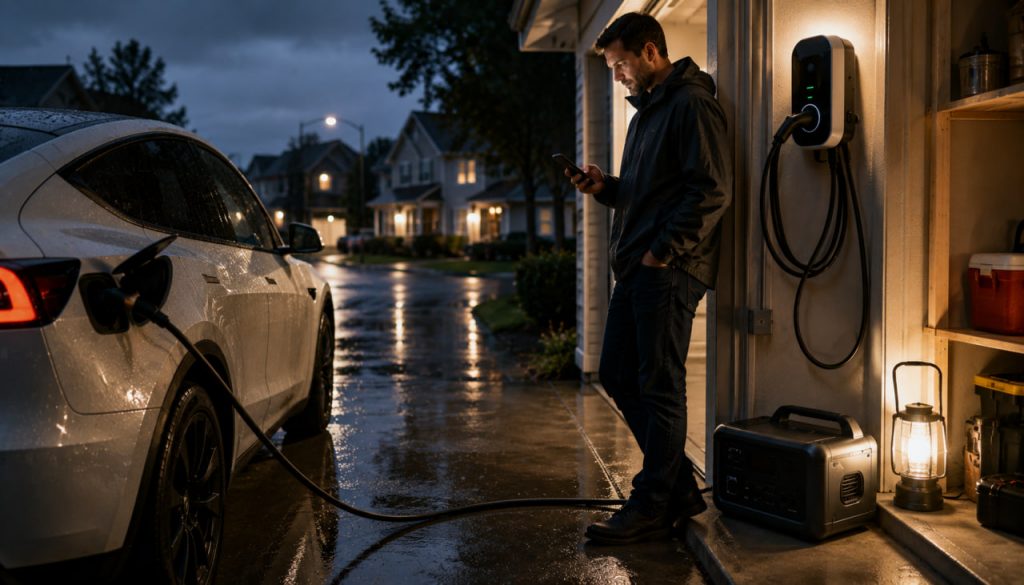
Regional power outages can disrupt homes, businesses, traffic systems, fuel stations, and public charging networks. For electric vehicle owners, the most important concern is usually not whether the car will continue operating, but whether reliable charging will remain available until the grid is restored.
An electric vehicle does not stop working when the electricity goes out. It continues using the energy already stored in its battery. The real challenge begins when the remaining charge becomes too low and nearby charging stations are unavailable or overcrowded.
The best protection against charging disruption is a combination of sensible battery reserves, advance planning, alternative charging locations, and accurate information about local grid conditions.
Keep a Practical Battery Reserve
Drivers in regions with unreliable electricity should avoid treating the final few percent of battery capacity as part of their normal daily range.
A practical reserve provides flexibility if:
- Home charging becomes unavailable
- Public chargers lose power
- Traffic congestion increases consumption
- A planned journey becomes longer than expected
- Operating charging stations develop queues
- Emergency travel becomes necessary
For everyday use, many drivers may find it sensible to keep the battery above approximately 30 percent when significant outages are possible. The appropriate reserve depends on the vehicle, daily mileage, climate, local charging density, and distance to essential destinations.
Before a predicted storm, scheduled shutdown, or period of grid instability, charging to a higher level may be reasonable. Follow the vehicle manufacturer’s recommendations regarding routine and occasional charging limits.
Battery reserve should be based on the distance required for essential travel, not simply on a preferred percentage.
Charge Before Planned Outages
Utilities and local authorities sometimes announce maintenance shutdowns, emergency conservation measures, severe weather alerts, or rolling blackouts in advance.
When warning is available:
- Charge the vehicle before the outage begins.
- Complete charging outside periods of peak grid demand when possible.
- Avoid waiting until the final hours before a planned shutdown.
- Confirm that the charging session has started correctly.
- Check whether the vehicle has scheduled charging settings that could delay the session.
- Prepare a backup charging location.
Charging early reduces the risk of competing with large numbers of drivers immediately before or after the outage.
Managed charging can also reduce pressure on electrical infrastructure by shifting demand away from the busiest periods. The International Energy Agency identifies controlled and flexible charging as an important method of integrating EVs while supporting power-system reliability.
Identify Several Charging Alternatives
Relying on one home charger or a single nearby public station creates unnecessary risk.
Prepare a list of alternative locations, including:
- DC fast-charging hubs
- Shopping centers
- Hotels
- Municipal parking facilities
- Dealership charging stations
- Workplace chargers
- Stations outside the affected grid area
Save these locations in the vehicle navigation system and in a separate mobile application. It is also helpful to record the operator’s customer-support number and understand whether the charger requires an account, membership card, or application.
Some charging sites may remain operational because they are supplied by a different distribution circuit, backup generator, battery system, solar microgrid, or independent energy source. Others may appear online but still be unavailable because the communication network, payment terminal, or local transformer is down.
Never assume a charger is operating solely because it appears on a map. Check recent status information and user reports before driving there.
Monitor Live Charger Status
During widespread outages, charging availability may change quickly.
Before leaving:
- Check the charging network application.
- Review recent driver comments.
- Confirm the number of working connectors.
- Look for temporary closures or reduced charging power.
- Check whether payment services are functioning.
- Call the location when practical.
Navigation systems can be useful, but information may not always update immediately during emergencies. Use more than one source whenever possible.
The U.S. Department of Energy’s emergency-response guidance recommends monitoring the status of EV charging infrastructure along important travel and evacuation routes during energy disruptions.
Reduce Unnecessary Driving
When electricity availability is uncertain, preserve battery energy for essential journeys.
Consider postponing:
- Nonessential shopping trips
- Recreational driving
- Multiple short journeys that could be combined
- High-speed highway travel when a slower route is practical
- Trips to chargers that have not been confirmed as operational
Combine errands into one route and avoid unnecessary detours. Efficient planning can preserve a meaningful amount of range without significantly changing daily life.
Drive Efficiently to Extend Range
Driving style becomes especially important when charging opportunities are limited.
To reduce consumption:
- Accelerate smoothly.
- Maintain moderate speeds.
- Anticipate traffic and brake gradually.
- Use regenerative braking effectively.
- Remove unnecessary external cargo.
- Keep tires correctly inflated.
- Avoid excessive cabin heating or cooling.
- Use heated seats instead of heating the entire cabin when appropriate.
- Select an efficient driving mode.
Highway speed can have a particularly strong effect on energy consumption because aerodynamic resistance rises rapidly as speed increases.
During a charging emergency, reducing speed can be more useful than repeatedly searching for a closer charger.
Precondition While Grid Power Is Available
If the vehicle is connected before an expected outage, preheat or cool the cabin while electricity is still available.
Preconditioning can:
- Improve passenger comfort
- Reduce initial heating or cooling demand
- Help prepare the battery for efficient operation
- Preserve more stored energy for driving
This is particularly useful during very cold or hot weather, when climate control can noticeably affect range.
Understand the Effect of Temperature
Cold weather can reduce available range because batteries operate less efficiently and the cabin requires heating. Hot weather can increase cooling demand and may cause the vehicle to devote energy to battery thermal management.
During extreme temperatures:
- Store the vehicle in a garage or shaded area when possible.
- Precondition before departure.
- Keep a larger range reserve.
- Avoid leaving the battery at a critically low state of charge.
- Expect consumption estimates to change during the journey.
Do not rely exclusively on the advertised range or a previous warm-weather trip when planning emergency travel in winter.
Prepare for Charging Queues
When only a few stations remain operational, queues may form.
Arrive with enough energy to:
- Wait while the vehicle remains powered
- Leave and reach another charger
- Return home if the station fails
- Avoid blocking traffic or charging spaces
When charging begins, take only the energy needed to reach a safe reserve or the next reliable destination if other drivers are waiting. Charging speed often slows significantly at high battery percentages, so occupying a fast charger until 100 percent may be inefficient during an emergency.
Follow posted limits and move the vehicle promptly after charging.
Confirm Whether Fuel Stations Are Also Affected
A common misconception is that gasoline vehicles are always unaffected by power failures.
Most fuel stations depend on electricity for:
- Fuel pumps
- Electronic payment
- Lighting
- Communications
- Safety and monitoring systems
Stations without functioning backup power may be unable to dispense fuel. Therefore, a regional blackout can affect both electric and combustion vehicles.
An EV with a well-charged battery may remain fully usable throughout a shorter outage, while a nearly empty gasoline vehicle may face similar infrastructure problems.
Use Portable Charging Equipment Safely
Keep the manufacturer-approved portable charging cable in the vehicle if practical. It may provide access to slower charging at a safe and suitable outlet outside the affected area.
However:
- Do not use damaged equipment.
- Do not use improvised adapters.
- Avoid ordinary extension cords unless specifically approved for the application.
- Confirm that the outlet and circuit are suitable for continuous charging.
- Stop charging if the plug, socket, or cable becomes unusually hot.
- Keep connectors protected from water and physical damage.
The National Fire Protection Association advises EV owners to use properly installed and approved charging equipment and to ensure that home charging installations meet current electrical safety requirements.
Be Extremely Careful with Portable Generators
A portable generator should not be treated as a simple universal solution for EV charging.
Potential problems include:
- Insufficient continuous power
- Incorrect grounding
- Unstable voltage or frequency
- Incompatible charging equipment
- Carbon monoxide exposure
- Fire risk
- Damage to the generator or charging system
Never operate a fuel-powered generator inside a garage, home, basement, or other enclosed area. Use one only when the generator, charging equipment, vehicle manufacturer, and installation arrangement explicitly support the intended connection.
Professional advice is strongly recommended before relying on generator-based EV charging.
Consider Home Solar and Battery Storage
A home equipped with solar panels and battery storage may offer greater resilience, but not every solar installation works during an outage.
Many grid-connected solar systems automatically shut down when the grid fails to protect utility workers. Continued operation may require:
- A compatible battery
- A hybrid inverter
- Automatic isolation equipment
- A protected backup circuit
- Appropriate energy-management controls
A home battery may not contain enough energy to fully recharge a large EV, but it can provide limited mobility or help maintain essential household loads.
Understand Vehicle-to-Home Capability
Some electric vehicles support bidirectional charging, allowing energy stored in the traction battery to power a home or selected appliances.
Depending on the system, vehicle-to-home technology may support:
- Refrigeration
- Lighting
- Communications equipment
- Medical equipment
- Selected household circuits
- Emergency backup power
The U.S. Department of Energy describes bidirectional EVs as mobile storage resources that can be positioned before planned outages or used after unexpected disruptions to supplement local energy supplies.
However, bidirectional backup requires more than a compatible vehicle. It may also require:
- Approved bidirectional charging equipment
- A transfer or isolation system
- Utility authorization
- Professional installation
- Compatible vehicle software
- Correct electrical protection
A normal charging cable cannot automatically turn an EV into a home backup battery.
Protect Energy Needed for Essential Transport
Decide in advance which journeys are essential during an extended outage.
These may include:
- Medical appointments
- Access to medication
- Work responsibilities
- Family care
- Evacuation
- Transporting vulnerable people
- Reaching an operating charging station
Estimate the energy required for the complete round trip and include a safety margin for congestion, weather, diversions, and charger failure.
Prepare an Emergency Kit
Keep a basic emergency kit in the vehicle.
Useful items include:
- Portable charging cable
- Compatible charging adapters
- Flashlight
- Power bank
- Drinking water
- Warm clothing
- First-aid supplies
- Reflective vest
- Tire repair equipment
- Paper list of important contacts
- Offline map of the region
A power outage may also affect mobile communications and internet access, so do not depend entirely on cloud-based information.
Download Offline Maps
Before severe weather or a planned shutdown, download maps for the region.
Offline navigation can help when:
- Mobile networks become overloaded
- Local internet service fails
- Charger applications cannot load
- Route changes are required
- You must travel outside the affected area
Record several charging addresses manually in case real-time services become unavailable.
Avoid Leaving the Vehicle at a Very Low State of Charge
Leaving an EV parked with almost no remaining energy reduces flexibility and may create additional problems if temperatures are extreme or the outage lasts longer than expected.
The vehicle may continue using a small amount of energy for:
- Battery protection
- Connectivity
- Security systems
- Thermal management
- Background electronics
These loads are normally modest, but they become more important when the battery is nearly empty.
Follow Official Information
During a regional outage, monitor:
- Utility announcements
- Local government alerts
- Emergency-management agencies
- Road closures
- Evacuation instructions
- Weather reports
- Charging-network notices
Avoid relying on rumors or outdated social media posts. Conditions can differ between neighborhoods and electrical circuits.
Expert Perspective: EVs Can Support Resilience, Not Only Consume Power
Energy experts increasingly view electric vehicles as potential components of resilient power systems.
The U.S. Department of Energy states that managed charging can ensure vehicles are ready when needed while reducing stress on buildings and supporting a more reliable grid.
The National Renewable Energy Laboratory has also examined the role of bidirectional power flow, through which EVs can supply electricity to buildings or the grid and function as mobile energy resources.
The International Energy Agency similarly notes that smart and bidirectional charging can turn EVs into flexible grid assets rather than treating them only as additional electrical demand.
The expert consensus is that EV resilience depends on intelligent charging, compatible infrastructure, and preparation—not simply on battery size.
What to Do Immediately When an Outage Begins
When electricity fails:
- Check the vehicle’s state of charge.
- Confirm whether the outage is local or regional.
- Review the utility’s estimated restoration time.
- Stop unnecessary travel.
- Identify confirmed operational chargers.
- Protect enough range for essential journeys.
- Charge elsewhere only when necessary.
- Monitor weather and emergency information.
- Avoid unsafe improvised charging methods.
- Reassess the plan if restoration estimates change.
Long-Term Preparation for Unreliable Grids
Drivers who regularly experience outages should consider:
- Installing a properly designed home charger
- Using scheduled charging
- Maintaining a higher daily reserve
- Adding solar and battery storage
- Choosing a vehicle with bidirectional capability
- Identifying chargers on different grid circuits
- Keeping portable equipment ready
- Creating a household energy-emergency plan
These investments should be evaluated according to outage frequency, budget, local regulations, home electrical capacity, and actual driving needs.
Conclusion
Regional electricity disruptions do not automatically make electric vehicles unusable. An EV can continue driving as long as sufficient energy remains in its battery, and many outages end before charging becomes necessary.
The greatest risk comes from poor preparation: allowing the battery to become critically low, depending on one charging location, driving unnecessarily, or using unsafe charging equipment.
Maintain a sensible reserve, charge before known disruptions, identify several alternatives, drive efficiently, and follow official updates. With these habits, an electric vehicle can remain dependable even when the regional power supply is unstable.