An electric vehicle cannot be charged without an energy source. If an entire region has lost grid power, the solution is not a special charging cable but access to electricity stored or generated elsewhere.
Depending on the duration of the outage, available infrastructure, and the vehicle’s remaining range, practical options may include driving to an operational charging station, using a mobile battery charger, charging from an off-grid solar system, or connecting the vehicle to a properly configured generator.
The safest and most efficient approach is usually to preserve the remaining battery, locate functioning infrastructure outside the affected area, and use emergency charging equipment only when necessary.
First Determine the Scale of the Power Outage
Before choosing a charging method, confirm whether the outage affects:
- Your building
- Your neighborhood
- The local distribution network
- The entire region
- Nearby highways and charging corridors
A local blackout does not always mean every public charger is unavailable. Some charging stations are connected to different substations, commercial microgrids, solar installations, or battery storage systems.
Charging-network applications may show station availability, but their information can become unreliable during communication outages. When possible, contact the charging-site operator directly before driving there.
Preserve the Battery You Already Have
During a regional outage, your remaining state of charge becomes an emergency resource.
Reduce unnecessary energy consumption by:
- Avoiding high speeds
- Accelerating smoothly
- Using an efficient driving mode
- Limiting cabin heating or air conditioning
- Using seat and steering-wheel heaters instead of heating the entire cabin
- Removing unnecessary cargo
- Maintaining correct tire pressure
- Avoiding repeated short trips
Do not drive toward an unverified charger if the journey could leave you stranded. Always calculate the energy required for the complete route, including a reserve for detours, weather, elevation changes, and unavailable stations.
Drive to a Charging Station Outside the Affected Region
If the vehicle has sufficient range, the simplest solution is often to travel beyond the blackout area.
Look for charging locations near:
- Airports
- Hospitals
- Emergency facilities
- Major highway service areas
- Hotels
- Industrial sites
- Shopping centers
- Municipal buildings
Some critical facilities operate backup generators or microgrids, although their chargers may be restricted to authorized vehicles during an emergency.
Public charging generally uses Level 2 equipment or DC fast chargers. Before departure, check whether the station is operational, accessible, compatible with your vehicle, and able to process payments during a communications failure.
Use a Mobile Battery-Based Charging Service
Mobile EV charging services use large battery packs installed in vans, trucks, or trailers. The equipment is charged in advance and transported to vehicles that cannot reach a permanent station.
The Alternative Fuels Data Center describes mobile charging systems that use battery energy storage and may operate without a permanent grid connection at the charging location.
Mobile charging can provide enough energy to:
- Reach the nearest working charger
- Continue an essential journey
- Move the vehicle to a safer location
- Support emergency or commercial fleets
Availability varies considerably by country and region. These services are more common in large cities, fleet operations, roadside-assistance networks, and disaster-response programs.
A mobile charger is usually intended to provide emergency range, not necessarily a complete battery recharge.
Use a Portable Generator Only as a Temporary Emergency Option
A fuel-powered generator can technically produce electricity for EV charging, but it must be compatible with the vehicle’s charging equipment and used under strict safety conditions.
A generator should provide:
- Stable voltage
- Stable frequency
- Continuous power above the selected charging load
- Correct grounding and neutral configuration
- A suitable outlet
- Weather protection
- Adequate fuel and cooling
Some EV charging cables perform electrical safety checks before charging begins. If the generator has an incompatible neutral or grounding arrangement, the vehicle may refuse to charge. Generator manufacturers distinguish between bonded-neutral and floating-neutral designs, and the correct configuration depends on how the equipment is connected.
For this reason, do not modify grounding, adapters, outlets, or charging equipment without guidance from a qualified electrician and the vehicle manufacturer.
Select the lowest practical charging current. A generator should not be operated continuously at its absolute maximum rating. For example, a charger drawing 2.3 kilowatts requires a generator capable of sustaining that load continuously, with additional operating margin.
Charging will usually be slow. At approximately 2 kilowatts, one hour of charging may add only enough energy for a relatively short drive, depending on the vehicle’s efficiency.
Generator Safety Is Critical
Portable generators produce carbon monoxide, an invisible and odorless gas that can cause fatal poisoning.
The United States Centers for Disease Control and Prevention advises that generators must never be operated inside a home, basement, garage, carport, or other enclosed or partially enclosed space. The CDC recommends keeping a generator outdoors and at least 20 feet from windows, doors, and vents, while also using a working carbon-monoxide detector.
Never operate a generator:
- Inside a garage, even with the door open
- Inside a building
- Under an enclosed balcony
- Near ventilation openings
- In deep snow that can block exhaust or cooling airflow
- In heavy rain unless the equipment has a manufacturer-approved protective setup
The generator must remain dry, properly ventilated, and positioned so exhaust cannot enter occupied spaces.
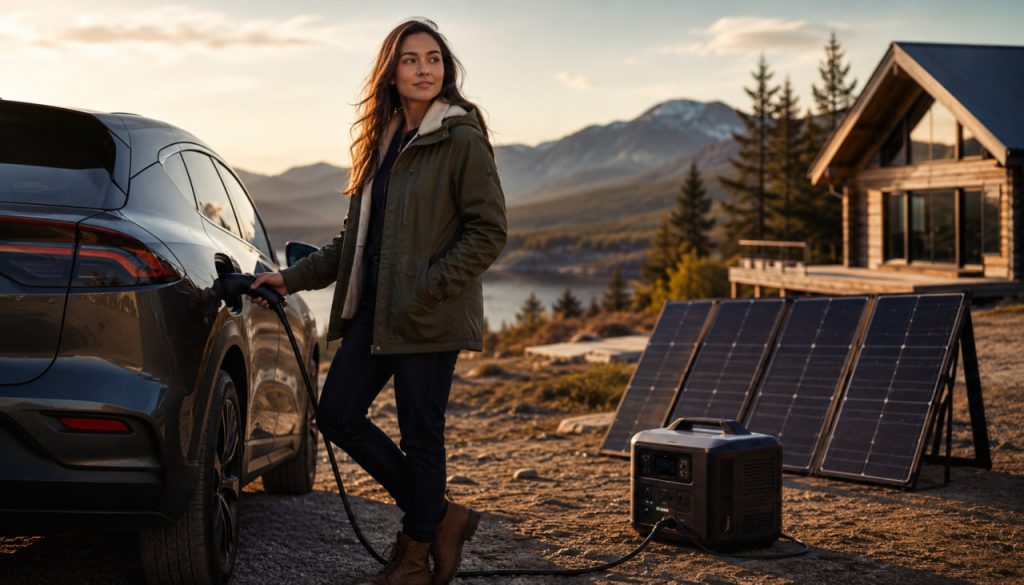
Charge From an Off-Grid Solar System
Solar panels can charge an electric vehicle without an operating regional grid, but the system must be designed for off-grid operation.
A conventional grid-connected solar installation usually shuts down during a blackout. This safety function prevents electricity from being exported into damaged power lines where it could endanger utility workers.
To charge during an outage, the installation generally needs:
- Solar panels
- An off-grid or hybrid inverter
- Battery storage
- A transfer or isolation system
- Compatible EV charging equipment
- Professional electrical installation
A solar-plus-storage system collects energy during daylight, stores it in a stationary battery, and delivers stable power to the vehicle.
Directly connecting ordinary solar panels to an EV charging port is not practical. The vehicle expects controlled electrical power and communication through approved charging equipment.
Some integrated systems can direct excess solar production into an EV. Tesla, for example, documents a system that can charge a compatible vehicle using surplus energy from a supported solar and home-storage installation.
Understand How Much Solar Power Is Required
Electric cars contain large batteries, so a small portable solar panel will not provide meaningful charging speed.
Consider an EV that consumes approximately 18 kilowatt-hours per 100 kilometers. Adding 100 kilometers of range would require roughly 18 kilowatt-hours before accounting for charging losses.
A 5-kilowatt solar array operating under favorable conditions might generate that amount over several hours, but actual production depends on:
- Sunlight intensity
- Cloud cover
- Season
- Panel orientation
- Temperature
- Inverter losses
- Battery-storage losses
- Other household loads
Solar charging is most useful as a planned resilience system, not as an improvised response after the blackout has already begun.
Use Stationary Battery Storage
A home or commercial battery can charge an EV during an outage if the system supports isolated backup operation and has sufficient output power.
Battery-buffered charging systems can also support charging stations during grid disruptions. The Alternative Fuels Data Center notes that battery energy storage can provide emergency backup power to EV charging sites during outages.
However, capacity must be considered carefully. A home battery containing 13.5 kilowatt-hours cannot transfer all of that energy into the car because:
- Some capacity may be reserved for the building
- Conversion losses occur
- The battery may have output limits
- Backup controls may restrict EV charging
- Essential household loads may have priority
During a prolonged outage, using all stationary storage for the vehicle could leave the home without lighting, refrigeration, communications, heating controls, or medical equipment.
Can One Electric Vehicle Charge Another?
Vehicle-to-vehicle charging is possible only when supported by compatible vehicles and equipment.
Some EVs provide high-power external outlets through vehicle-to-load systems. In limited situations, another EV may charge from that outlet using its standard portable charging cable. However, power output, grounding behavior, connector compatibility, and manufacturer restrictions must all be verified.
Purpose-built bidirectional charging is more advanced. It allows compatible vehicles to export stored electricity to buildings, equipment, or the grid.
The United States Department of Energy explains that bidirectional EVs can function as mobile batteries and may be deployed before or shortly after an outage to supplement local generation or provide emergency reserves.
This technology is expanding, but it is not universal. A vehicle with bidirectional capability still requires compatible hardware, software, electrical protection, and installation.
Use a Vehicle With Onboard Power Export
Certain electric pickups, vans, and plug-in hybrids include built-in AC outlets capable of powering tools, appliances, or charging equipment.
A sufficiently powerful onboard outlet may provide emergency energy to another EV, but the process can be inefficient because electricity passes through several conversion stages.
Before attempting it, verify:
- Maximum continuous output
- Outlet voltage and frequency
- Grounding compatibility
- Whether EV charging is permitted
- Cable and adapter ratings
- Remaining energy in the donor vehicle
- Manufacturer instructions
Never create improvised connections between vehicle battery terminals, charging ports, or high-voltage systems.
Consider Towing or Roadside Transport
If no safe electricity source is available, transporting the vehicle is often the best decision.
Request:
- A flatbed recovery truck
- Manufacturer roadside assistance
- Insurance-supported vehicle recovery
- Emergency fleet assistance
A flatbed is generally preferable because it keeps all wheels off the road. Improper towing can damage some electric drivetrains or generate unwanted electrical energy through the motors.
Consult the owner’s manual before towing. Do not attempt to recharge the battery by towing the EV while it is switched on unless the manufacturer explicitly authorizes that procedure.
Prepare Before the Next Outage
Drivers in regions with unreliable electricity should create a charging-resilience plan before an emergency occurs.
Useful preparations include:
- Keeping the battery above a chosen minimum level
- Charging before severe weather or planned outages
- Mapping chargers outside the local grid area
- Carrying the manufacturer-approved portable charging cable
- Keeping compatible outlet adapters
- Registering with more than one charging network
- Saving offline maps
- Storing roadside-assistance numbers
- Installing solar and stationary storage where practical
- Coordinating with nearby businesses or community facilities
- Confirming whether local mobile charging services exist
For remote travel, plan routes based on the last reliable charging point rather than the vehicle’s maximum advertised range.
Expert Perspective on Resilient EV Charging
The United States Department of Energy identifies bidirectional vehicles as mobile energy-storage resources that can support emergency reserves during outages. Its guidance emphasizes that mobile batteries can be moved where they are needed, unlike fixed generation and stationary storage.
This reflects a broader change in EV infrastructure planning. The long-term solution is not dependence on a single grid connection, but a resilient combination of public charging, mobile storage, local generation, stationary batteries, and bidirectional vehicles.
What Not to Do
Never attempt to charge an EV by:
- Connecting directly to damaged power lines
- Using exposed wires
- Bypassing the charging cable’s safety electronics
- Modifying the vehicle’s high-voltage system
- Using overloaded household extensions
- Operating a generator indoors
- Charging from flooded or visibly damaged equipment
- Using unapproved homemade adapters
- Connecting a generator directly to a building without a proper transfer system
Water, damaged wiring, incorrect grounding, and improvised high-current connections can cause electric shock, fire, equipment damage, or death.
Conclusion
Charging an electric car during a regional power outage is possible only when electricity can be obtained from another source. The most practical options are reaching an operational charger outside the affected area, using a mobile battery service, charging from a properly designed solar-and-storage system, or using a compatible generator as a temporary emergency measure.
The safest strategy is to conserve the remaining battery, verify every charging source before traveling, avoid improvised electrical connections, and prepare a resilience plan before the next outage occurs.
As mobile charging, microgrids, stationary storage, and bidirectional vehicles become more widely available, electric cars will increasingly serve not only as transportation but also as important components of resilient local energy systems.