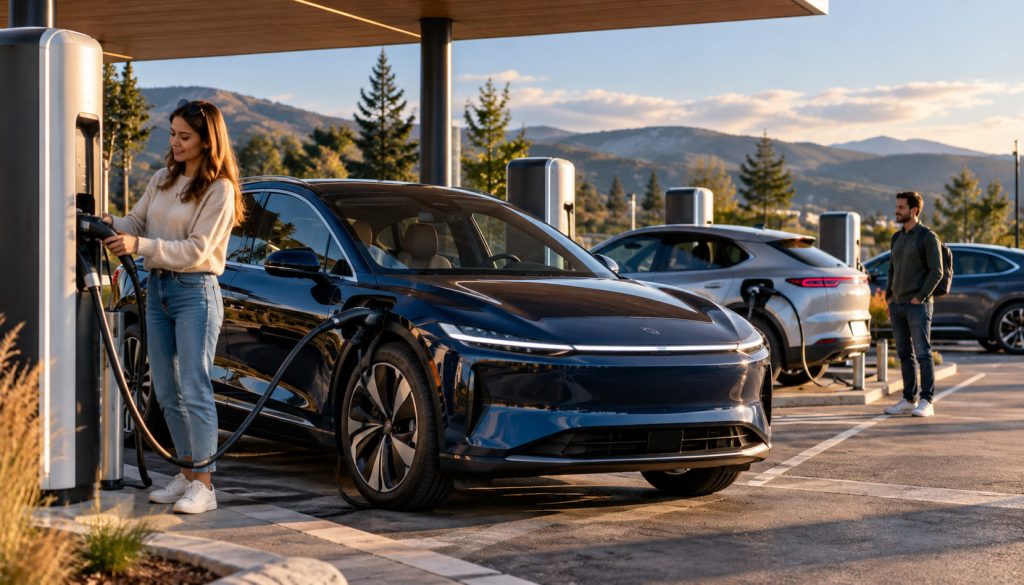
Electric vehicle charging has become an essential part of modern motoring. As more drivers switch from gasoline and diesel cars to electric vehicles, public charging stations are becoming increasingly important for daily commuting, long-distance travel, and urban transportation.
Unlike conventional fuel stations, where refueling usually takes only a few minutes, charging an electric car can require significantly more time. Charging speed depends on battery capacity, temperature, vehicle technology, charger power, and the battery’s current state of charge.
This creates situations where several drivers may need to share limited charging infrastructure. A vehicle occupying a charger unnecessarily can delay other motorists, while poor parking, damaged equipment, or confusing queues can make the experience frustrating.
Fortunately, most problems can be avoided by following a few straightforward principles.
Good EV charging etiquette means using charging infrastructure responsibly, respecting other drivers, and making charging stations available as efficiently as possible.
Understanding these unwritten rules is becoming just as important as knowing how to connect a charging cable.
Charging Spaces Are for Charging, Not Parking
The most fundamental rule of electric vehicle charging etiquette is simple: a charging space should be used for its intended purpose.
An electric car parked beside a charger without actively charging can prevent another driver from accessing electricity.
This behavior is sometimes called EV blocking, while the term ICEing generally describes a gasoline or diesel vehicle occupying a designated EV charging space.
Both situations reduce charging availability.
Drivers should avoid using charging bays as convenient parking spaces, even when they are located close to shopping centers, restaurants, or building entrances.
A suitable charging space is not simply a reward for owning an electric vehicle.
The right to occupy a charging bay should generally depend on actively using the charger and complying with the location’s posted rules.
Some facilities allow additional parking time after charging finishes, while others require immediate departure or impose time limits.
Always check local signage and operator policies.
Move Your Car When Charging Is Complete
One of the most frustrating situations at a busy charging station is finding a vehicle that has finished charging but remains connected.
The charging session may be complete, yet the space remains unavailable to other drivers.
Many charging networks address this problem through idle fees or congestion charges.
Tesla, for example, uses congestion fees at applicable busy Supercharger locations. These charges can begin when a vehicle reaches a specified high state of charge or when its charging session ends, following a short grace period.
Other charging providers may impose fees when drivers leave vehicles connected after charging finishes.
The details differ by operator and location.
The most effective approach is to monitor charging progress through the vehicle or charging provider’s application.
When your required charging level is reached, return promptly, disconnect, and move to an ordinary parking space.
A completed charging session should release the charger, not turn it into a temporary parking reservation.
Do Not Automatically Charge to 100 Percent
Charging an electric vehicle to 100 percent is not always necessary, especially when using a busy DC fast charger.
Most electric vehicles charge fastest when their batteries are at relatively low or moderate states of charge.
As the battery approaches a high charge level, charging power typically decreases.
The United States Department of Energy explains that many EV batteries reduce charging power significantly between approximately 80 and 100 percent during DC fast charging.
Consequently, the final portion of a charging session may take disproportionately longer than the earlier stages.
For many road trips, charging to around 80 percent and continuing to another suitable station can be more time-efficient than waiting for a full battery.
However, 80 percent is not a universal requirement.
A driver traveling through an area with limited charging infrastructure may genuinely need 90 or 100 percent.
Battery chemistry, weather, route distance, and vehicle recommendations also matter.
The considerate approach is to charge as much as your journey reasonably requires, rather than automatically occupying a fast charger until the battery reaches 100 percent.
Respect the Charging Queue
Busy charging stations can create confusion when several vehicles arrive before a charger becomes available.
Unlike conventional fuel stations, charging locations do not always have clearly marked waiting lanes.
Some have parking spaces arranged in several rows, making it difficult to determine who arrived first.
When possible, respect the order in which drivers arrived.
If the queue is unclear, communicate politely with other motorists before entering an available charging space.
Charging networks may provide digital waitlists or reservation systems that establish an official order.
When such systems are available, follow their procedures.
A practical approach includes:
- Check whether an organized queue already exists.
- Ask waiting drivers who arrived first.
- Avoid blocking entrances or traffic lanes.
- Follow digital reservations where applicable.
- Move promptly when your charging opportunity begins.
- Never create a dangerous traffic situation while waiting.
A little communication can prevent considerable frustration.
Never Unplug Another Vehicle Without Permission
Removing a charging connector from someone else’s electric vehicle is generally unacceptable.
Even when a car appears fully charged, disconnecting it without permission can create problems.
Some vehicles lock their charging connectors to prevent unauthorized removal.
Attempting to force a connector free can damage the charging port, cable, or locking mechanism.
Interrupting a charging session can also interfere with the owner’s travel plans.
ChargePoint, a major charging infrastructure provider, explicitly recommends that drivers avoid unplugging other vehicles without permission.
Certain shared charging arrangements may permit authorized cable sharing, and some drivers may leave clear permission for others to disconnect their vehicles.
However, these situations should not be assumed.
If someone else’s vehicle is connected, leave the charging cable alone unless the owner has explicitly permitted disconnection and the equipment supports it safely.
When a vehicle has remained connected for an unreasonable period, contact the charging operator or facility management rather than interfering with the equipment.
Understand That Two Connectors May Not Mean Two Charging Sessions
Some public charging units have multiple connectors, but that does not necessarily mean they can charge multiple vehicles simultaneously.
Certain DC fast chargers provide two cable options to accommodate different vehicle charging-port positions or connector standards.
Only one connector may be active at a time.
Other charging systems can support simultaneous sessions but share available electrical power between vehicles.
Before connecting, check whether the charger is already occupied and whether it supports multiple sessions.
Do not assume that an unused cable means the charger is available.
This distinction helps prevent interrupted sessions, confusion, and unnecessary waiting.
Choose a Charger That Matches Your Vehicle
Public charging stations may offer different maximum power outputs.
Common DC fast-charging equipment includes units rated at approximately 50, 150, 300, or 350 kW, although many other configurations exist.
A charger’s advertised maximum power does not mean every vehicle can receive electricity at that rate.
Charging performance depends on the vehicle’s hardware, battery conditions, and charging curve.
For example, a vehicle limited to approximately 50 kW of DC charging will not suddenly charge at 350 kW when connected to a 350 kW station.
When chargers with different power levels are available, choose one that suits your vehicle’s capabilities.
A vehicle with relatively low DC charging capability may be better served by a lower-power charger, leaving a high-output unit available for cars capable of benefiting from it.
However, this is a courtesy guideline rather than an absolute rule.
If the only available compatible charger has a high power rating, using it is entirely reasonable.
Park Carefully and Keep Charging Cables Clear
Electric vehicles have charging ports in different locations.
Some are positioned near the front of the vehicle, while others are located on the rear quarter panel or side.
This variation can make positioning difficult, especially at stations with short cables.
Drivers should park within the designated bay whenever possible and avoid obstructing neighboring spaces.
Do not stretch a charging cable across another vehicle or pedestrian route merely to reach a poorly positioned charging port.
Improper cable placement can create tripping hazards and increase the risk of equipment damage.
If a connector cannot comfortably reach your vehicle, reposition the car or use another compatible charging bay.
Correct parking is part of charging etiquette because one badly positioned car can make several charging spaces unusable.
Respect Accessible Charging Spaces
Accessibility is an essential part of responsible charging infrastructure use.
Some charging spaces are designed with additional clearance for wheelchair users or people who need assistance entering and exiting vehicles.
The US Department of Energy’s Alternative Fuels Data Center emphasizes clear access routes, sufficient maneuvering space, and unobstructed access to charging equipment.
Drivers should never block designated access aisles with vehicles, cables, or personal belongings.
Where local rules reserve accessible charging bays for eligible users, those restrictions must be respected.
At locations with accessibility-oriented charging spaces that are not legally reserved, follow posted policies and avoid occupying those spaces unnecessarily when suitable alternatives exist.
A charging station is not genuinely accessible if another driver has blocked the space required to use it.
Monitor Your Charging Session
Modern electric vehicles and charging networks commonly offer mobile notifications.
These can indicate when charging begins, when the battery reaches a selected level, or when the session finishes.
Monitoring is especially useful at shopping centers, restaurants, and highway service areas.
A driver who leaves the vehicle for a meal should have a realistic idea of when charging will finish.
Setting a notification or reminder can help prevent unnecessarily occupying a charger.
Charging sessions may also stop unexpectedly because of communication errors, payment problems, or equipment faults.
Checking progress occasionally helps drivers identify such problems earlier.
However, never use a phone while driving simply to monitor charging information.
Keep Charging Stations Clean and Equipment Protected
Public charging equipment is shared infrastructure.
Every driver has a responsibility to leave it in suitable condition for the next user.
Charging connectors should be returned to their designated holders when the session is complete.
Cables should not be left across the ground where they can be driven over or damaged.
Avoid:
- Dropping connectors onto hard surfaces
- Driving over charging cables
- Forcing incompatible connectors
- Leaving rubbish beside charging equipment
- Blocking emergency access
- Pulling cables beyond their intended reach
- Ignoring visibly damaged equipment
If a charger appears damaged, report the issue to the operator.
Do not attempt to repair electrical equipment yourself.
Treat public charging infrastructure with the same care you would expect other drivers to show toward equipment you depend on.
Be Considerate When Charging During Long Road Trips
Long-distance electric vehicle travel creates additional pressures because drivers often depend on public fast chargers to complete their journeys.
A delayed charging session can affect subsequent stops, hotel arrivals, and travel schedules.
Before beginning a trip, identify several compatible charging locations rather than depending on one station.
Consider charger availability, vehicle range, battery temperature, and alternative routes.
During busy holiday periods, avoid extending a charging session unnecessarily.
If another driver is waiting, it may be considerate to stop once you have enough energy to reach your next reliable charging opportunity.
However, drivers should not feel pressured into leaving without sufficient energy to travel safely.
The goal is cooperation rather than competition for charging access.
Charging Etiquette in Winter
Cold weather creates additional challenges for electric vehicles.
Battery temperatures can influence charging performance, and some vehicles require battery preconditioning before DC fast charging.
Cold conditions may also increase energy consumption because of cabin heating and battery thermal management.
Drivers should consider these factors when planning charging stops.
A vehicle charging slowly during freezing weather is not necessarily experiencing a malfunction or deliberately occupying the charger longer than necessary.
Avoid criticizing other drivers based solely on their charging speed.
Where supported, use the vehicle’s navigation-based battery preconditioning functions before arriving at a fast charger.
Always follow manufacturer recommendations for charging and battery management.
Workplace and Apartment Charging Require Cooperation
Shared chargers in office buildings and residential complexes create a different etiquette challenge.
Unlike highway fast chargers, these systems often provide relatively slow AC charging over several hours.
Employees may arrive in the morning and leave their vehicles connected throughout the working day.
Apartment residents may need overnight charging.
In these environments, clear scheduling and fair access become particularly important.
Useful arrangements include:
- Reservable charging sessions
- Shared booking calendars
- Notifications when charging finishes
- Agreed time limits
- Transparent parking policies
- Clear procedures for resolving conflicts
Charging schedules should reflect the intended purpose of the equipment.
A workplace charger designed for several employees to share may require vehicle movement during the day, while a residential overnight charger may legitimately support much longer sessions.
Good etiquette depends on the charging environment: a highway fast charger and an overnight residential charger serve very different purposes.
Handle Charging Problems Without Confrontation
Public charging can occasionally produce stressful situations.
A charger may fail, a payment system may reject a transaction, or someone may occupy a station without charging.
The best response is calm and practical.
If equipment malfunctions, check the instructions, try an appropriate alternative connector if available, or contact the network operator.
If another vehicle blocks access, avoid aggressive confrontation or attempts to damage or move it.
Do not disconnect another driver’s cable as retaliation.
If a charging station has a reporting function, use it to document the issue.
Facility staff or parking enforcement may be able to address unauthorized parking.
Courtesy is especially important because misunderstandings are common. A driver may be unfamiliar with the equipment, experiencing a fault, or following a charging policy that is not immediately obvious.
Help New Electric Vehicle Drivers
As electric mobility expands, many charging station users will be relatively inexperienced.
Some may not understand connector compatibility, payment authorization, charging curves, or station procedures.
Experienced EV owners can help make public charging less intimidating.
If someone appears confused, politely offer assistance.
A short explanation of how to start a charging session or identify an available connector can prevent unnecessary delays.
However, respect personal boundaries and do not interfere with another driver’s equipment without permission.
The strongest EV charging communities are built on cooperation and shared practical knowledge.
Why Charging Etiquette Matters for the Entire EV Industry
Charging etiquette is more than a question of individual politeness.
It influences how efficiently public infrastructure is used.
A charging station occupied by a vehicle that no longer needs electricity has reduced effective availability, even though the hardware itself may be functioning perfectly.
Poor charging behavior can create queues, increase waiting times, and damage public confidence in electric mobility.
As EV adoption grows, infrastructure expansion remains essential, but better use of existing charging stations also matters.
Charging operators can contribute through clear signage, accessible layouts, accurate availability information, fair pricing, and understandable queue-management systems.
Drivers contribute by following site policies and respecting the needs of others.
A reliable charging network depends not only on technology and investment, but also on how responsibly drivers share the infrastructure.
Conclusion
Electric vehicle charging etiquette is becoming an essential part of modern driving culture.
The most important principles are straightforward: use charging bays only when necessary, respect queues, avoid disconnecting other vehicles, park correctly, protect equipment, and move promptly when charging is complete.
Drivers should also understand charging curves, select appropriate charging equipment, respect accessible spaces, and follow the specific rules of each charging location.
Charging to 100 percent may sometimes be justified, especially during demanding journeys, but unnecessarily occupying a busy fast charger reduces availability for everyone.
Public charging will continue to evolve as electric vehicles become more common and charging networks expand.
However, even the fastest and most sophisticated charging equipment cannot eliminate every problem caused by inconsiderate behavior.
The golden rule of EV charging etiquette is simple: use the charger efficiently, leave it ready for the next driver, and treat other electric vehicle owners with the same consideration you would expect from them.