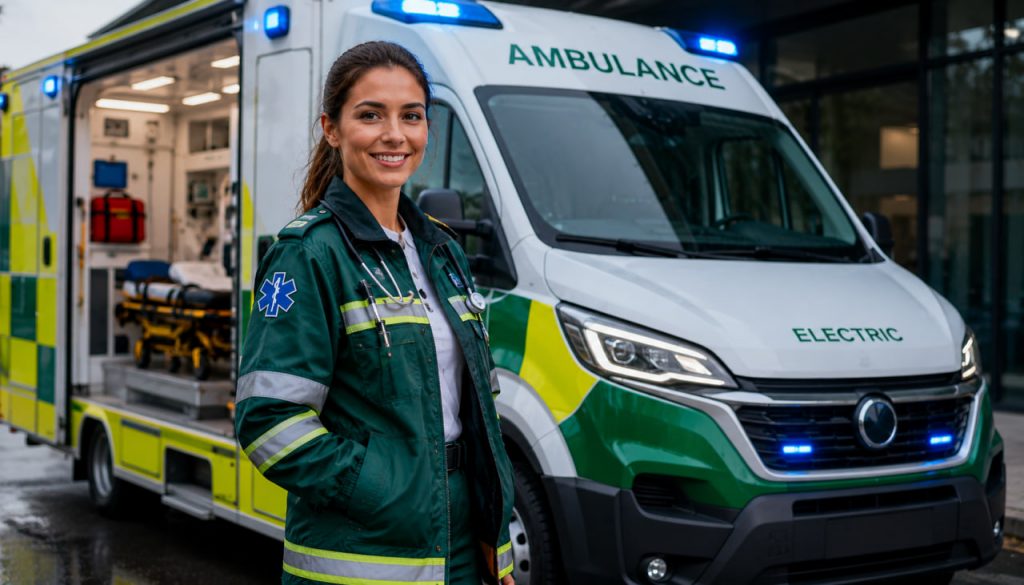
Electric vehicles are moving far beyond private cars, delivery vans, and city buses. Ambulance services, fire departments, municipal authorities, airports, police forces, utility companies, and waste-management operators are beginning to introduce electric vehicles into some of the most demanding transport roles.
This transition is more complicated than replacing a gasoline or diesel engine with an electric motor. Specialized vehicles must carry heavy equipment, power onboard systems, remain available for long shifts, and perform reliably in emergencies. For an ambulance or fire engine, charging delays and unexpected downtime are operational risks rather than minor inconveniences.
Despite these challenges, real-world trials show that electrification can work in many specialist applications, particularly when vehicles operate on predictable routes, return regularly to a depot, or spend much of their time in urban environments.
Specialized electric transport is not developing as one universal solution. Each vehicle must be designed around its mission, payload, duty cycle, charging opportunities, and emergency-reserve requirements.
What Is Specialized Electric Transport?
Specialized electric transport includes battery-powered vehicles built or converted for professional tasks beyond ordinary passenger and freight movement.
Examples include:
- Emergency ambulances
- Patient transport vehicles
- Rapid-response medical cars
- Fire engines
- Police patrol vehicles
- Refuse collection trucks
- Street sweepers
- Sewer-cleaning vehicles
- Utility maintenance vans
- Airport ground-support equipment
- Construction vehicles
- Mobile workshops
- Refrigerated service vehicles
These vehicles may share basic platforms with commercial vans or trucks, but their working equipment, electrical architecture, safety systems, and operational requirements are usually much more complex.
Why Ambulance Electrification Is So Challenging
An ambulance carries more than patients and medical staff. It may also need to power:
- Medical monitors
- Ventilation equipment
- Refrigeration
- Heating and air conditioning
- Interior lighting
- Communications systems
- Hydraulic or electric loading systems
- Emergency lights and sirens
- Computers and navigation equipment
These auxiliary systems consume energy even when the vehicle is stationary. A conventional ambulance can use its engine or separate electrical systems to support these loads, while an electric ambulance must manage both propulsion and medical equipment without compromising operational range.
Ambulances also have irregular schedules. A vehicle may complete a predictable transfer one day and spend hours responding continuously to emergencies the next.
The key design question is not only how far an electric ambulance can drive, but how much energy remains after powering its medical and emergency systems throughout a shift.
Electric Patient Transport Vehicles Are Leading the Transition
Scheduled patient transport is one of the most practical early applications for electric ambulances.
These vehicles usually:
- Follow planned routes
- Operate within a defined service region
- Return regularly to a depot
- Carry less emergency equipment
- Have more predictable daily mileage
- Spend more time in urban traffic
In May 2026, the North East Ambulance Service in England began trialling an electric Renault Master stretcher vehicle in regular patient transport operations. The service said the trial would evaluate how zero-emission technology performs during live scheduled patient journeys.
This type of controlled deployment allows operators to gather data on energy consumption, charging time, patient comfort, driver experience, seasonal performance, and vehicle availability before expanding electrification into more demanding emergency roles.
Fully Electric Emergency Ambulances Are Already Being Tested
Electric emergency ambulances are no longer only design concepts.
NHS England reported that early zero-emission ambulance projects were designed to serve both urban and rural populations, while its broader transport strategy describes trials involving emergency response vehicles, mental-health response vehicles, and fully electric rapid-response fleets.
West Midlands Ambulance Service introduced what NHS England described as the country’s first fully electric ambulance in October 2020.
However, widespread adoption remains gradual because emergency ambulances must demonstrate reliable performance under demanding conditions, including:
- High-speed response driving
- Long operating hours
- Heavy payloads
- Extreme temperatures
- Rural distances
- Unpredictable call volumes
- Continuous use of auxiliary equipment
For this reason, ambulance electrification often begins with rapid-response cars, patient transport vans, and specialist support vehicles before moving toward complete replacement of double-crewed emergency ambulances.
Electric Rapid-Response Vehicles
Rapid-response vehicles are generally easier to electrify than full-size ambulances because they are smaller, lighter, and carry less equipment.
They can be used by:
- Paramedics
- Clinical supervisors
- Mental-health response teams
- Community medical teams
- Emergency coordinators
- Specialist practitioners
London Ambulance Service had already procured dozens of fully electric fast-response vehicles as part of NHS fleet-electrification programs.
Electric rapid-response cars offer several advantages in cities:
- Immediate acceleration
- Quiet operation
- Lower local emissions
- Reduced routine maintenance
- Easier access to existing public charging infrastructure
Their smaller batteries can also be recharged more quickly than those used in large emergency ambulances.
Patient Comfort Can Improve
Electric drivetrains produce less vibration and mechanical noise than diesel engines.
For patients, this may create:
- A quieter cabin
- Smoother acceleration
- Less vibration
- Clearer communication with medical staff
- Reduced exposure to exhaust fumes around hospitals
Quiet operation may be especially valuable when transporting elderly patients, children, people experiencing mental-health crises, or patients who are sensitive to noise and vibration.
NHS electric mental-health response vehicles have been introduced partly to provide healthcare teams with a quieter and more suitable environment for supporting patients.
Charging Infrastructure Is as Important as the Vehicle
Specialized electric fleets cannot depend entirely on ordinary public charging stations.
Emergency and municipal operators may require:
- Dedicated depot chargers
- Multiple charging points
- Backup power
- Priority charging access
- Load-management systems
- Fast-charging capability
- Charging at hospitals or service centers
- Battery and charger monitoring
- Redundant electrical connections
In February 2026, the UK government announced additional funding for hundreds of charging sockets across NHS facilities, building on support for more than 1,000 sockets intended for electric ambulances and other health-service vehicles.
For mission-critical fleets, charger redundancy is part of operational safety. A vehicle cannot be considered reliable if its charging system has a single point of failure.
Fire Engines Are Becoming Electric
Fire engines are among the most demanding vehicles to electrify. They carry water, pumps, ladders, rescue tools, protective equipment, and a full crew. They may also need to operate pumps and electrical systems for extended periods at an incident.
Rosenbauer’s electric RT fire engine was designed specifically around emergency-service requirements rather than simply converting an ordinary truck. It combines electric propulsion with a specialized body, low-entry cab, adjustable suspension, and systems intended for firefighting operations.
After testing an early vehicle, the Berlin Fire Brigade placed five additional electric RT fire engines into regular service in 2024. Rosenbauer stated that almost all operations could be completed in fully electric mode.
Some electric fire engines also use a backup energy source or range extender. This provides additional resilience when incidents last longer than expected or charging is unavailable.
Why Electric Fire Engines Can Work Well in Cities
Urban fire engines often operate from fixed stations and complete many relatively short journeys.
This creates several favorable conditions:
- Predictable home bases
- Overnight charging
- Short response distances
- Frequent periods at the station
- Reduced noise around residential areas
- Regenerative braking in city traffic
Electric motors also deliver immediate torque, which is useful when accelerating a heavy emergency vehicle.
At an incident, electric systems may operate lights, pumps, ventilation equipment, and rescue tools without leaving a diesel engine idling continuously. This can reduce noise and local exhaust exposure for firefighters and nearby residents.
Refuse Collection Trucks Are Strong Candidates for Electrification
Waste collection is one of the most suitable heavy-duty applications for battery-electric trucks.
Refuse trucks generally:
- Travel on predictable routes
- Return to the same depot
- Operate at low urban speeds
- Stop and start frequently
- Produce significant noise when diesel-powered
- Can use regenerative braking repeatedly
The Volvo FE Electric is designed for urban duties including waste collection, light construction, and distribution. Current configurations offer a gross weight of up to approximately 28 tonnes, battery capacities between 280 and 375 kWh, and a stated range of up to 275 kilometers, depending on configuration and operating conditions.
Electric refuse trucks can significantly reduce early-morning noise in residential neighborhoods while eliminating tailpipe emissions along collection routes.
Electric Street Sweepers and Sewer-Cleaning Trucks
Municipal cleaning vehicles often operate slowly for many hours, making efficiency and auxiliary energy consumption critical.
Electric versions can power:
- Brushes
- Vacuum systems
- Water pumps
- Hydraulic equipment
- Waste compactors
- Cleaning equipment
Volvo Trucks and Bucher Municipal developed fully electric sewer-cleaning vehicles based on the Volvo FL Electric platform. The project was intended to support urban operations in areas with increasingly strict noise and emissions regulations.
Electrification can be especially beneficial for street cleaning at night because electric vehicles produce less drivetrain noise and can operate in areas where conventional machinery may disturb residents.
Electric Utility and Maintenance Vehicles
Electric vans and trucks are increasingly used by:
- Electricity network operators
- Telecommunications companies
- Water utilities
- Road-maintenance teams
- Railway operators
- Municipal repair departments
These vehicles may carry tools, replacement components, lifting equipment, or mobile workshops.
Their suitability depends on whether auxiliary equipment can be powered efficiently. In some cases, the high-voltage traction battery can operate tools and equipment directly, eliminating the need to run an idling engine or separate generator.
Electric utility vehicles can also serve as mobile power sources when equipped with compatible export-power or bidirectional systems.
Electric Police Vehicles
Police departments are introducing electric vehicles for selected roles, including:
- Patrol duty
- Traffic enforcement
- Administrative transport
- Community policing
- Detective work
- Station support
Electric cars provide rapid acceleration and low-speed efficiency, but emergency police use creates additional demands.
Equipment such as radios, lights, computers, cameras, and climate control can remain active while the vehicle is parked. High-speed driving can also increase energy consumption significantly.
For this reason, police fleet managers must evaluate real operational data rather than relying only on official passenger-car range figures.
Electric vehicles may be highly effective for predictable urban patrols, while extended rural operations or continuous emergency shifts may still require carefully planned charging or mixed fleets.
Electric Airport Ground-Support Equipment
Airports are well suited to electrification because many vehicles remain within a controlled area and return frequently to designated parking locations.
Electric airport equipment can include:
- Baggage tractors
- Passenger buses
- Catering trucks
- Aircraft tugs
- Service vans
- Belt loaders
- Mobile stairs
- Ground power units
These vehicles often travel short distances and spend considerable time idling when powered by combustion engines.
Replacing them with electric alternatives can improve local air quality around airport workers and aircraft while reducing noise and operating costs.
Electric Construction and Industrial Vehicles
Battery-electric technology is also appearing in:
- Excavators
- Wheel loaders
- Mining vehicles
- Forklifts
- Terminal tractors
- Concrete equipment
- Compact construction machines
Electric construction equipment is particularly useful for indoor work, tunnels, residential areas, hospitals, and projects with strict noise limitations.
However, heavy machinery can consume energy rapidly under continuous load. Successful deployment depends on battery size, charging access, shift length, and the ability to recharge during scheduled breaks.
Operational Advantages of Specialized Electric Vehicles
When matched to the correct duty cycle, specialized electric vehicles can provide:
- Lower local air pollution
- Reduced noise
- Smooth low-speed control
- Immediate torque
- Less engine vibration
- Lower routine maintenance
- Reduced idling losses
- Improved working conditions
- Compatibility with renewable electricity
- Better access to low-emission zones
Electric operation is particularly valuable in dense urban areas where workers and residents are repeatedly exposed to noise and exhaust emissions.
Maintenance Can Be Simpler, but Not Always Cheaper
Electric drivetrains contain fewer routine service items than combustion engines.
They do not normally require:
- Engine oil changes
- Exhaust-system maintenance
- Fuel filters
- Traditional engine tune-ups
- Complex multi-speed transmissions in many applications
Regenerative braking can also reduce wear on conventional brakes.
However, specialized electric vehicles introduce other maintenance requirements:
- High-voltage safety procedures
- Battery cooling systems
- Charging hardware
- Specialized diagnostic equipment
- Software updates
- Electrically powered auxiliary systems
- Technician training
A simpler drivetrain does not eliminate the need for skilled maintenance. It changes the type of expertise required.
Range Is Only One Part of the Calculation
Passenger EV buyers often focus on maximum driving range, but specialist fleet operators need a more detailed energy model.
They must consider:
- Vehicle weight
- Payload
- Driving speed
- Topography
- Weather
- Heating and cooling
- Emergency equipment
- Hydraulic systems
- Pump operation
- Time spent stationary
- Battery reserve
- Charger availability
A refuse truck covering 100 kilometers while operating a compactor all day may consume energy very differently from a delivery truck traveling the same distance.
Specialized vehicles must be assessed by energy consumed per completed mission, not simply by distance traveled.
Payload and Battery Weight
Large batteries increase vehicle weight. This can reduce the payload available for patients, water, tools, equipment, or waste.
Manufacturers address this through:
- Lightweight body materials
- Optimized battery placement
- Purpose-built chassis
- More efficient auxiliary systems
- Different battery-size options
- Higher legal weight allowances in some regions
Purpose-built vehicles can distribute battery mass more effectively than conversions based on platforms originally designed for combustion engines.
Extreme Weather Remains an Important Test
Cold weather can reduce battery efficiency and increase heating demand. Hot weather can increase air-conditioning and battery-cooling requirements.
Specialized vehicles may be particularly affected because:
- Ambulances require stable cabin temperatures.
- Fire engines may operate near intense heat.
- Refuse trucks may work through long winter shifts.
- Utility vehicles may remain outdoors for extended periods.
- Emergency vehicles cannot always reduce performance to save energy.
Thermal management and realistic seasonal testing are therefore essential before large-scale deployment.
Emergency Resilience and Backup Planning
Essential services cannot assume that every charger will always be available.
Fleet plans may include:
- Backup generators
- Battery storage
- Solar-supported depots
- Multiple charging sites
- Reserve vehicles
- Mixed electric and combustion fleets
- Mobile charging
- Priority utility connections
- Minimum state-of-charge rules
For emergency services, temporary use of hybrid or range-extended vehicles may provide a practical transition while charging networks and battery technology continue improving.
Charging Schedules Must Match the Duty Cycle
A private EV can remain parked overnight, but many professional vehicles operate across several shifts.
Fleet operators may use:
- Overnight depot charging
- Opportunity charging during breaks
- Fast charging between shifts
- Vehicle rotation
- Dynamic charger allocation
- Automated energy management
Software can prioritize vehicles according to departure time, required range, battery state, and operational importance.
A fleet with enough total charging power can still experience failures if too many vehicles need energy at the same time.
The Financial Case
Electric specialized vehicles often cost more to purchase than diesel equivalents.
Potential long-term savings may come from:
- Lower energy costs
- Reduced routine maintenance
- Less brake wear
- Lower idling consumption
- Access to government incentives
- Reduced exposure to fuel-price volatility
- Longer service in restricted-emission areas
The financial result depends heavily on annual mileage, electricity prices, charging infrastructure, vehicle utilization, financing, and maintenance contracts.
High-utilization urban vehicles may achieve savings more quickly than vehicles that travel only occasionally.
Environmental Benefits Depend on the Entire System
Electric specialized vehicles produce no tailpipe emissions during battery operation, but total environmental impact also depends on:
- Electricity generation
- Battery production
- Vehicle lifetime
- Annual utilization
- Battery size
- Manufacturing efficiency
- Recycling
- Replacement frequency
The strongest environmental case usually exists when an electric vehicle replaces a heavily used diesel vehicle operating in populated areas.
Reducing local nitrogen oxides, particulate pollution, and noise can be especially important near hospitals, schools, residential streets, and city centers.
Expert Perspective: Start with the Right Vehicles and Routes
A reliable expert view is that fleet electrification should begin with vehicles whose operational patterns match current battery and charging capabilities.
NHS fleet programs have expanded electric rapid-response, patient transport, and support vehicles while continuing to test more demanding ambulance applications. This phased strategy allows services to gather operational evidence without compromising patient care.
Volvo Trucks similarly emphasizes evaluating driving cycles, load capacity, uptime, range, and charging requirements when transitioning specialist commercial fleets to electric power.
Rosenbauer’s electric fire-engine deployments demonstrate the same principle: a specialized electric vehicle must be designed around the working environment and operational requirements of the service, not treated as an ordinary truck with a different drivetrain.
The expert consensus is clear: successful electrification begins with mission analysis, charging strategy, and operational testing—not with purchasing vehicles first and solving infrastructure problems later.
Will Every Specialized Vehicle Become Fully Electric?
Not immediately.
Battery-electric power is likely to expand fastest in applications with:
- Predictable routes
- Urban operation
- Regular depot access
- High annual utilization
- Strong charging infrastructure
- Significant idling
- Strict noise or emissions limits
More difficult applications may continue using:
- Plug-in hybrids
- Range extenders
- Hydrogen fuel cells
- Renewable fuels
- Mixed fleets
The future may involve several technologies rather than one universal power source.
The Future of Electric Specialized Transport
Future progress is expected in:
- Higher-density batteries
- Faster depot charging
- Megawatt charging for heavy vehicles
- More efficient heating systems
- Bidirectional energy capability
- Improved vehicle-to-depot communication
- Automated charging management
- Modular battery systems
- Lighter specialist bodies
- Better emergency backup systems
Purpose-built electric platforms will also allow manufacturers to rethink vehicle layout.
Ambulances may gain more interior space, fire engines may offer easier crew access, and municipal trucks may become quieter and more maneuverable.
Conclusion
Electric ambulances, fire engines, refuse trucks, street sweepers, police vehicles, utility vans, and airport equipment show that electrification is moving into some of transportation’s most demanding sectors.
The transition will not happen at the same speed for every vehicle. Patient transport vans and municipal trucks may be easier to electrify than emergency ambulances or heavy fire engines, but real-world deployments are steadily proving that specialized electric vehicles can perform essential work when their charging, payload, and operational requirements are properly planned.
Specialized electric transport succeeds when the vehicle, infrastructure, software, and working schedule are designed as one complete system.
As battery performance improves and fleets gain more operational experience, electric vehicles are likely to become increasingly common not only on private driveways, but also outside hospitals, fire stations, airports, construction sites, and municipal depots.