The global transition toward electric vehicles (EVs) raises an essential infrastructure question: can existing power grids support large-scale electrification of transport? As governments introduce stricter emission regulations and EV adoption accelerates, electricity demand patterns are shifting. Unlike traditional fuel-based vehicles, EVs rely entirely on electrical energy, placing new loads on distribution networks. However, the challenge is not simply about total energy capacity — it is primarily about timing, grid flexibility, and smart management. Understanding how modern electric grids, load balancing systems, and energy storage technologies function is critical to evaluating whether the transition is sustainable.
How Much Electricity Do EVs Actually Consume?
An electric vehicle typically consumes between 15 and 20 kWh per 100 kilometers, depending on efficiency and driving conditions. When scaled across millions of vehicles, this represents a significant increase in electricity demand. However, total annual energy consumption is often less concerning than peak demand periods. Power grids are designed to handle fluctuating loads, but sudden spikes during evening charging hours can strain local transformers and distribution lines.
According to energy systems analyst Dr. Marcus Hill:
“The real challenge of EV integration is not total generation capacity, but peak load management at the local distribution level.”
In many developed countries, existing generation capacity can technically support EV growth, provided that charging is intelligently managed.
Peak Load and Distribution Bottlenecks
Electric grids operate on a delicate balance between generation and consumption. When too many vehicles charge simultaneously — especially during evening hours when households already consume high electricity volumes — localized stress can occur. This is known as a peak load event, where demand approaches or exceeds infrastructure limits.
While national grids may have sufficient overall capacity, neighborhood-level transformers may require upgrades. Infrastructure modernization, including higher-capacity transformers and improved distribution systems, becomes necessary as EV density increases.
Smart Charging as a Grid Stabilizer
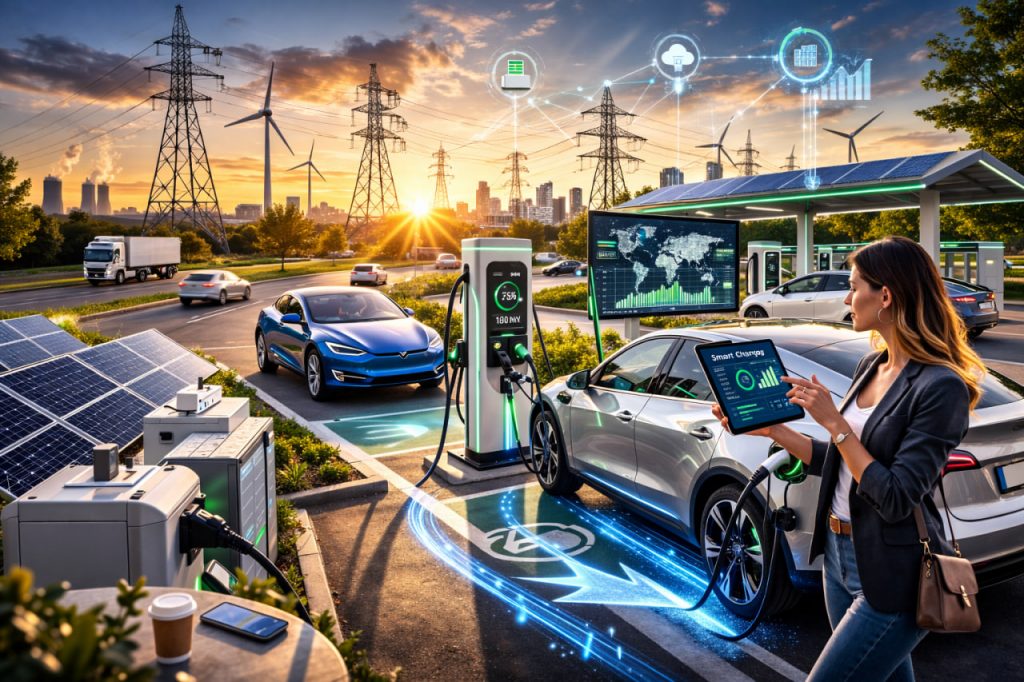
One of the most effective solutions to prevent grid overload is smart charging technology. Smart charging allows EVs to automatically adjust charging times based on grid demand, electricity pricing, and renewable energy availability. Rather than charging immediately after drivers return home, vehicles can charge overnight when demand is lower.
Smart charging integrates with time-of-use tariffs, where electricity prices vary depending on demand periods. This economic incentive encourages drivers to charge during off-peak hours, reducing stress on infrastructure.
According to sustainable grid researcher Dr. Elena Fischer:
“Smart charging transforms EVs from grid stressors into flexible energy assets.”
By shifting demand intelligently, the grid can accommodate higher EV penetration without massive expansion.
Renewable Energy Integration
Mass EV adoption aligns closely with renewable energy expansion. Solar and wind generation are variable, producing electricity depending on weather conditions. EVs can act as flexible demand units that absorb excess renewable generation during peak production hours.
For example, daytime workplace charging can utilize solar output, while overnight charging can leverage surplus wind generation. Coordinated energy management systems enable this alignment, increasing overall grid efficiency and sustainability.
Vehicle-to-Grid (V2G) Technology
An emerging innovation is Vehicle-to-Grid (V2G) technology, where EV batteries supply electricity back to the grid during peak demand. In this system, parked vehicles act as distributed energy storage units. When grid demand rises, aggregated EV batteries can discharge small amounts of power to stabilize frequency and prevent overload.
According to grid innovation expert Professor Daniel Brooks:
“Vehicle-to-Grid integration has the potential to convert millions of cars into a decentralized energy reserve.”
Although still in early deployment phases, V2G could significantly enhance grid resilience.
Infrastructure Investment and Modernization
Large-scale EV adoption will require targeted investment in grid modernization. This includes upgrading substations, expanding smart meter networks, and reinforcing distribution lines. Governments and utilities are already incorporating EV demand forecasts into long-term infrastructure planning.
Importantly, electrification of transport often coincides with improvements in energy efficiency and distributed generation. As energy systems become more digitalized, real-time monitoring and automated balancing increase grid stability.
Will the Grid Collapse?
Current research suggests that with strategic planning and smart charging implementation, most developed power grids can accommodate high EV adoption rates. Challenges are primarily local rather than systemic. The key variables include charging behavior, policy incentives, and investment speed in infrastructure upgrades.
Unmanaged charging scenarios could create localized bottlenecks, but coordinated digital management significantly reduces risk.
Conclusion
Mass adoption of electric vehicles presents challenges for power grids, but these challenges are manageable with modern technologies and strategic infrastructure planning. The issue is less about total electricity production and more about intelligent demand distribution. Through smart charging, renewable integration, and vehicle-to-grid innovation, EVs can become part of the solution rather than a strain on the system. The future of electric mobility depends not only on vehicle technology but also on the digital transformation of energy networks.