Wireless charging for electric vehicles has long been considered a futuristic concept, yet it is already moving from experimental testing into real-world deployment. The idea of charging a car simply by parking over a charging pad eliminates cables, connectors, and manual interaction. While still less common than traditional plug-in charging, wireless EV charging is gaining attention as infrastructure, efficiency, and standardization improve. To understand its true potential, it is important to examine how the technology works today and what challenges remain for widespread adoption.
How Wireless Charging Works
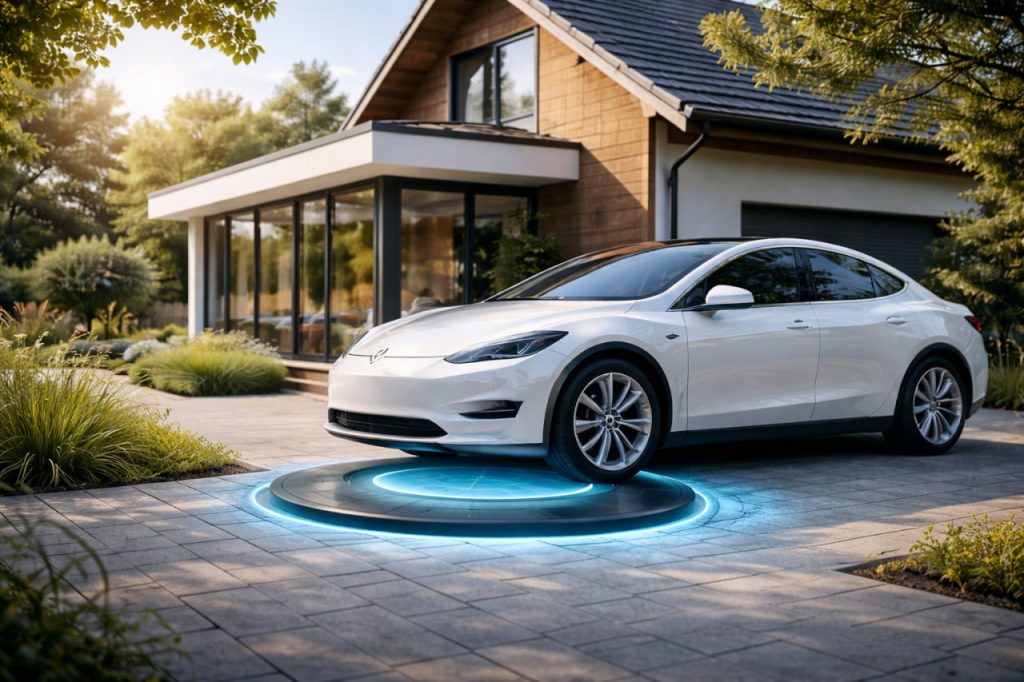
Wireless EV charging is based on inductive power transfer, a method that transfers energy through electromagnetic fields rather than physical cables. A charging pad installed on the ground generates an alternating magnetic field. A receiver coil mounted underneath the vehicle converts this magnetic field back into electrical energy, which is then stored in the battery. The process relies on resonant inductive coupling, meaning both transmitter and receiver operate at matching frequencies to maximize efficiency.
“Inductive charging is fundamentally about energy transfer through magnetic resonance rather than direct contact,” — Dr. Laura Bennett, power electronics researcher.
Efficiency and Power Levels Today
Current wireless charging systems typically operate at power levels between 3.7 kW and 11 kW, similar to standard AC home charging. Efficiency ranges from 85% to 93%, slightly lower than wired systems due to energy losses in magnetic transfer. However, technological improvements continue to reduce these losses. Modern systems include automatic alignment assistance to ensure optimal positioning between the ground pad and vehicle receiver.
Advantages of Wireless Charging
One of the main advantages of wireless charging is convenience. Drivers simply park over a charging pad, and the system begins charging automatically. This reduces wear on connectors and eliminates cable handling in adverse weather conditions. Wireless systems also improve accessibility for elderly or disabled drivers who may struggle with physical connectors.
“Convenience and automation are the strongest drivers behind wireless charging adoption,” — Michael Turner, EV infrastructure analyst.
Limitations and Technical Challenges
Despite its appeal, wireless charging faces technical and economic barriers. Installation costs are higher than conventional wall-mounted chargers due to ground integration requirements. Efficiency losses, although improving, still make wired charging slightly more energy-efficient. Additionally, widespread adoption requires standardization, ensuring compatibility across manufacturers and regions.
Dynamic Wireless Charging: Charging While Driving
The future of wireless charging may extend beyond stationary pads. Researchers are developing dynamic wireless charging, where charging coils embedded beneath road surfaces transfer energy to moving vehicles. This concept could significantly reduce battery size requirements by providing continuous energy during travel. However, large-scale implementation would require extensive infrastructure investment and urban planning coordination.
“Dynamic charging could redefine range limitations, but infrastructure cost remains the main hurdle,” — Dr. Samuel Lee, sustainable mobility strategist.
Safety and Electromagnetic Considerations
Wireless charging systems are designed with strict safety standards. Electromagnetic fields are carefully shielded and automatically deactivate if foreign objects are detected between the pad and vehicle. International safety guidelines ensure that exposure levels remain well within regulated limits.
The Role of Smart Integration
Future wireless systems are expected to integrate with smart grids, home energy management systems, and renewable energy sources. Automated charging scheduling could optimize energy consumption during off-peak hours or when solar production is highest. Such integration enhances sustainability and cost efficiency.
Market Outlook and Industry Adoption
Several automotive manufacturers and technology companies are already testing wireless charging solutions in pilot programs. While still a niche technology compared to plug-in charging, gradual expansion is expected in premium vehicles, fleet applications, and urban environments. As costs decrease and efficiency improves, adoption rates may accelerate.
Conclusion
Wireless charging for electric vehicles represents a promising evolution in convenience and automation. While current systems are slightly less efficient and more expensive than wired alternatives, technological advancements and infrastructure development are steadily improving feasibility. In the long term, wireless charging—especially dynamic road-based systems—could significantly reshape how electric vehicles are powered, making charging more seamless and integrated into everyday mobility.