As electric vehicles become the standard for daily mobility and long-distance travel, reliable access to charging infrastructure is no longer just a convenience — it is a necessity. In 2025, EV charging maps and mobile applications have evolved into intelligent ecosystems that do far more than simply display station locations. They provide real-time availability, route planning based on battery level, charging speed filtering, payment integration, and even predictive occupancy. Choosing the right app can determine whether a journey is smooth and efficient or stressful and uncertain.
Why Charging Apps Are Essential for Every EV Driver
Unlike traditional fuel stations, EV charging points differ in connector types, power levels, network providers, and pricing models. A modern charging app acts as a central control hub that brings all this information together in real time. These platforms allow drivers to plan trips based on state of charge (SoC), driving style, weather conditions, and elevation changes.
“A good charging app is as important as the battery itself for long-distance EV travel,” — Dr. Martin Keller, electric mobility infrastructure analyst.
Key Features That Define the Best Charging Apps
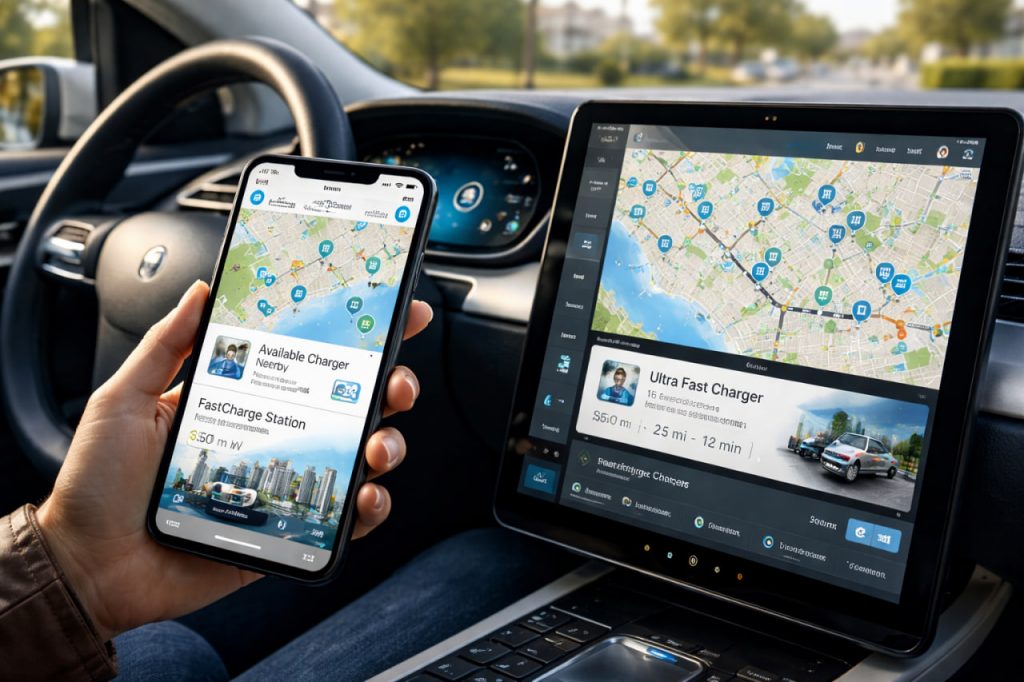
The best EV charging apps in 2025 share several core features. Real-time charger availability prevents wasted time at occupied or offline stations. Power filtering allows drivers to select only high-speed DC fast chargers when time is limited. Integrated payment systems eliminate the need for multiple subscriptions or RFID cards. Advanced apps also include user reviews, reliability scores, and dynamic route planning that automatically adjusts based on energy consumption.
Leading EV Charging Apps in 2025
PlugShare remains one of the most widely used global platforms due to its massive community database and detailed station information. It supports trip planning, live status updates, and compatibility filters for different vehicles.
A Better Routeplanner (ABRP) is considered the gold standard for long-distance EV navigation. It calculates routes using real-time vehicle data, temperature, speed, and terrain to determine optimal charging stops.
ChargePoint offers one of the largest integrated networks, combining station search, session control, and seamless payment in a single interface.
Electromaps continues to be a strong solution across Europe, providing broad coverage, roaming access, and detailed station analytics.
Tesla app and NACS-based navigation remain among the most efficient closed ecosystems, with automatic charger preconditioning and availability prediction.
“The best platforms combine navigation intelligence with infrastructure access,” — Laura Simmons, EV user experience researcher.
Route Planning and Range Confidence
One of the most powerful functions of modern charging apps is range-aware navigation. These systems continuously monitor energy consumption and automatically add charging stops when needed. If driving conditions change — for example due to wind, traffic, or temperature — the route updates dynamically. This eliminates range anxiety and allows EV drivers to travel with the same confidence as in combustion vehicles.
Network Roaming and Universal Access
In 2025, many apps support charging network roaming, meaning a single account can activate chargers from multiple providers. This reduces the need for multiple contracts and simplifies cross-border travel. Unified payment solutions and plug-and-charge technology are becoming more common, allowing automatic authentication when the cable is connected.
Smart Integration With the Vehicle
Modern EVs integrate directly with charging apps and cloud platforms. The vehicle can send battery data to the route planner, while the app prepares the battery for fast charging before arrival. This battery preconditioning ensures maximum charging speed and shorter stop times.
Challenges and Real-World Considerations
Despite rapid progress, differences in pricing transparency, station reliability, and regional coverage still exist. Not all networks update status information in real time, and some rural areas remain underdeveloped. Experienced drivers typically use more than one app to ensure redundancy.
The Future of EV Charging Navigation
Charging apps are evolving into energy management platforms that will coordinate home charging, public charging, renewable energy integration, and grid interaction. Artificial intelligence will predict charger availability, recommend optimal travel times, and minimize charging costs automatically.
Conclusion
In 2025, EV charging maps and applications are no longer simple location tools — they are intelligent travel assistants that manage energy, time, and infrastructure access. Solutions such as PlugShare, ABRP, ChargePoint, Electromaps, and integrated vehicle systems provide the reliability and flexibility required for everyday driving and long-distance journeys. For modern EV owners, the right charging app is the key to stress-free mobility and complete range confidence.