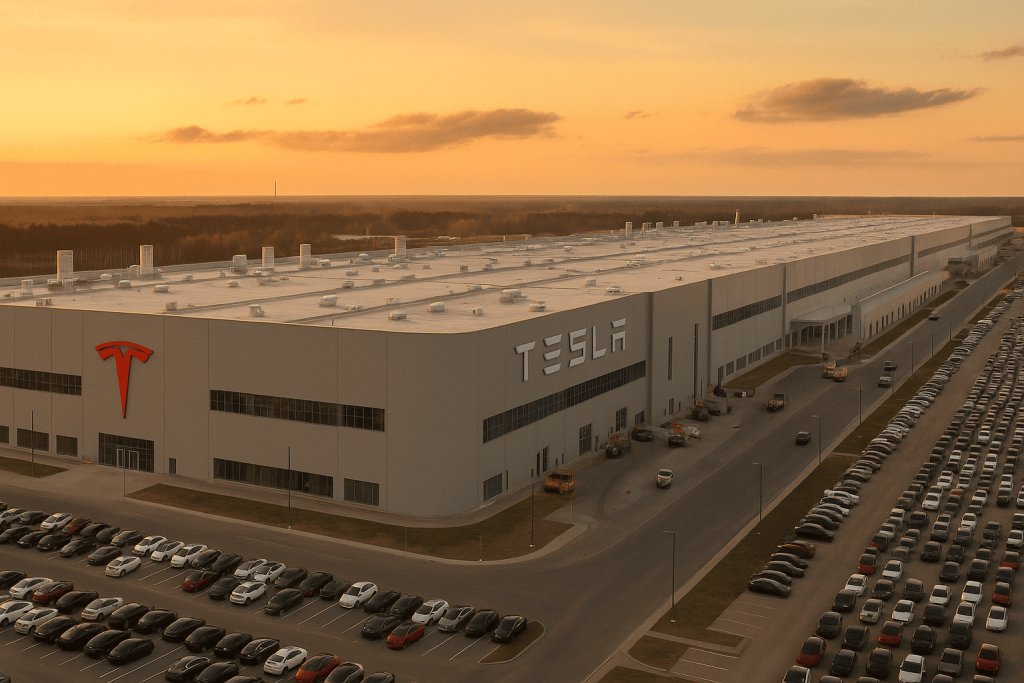
EV leaders don’t win by building cars the old way; they win by building factories that build cars in a new way. Tesla’s Gigafactory Berlin (Giga Berlin-Brandenburg) and Gigafactory Austin (Giga Texas) are the clearest expression of that philosophy: fewer parts, shorter paths, bigger castings, and software steering the whole dance. Together they preview how the “unboxed” manufacturing concept—and the scale it unlocks—can bend cost curves and speed up innovation. ⚙️⚡️
What “unboxed” means in practice. Traditional auto plants shuffle partly assembled vehicles down a long line, revisiting the same body many times. The unboxed approach breaks the car into large, independently built sub-assemblies—front underbody, rear underbody, center energy structure, and cabins—each produced and tested in parallel. Final assembly becomes a short, “snap-together” step instead of a marathon. The payoff: less work-in-progress, fewer conveyors, and fewer chances to rework defects.
Why Berlin and Austin are the testbeds. Both sites were greenfield canvases with room for massive die-casting cells, structural pack lines, and automated material flow. Berlin focuses on European supply and tuning (chassis, NVH, thermal strategy for colder climates), while Austin carries broader platform R&D, including the leap toward even larger castings and next-gen pack integration. Each factory informs the other—design changes in Austin roll to Berlin, and process refinements in Berlin loop back to the U.S.
Gigacastings 101. Replace dozens of stamped pieces and hundreds of welds with a single high-pressure aluminum cast for the front and/or rear underbody. Benefits stack fast: fewer parts to source, fewer robots, tighter dimensional consistency, and lighter weight for the same stiffness. When paired with a structural battery pack, the body suddenly needs fewer crossmembers—freeing space and time.
Structural battery packs: the new “floor.” Instead of mounting a battery as cargo, the pack becomes part of the body-in-white. This reduces fasteners and brackets, improves torsional rigidity, and can lower the ride floor for better packaging. On the line, a structural pack arrives as a tested, sealed module; robots mate it to the castings in a short, deterministic step. Fewer stations, fewer human interventions, faster takt. 🔋
Shorter factory = faster learning. Every meter of conveyor is lead time and maintenance. Unboxed flow and gigacastings compress the building footprint and the bill of materials. That makes engineering changes cheaper to roll in: a revised cooling manifold or casting geometry can propagate across fewer fixtures. Iteration cycles shrink from quarters to weeks, and yield climbs with each turn.
Software as the foreman. In Berlin and Austin, digital twins and MES (manufacturing execution system) data track torque signatures, thermal curves, sealant beads, and casting parameters in real time. When a parameter drifts, stations self-correct or flag intervention before the defect walks downstream. The same telemetry powers predictive maintenance on die-cast machines and paint shop gear, swapping unplanned stoppages for planned micro-pauses.
Economies of scale that matter (not just “bigger”). Scale lowers unit cost only if complexity doesn’t scale with it. Unboxed reduces complexity growth: fewer unique parts, fewer weld points, fewer logistics loops. As volume rises, procurement locks in commodity costs, while fixed capex (foundations, presses, robots) amortizes over more units. The result is a steeper experience curve—each doubling of cumulative output drops cost more than in a traditional plant.
Logistics and the “one-tap” supply chain. Both gigafactories pull suppliers onto the campus or the immediate perimeter. Large, pre-tested modules arrive just-in-time to parallel lines, not one long serial chain. Autonomous carts and overhead carriers feed stations with small, frequent batches; inventory days shrink, quality feedback loops tighten, and cash isn’t trapped as long in parts that will be reworked later.
Paint, trim, and the Berlin effect. Berlin’s paint shop is tuned for European tastes—tight color tolerances, metallic flakes, durable clear coats for road salt. Because the body is more rigid (thanks to structural pack + castings), panel alignment is easier to hold through paint cure. Downstream trim and cockpit installs benefit: fewer shims, faster fit, quieter cabins.
Energy, water, and sustainability at scale. Compressing the line reduces process energy per car. Larger, hotter die-cast cycles use a lot of power, but fewer sub-welds and shorter paint conveyors offset it. Closed-loop water systems, heat recovery from ovens, and smarter HVAC zoning cut utility bills and emissions. Scale also justifies on-site solar, storage, and substation upgrades—lowering both cost and carbon per unit. 🌱
Quality through part count. Every joint is a potential squeak, leak, or rattle. Castings and structural packs remove hundreds of joints, and fewer joints mean fewer failure modes. Dimensional repeatability goes up; downstream operations (doors, glass, IP) snap into more consistent references. Warranty tail thins, which is its own compounding “scale advantage.”
People and robots, complementary tasks. Bots excel at repeatability and heavy lifts; humans excel at feel, finesse, and judgment. Berlin and Austin target robots where variance is costly (adhesive beads, casting extraction, battery mating) and place people where perception matters (surface inspection, squeak-and-rattle checks, detail trim). Training focuses on multi-skill “athletes” who can float between zones as models and options evolve. 🤝
Risk and the casting debate. A cracked stamp is annoying; a cracked giga-mold is expensive. Unboxed architecture hedges by keeping modules separable—front casting issues don’t stall cabin assembly. Redundant cells, spare dies, and flexible routing keep output resilient. Meanwhile, continuous material R&D (alloys, heat-treat) and in-line CT scans lower casting scrap rates.
Customization without chaos. A shorter, modular line can still offer variety—color, wheels, interior, software packages—so long as options are grouped into stable kits. Software-defined features (driver assistance, charging behaviors, thermal strategies) ship post-SOP via OTA, moving “choice” out of the physical line where it causes delays and into the digital layer where it doesn’t.
Speed-to-market as a weapon. When the factory is a product, version 1.1, 1.2, 1.3… come quickly. Berlin and Austin can roll in a new heat-pump manifold or inverter revision with minimal disruption, then learn from warranty and telemetry the same quarter. That faster learning rate becomes a moat: competitors copying the last iteration are already late to the next one.
What it unlocks next. Unboxed flow is a stepping stone to even larger structural modules, simplified wiring (or zonal electronics), and cabin systems pre-tested as complete “pods.” Expect quieter cabins, lighter bodies, faster facelifts, and lower pack costs as chemistries evolve (LFP/LMFP/NMC) without re-laying an entire plant. The more the car becomes a set of tested “blocks,” the more the line becomes a fast, reliable click-together. 🧩
The investor lens. Scale + unboxed shrinks COGS and capex-per-unit while boosting ROIC. Shorter cash cycles (less WIP, quicker ramp learning) improve operating cash flow. The tell-tales: rising first-pass yield, falling hours-per-vehicle, shorter ECN lead times, and expanding variable margin even in a price-competitive market.
The policy and workforce lens. Localized, high-tech manufacturing builds durable jobs and tax bases. Training pivots from manual welding to mechatronics, casting operations, quality analytics, and line software. Regions hosting gigafactories often pull in supplier ecosystems—cast alloys, electronics, seats—multiplying the impact beyond final assembly.
Competitive pressure. Rivals can (and will) adopt big castings and modular packs, but each step demands design-for-casting from day one and a willingness to rewrite plant flow. Copying parts without copying the factory philosophy leaves most savings on the table. The Berlin–Austin model is less about one trick than a system-of-systems re-architecture.
Reality check. None of this is “free.” Casting yields must be tamed, structural packs need bulletproof thermal and crash behavior, and supply chains must keep pace with high takt. But each quarter of run-time lowers scrap, tightens tolerances, and knocks minutes from cycles. Scale then compounds the gains.
Conclusion. Gigafactories Berlin and Austin aren’t just bigger buildings—they’re a new operating system for carmaking. Unboxed manufacturing turns final assembly into a short, predictable step; gigacastings and structural packs slash parts and processes; and software closes the loop in real time. As scale rises, cost falls, quality tightens, and iteration speeds up. That’s how EV leaders pull away: not one headline feature, but a factory that learns faster than everyone else. ✅
It makes it instantly clear why their costs drop faster than everyone else’s